BREAKING  JuneBrain wins 2025 NOBIC BioChallenge - first place + crowd favorite FUNDING  ETC, New Orleans BioFund & Gulf South Angels back the Baltimore medtech MILESTONE  Four issued patents - FDA submission on the horizon WHO  Samantha Scott, PhD - Stanford & USC engineer turned founder BREAKING  JuneBrain wins 2025 NOBIC BioChallenge - first place + crowd favorite FUNDING  ETC, New Orleans BioFund & Gulf South Angels back the Baltimore medtech MILESTONE  Four issued patents - FDA submission on the horizon WHO  Samantha Scott, PhD - Stanford & USC engineer turned founder
Founder · CEO · Biomedical Engineer

Samantha
Scott

She named her company after Tennessee fireflies. Now JuneBrain is building a wearable eye scanner that reads the one piece of your brain you can see from the outside.

$3M+Private investment
$3MNSF grants won
4Issued patents
2017Year founded
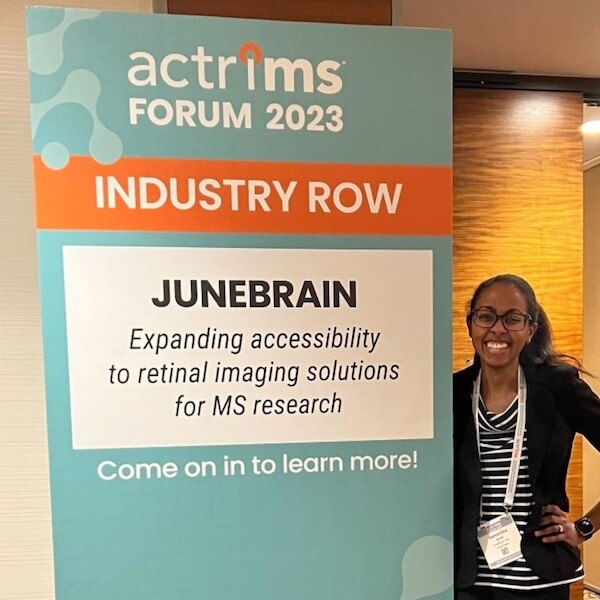
Samantha Scott, founder and CEO of JuneBrain
Samantha Scott, mid-pitch. The lab coat is optional. The conviction isn't.
The Dispatch

The retina is a window to the brain. She built the wearable that looks through it.

Most people think of an eye exam as a thing that happens once a year, in a dim room, with a stranger asking you to read the smallest line. Samantha Scott looked at that same room and saw a bottleneck. The retina is the only part of the central nervous system you can photograph without cutting anyone open. So why was the equipment that captures it locked inside specialty clinics, bolted to a table, run by a technician?

That question is the entire premise of JuneBrain, the Baltimore company she founded in 2017 and still runs as CEO. The flagship device, the Neuro-i SS-OCT, is a high-resolution optical coherence tomography scanner shrunk into something closer to a VR headset than a clinic console. No technician. No appointment three months out. The idea is to put diagnostic-grade retinal imaging into pharmacies, neurology offices, community health centers, mobile clinics, eventually homes - anywhere a person needs to be watched more often than once a year.

Pair that hardware with AI trained to read the layers of the retina, and you get a way to detect and monitor neuroinflammation and neurodegeneration remotely. Conditions like multiple sclerosis and macular degeneration leave fingerprints in the retinal layers long before a patient notices a change. Scott's bet is that catching those fingerprints early, and often, changes the math of care.

She is not a marketer who hired engineers. She is the engineer. A PhD in biomedical engineering from USC, an undergraduate degree from Stanford, a detour through Oxford to study computational neuroscience. Twelve years building biomedical devices and studying how the brain and the retina actually work before she ever wrote a pitch deck.
I've always been a nerd. - Samantha Scott

At a glance

PhD, Biomedical Eng. USC Viterbi '14 Stanford BS Oxford / neuroscience Based in Baltimore Women-owned (WBENC)
The Machine

How a headset becomes a brain monitor

01

Look in

A wearable, technician-free scanner captures high-resolution retinal images using swept-source OCT - the kind of imaging that used to need a clinic console.

02

Let the AI read

Deep-learning software performs multi-layer segmentation, measuring the retinal layers automatically and turning a scan into structured data.

03

Watch over time

Because the device can travel to the patient, clinicians track change between visits instead of guessing once a year - earlier signals, individualized care.

If you have a disability or need some level of accessibility, that's just not an issue for us. - Samantha Scott, on how she runs JuneBrain
The Strange Specific

Why a serious medtech company is named after a bug

/ THE NAME

June

For the June bugs of her Tennessee high-school hometown, and for the month the company launched - which happens to be Brain Awareness Month.

/ THE NAME

Brain

For the organ Scott says she loves most. Put them together and you get a name no committee would have approved - which is exactly the point.

Founders love to lead with the impressive general: the market size, the disruption, the inevitability. Scott leads with a firefly. The company name is a tell - it comes from a real place, a real childhood, a real affection for the thing she studies.

The origin is just as specific. The seed was a suggestion from her husband: use that biomedical engineering background to find a way to monitor health from home rather than waiting on the calendar. The question that followed - what if monitoring a neurological condition could be as easy as putting on a headset? - became a company.

Ask her what she wanted to be as a kid and the answer is gloriously un-strategic: a garbage truck operator, because she was fascinated by the mechanical movement, or a pediatrician, because she wanted to help people immediately. Look at JuneBrain and you can see both kids in the room. The one who loves machines that move, and the one who wants the help to arrive right now.

When she raised money, some investors advised her to keep personal details quiet, arguing it would undercut her standing as a CEO. She declined, and turned the advice into a filter: a partner who needs her to be less herself is the wrong partner. The pitch and the person are the same thing.

In Her Words

Five lines that explain the whole thing

It is hard because when running a startup, it is very important to separate who you are from your company.
It gave it a very human perspective, and I think that's part of why it was so important to me to do translational work.
Being named the BioChallenge winner is a milestone for JuneBrain and a springboard for what comes next.
I've always been a nerd.
By The Numbers

Receipts

What JuneBrain has assembled

Private investment raised$3M+
NSF SBIR grants (Phase I + II)~$3M
Qualified sales pipeline$6M
Issued patents4

Bars are illustrative, scaled for comparison.

/ TEAM

4 fields

Engineers, software developers, neurologists and ophthalmologists under one roof.

/ HOME

Baltimore

Built at the UM BioPark and The LaunchPort - a deliberate bet on the city's medtech cluster.

/ PRIZE

1st place

2025 NOBIC BioChallenge - and the crowd favorite award, too.

/ STATUS

FDA-bound

Working prototype in hand and a regulatory submission in its sights.

The Arc

From retinal implants to a headset of her own

2014
Earns her PhD in biomedical engineering at USC Viterbi, researching retinal implants at the Biomimetic MicroElectronic Systems Engineering Research Center.
POST-PHD
Works as a research scientist at Vasoptic Medical and as a postdoctoral fellow and collaborator at the National Institutes of Health.
2017
Founds JuneBrain - June bugs, Brain Awareness Month, and the organ she loves rolled into one name.
2023
JuneBrain reaches a working prototype and lines up early revenue and an FDA submission.
OCT 2025
Wins first place and crowd favorite at the NOBIC 2025 BioChallenge pitch competition in New Orleans.
FEB 2026
Baltimore's Emerging Technology Centers invests as JuneBrain scales its base at the UM BioPark.
MAR 2026
New Orleans BioFund and Gulf South Angels announce a joint investment in the company.

Things you didn't know you wanted to know

Naming

JuneBrain blends Tennessee fireflies with the brain. Try getting that past a branding agency.

Timing

The company launched in June - which is, fittingly, Brain Awareness Month.

Biology

The retina is the one slice of your central nervous system visible from outside the body. That's why an eye scanner can hint at brain health.

Schooling

She studied computational neuroscience at Oxford through a Stanford study-abroad program before her USC PhD.

Leadership

She calls herself a "supercharged nerd magnet" - her shorthand for the talent she pulls into the room.

Childhood plan A

Garbage truck operator. She loved the mechanics. Plan B was pediatrician. The startup is both.

The Operator

What people who've met her notice

Lifelong nerd Translational thinker Talent magnet Accessibility-first Contrarian when it counts Builds across disciplines Stubbornly herself