BREAKING  Neura Health closes $11.4M Series A to expand virtual neurology nationwide FIRST EVER  American Heart Association's Go Red for Women Fund writes its debut venture check RECEIPTS  Peer-reviewed data: 73% drop in ER and urgent-care visits ORIGIN  The first product was a Google Sheet STANFORD  Computer science and philosophy, both BREAKING  Neura Health closes $11.4M Series A to expand virtual neurology nationwide FIRST EVER  American Heart Association's Go Red for Women Fund writes its debut venture check RECEIPTS  Peer-reviewed data: 73% drop in ER and urgent-care visits ORIGIN  The first product was a Google Sheet STANFORD  Computer science and philosophy, both
Founder Dossier · YesPress

Elizabeth Burstein

She waited six months for an appointment, kept her own notes in a spreadsheet, and decided the wait itself was the bug worth fixing.

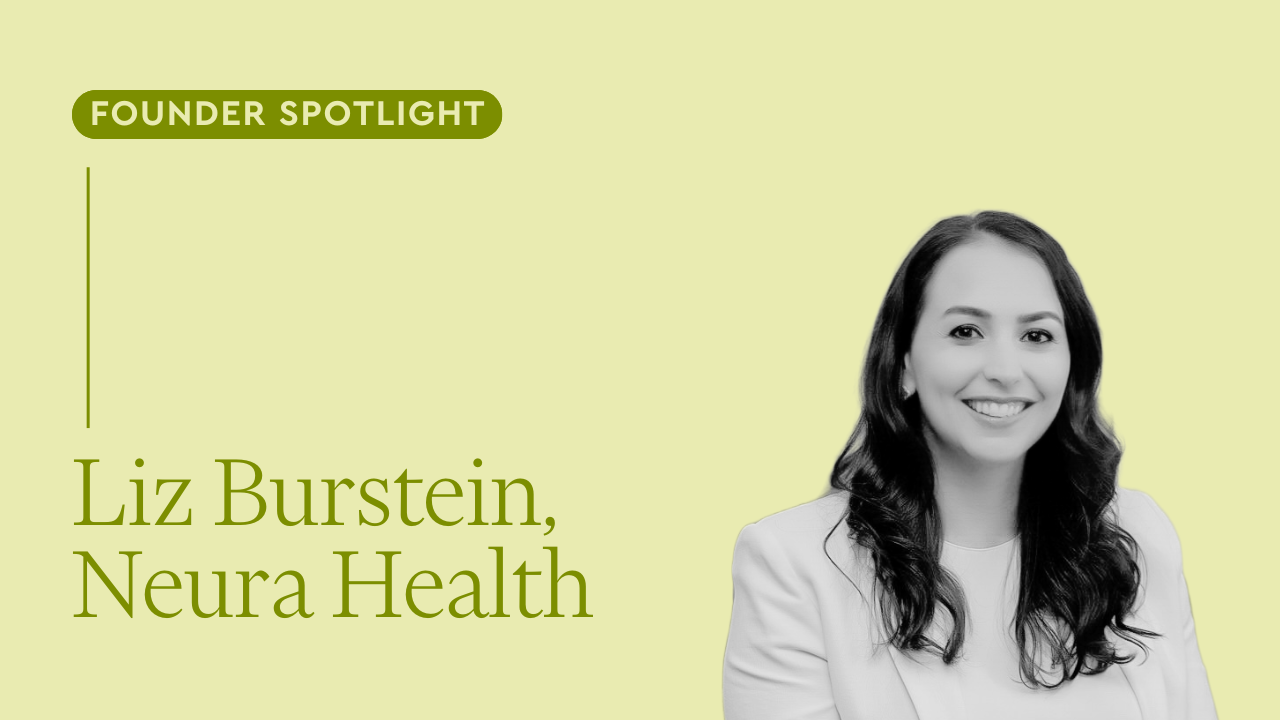
Elizabeth Burstein, CEO and co-founder of Neura Health

// Liz Burstein, mid-stride. The spreadsheet is off-camera.

Share in / LinkedIn X / Twitter f / Facebook Instagram

Running the clinic she once couldn't get into

Today Elizabeth Burstein runs Neura Health, a virtual neurology clinic that pairs board-certified specialists with a patient app, dedicated care coaching, and the kind of data-sharing she once begged for and never got.

In September 2025 the company closed an $11.4 million Series A, and the lead investor made it newsworthy on its own: the American Heart Association's Go Red for Women Venture Fund picked Neura as its first investment ever. Norwest Venture Partners, Koch Disruptive Technologies, Esplanade Ventures, Pear VC, Correlation Ventures and E12 Ventures filled out the round. The money has one job - take a model that works in a handful of states and make it national.

The pitch is unglamorous and exactly the point. There are roughly 145 million Americans living with a neurological condition and nowhere near enough neurologists to see them. Burstein's answer is not a chatbot pretending to be a doctor. It is real specialists, scheduled fast, supported by software that handles the tracking, the histories, and the coordination that used to vanish into fax machines. The clinical paper she likes to cite reports a 73% reduction in ER and urgent-care visits among members. For a founder who got into this because the system ignored her own carefully kept notes, that number is the whole argument.

Notice who led the round. The American Heart Association's Go Red for Women Venture Fund had never made a venture investment before Neura. A century-old institution that usually moves with the caution of a battleship chose a five-year-old startup as the place to start. That is not a coincidence of branding. It is a signal that the gap Burstein is chasing - specialist care that most people can actually reach - reads as a public-health problem to the people who measure public health for a living. The rest of the cap table, Norwest and Koch and the early believers at Pear, had been making that bet for years.

$11.4M
2025 Series A
$22M+
Total raised
43,000+
Patients reached
73%
Fewer ER / urgent visits
The Spreadsheet

It started with a tab nobody would read

During the early pandemic, Burstein hit a wall that millions hit quietly every year. A specialist she needed was booked out for months. The generalist in front of her could not help. And the meticulous record she was keeping - levels, medications, exercise, diet, all of it logged by hand - had no door to walk through. Doctors did not have time to read a stranger's Google Sheet.

So she did the thing product people do when a workflow is broken. She studied it. Before writing a line of code, she ran more than fifty interviews with neurologists and dozens with patients, looking for the load-bearing problem rather than the loudest complaint. The pattern was blunt: access was scarce and quality was uneven, and the two fed each other. The crude spreadsheet, the one no clinician would open, was a prototype hiding in plain sight.

In October 2020 she incorporated Neura Health with Sameer Madan, a Stanford classmate and former Meta engineer who had his own frustrating turn as a patient. Pear VC backed the pre-seed in 2021. Koch Disruptive Technologies led the seed. What began as a direct-to-consumer app grew into something employers and health systems now buy, because a workforce with untreated neurological conditions is expensive in every direction.

The two of them split the work along an obvious seam. Madan, who had spent his engineering years inside one of the largest software companies on earth, owned the build. Burstein, who had shipped product to hundreds of millions of users and then sat on the venture side reading other founders' pitches, owned the why and the how-fast. Bonding over their own bad experiences as patients was the spark; what kept the company moving was a shared allergy to the answer "that's just how healthcare works." It rarely is. It is usually just how healthcare has been.
If you're going through hell, keep going.
// the Churchill line she keeps close - and, roughly, the founding plan
Build vs. Buy

She named the two things worth owning early - aggregating neurological data and the patient-engagement app - and refused to reinvent the rest. First-principles, not first-instincts.

The Resume Before The Title

A product career with a single throughline

Burstein did not arrive at healthcare by accident. Read her path forward and it looks like a scenic route. Read it backward and it looks like preparation. Each stop taught a piece of the company she would eventually build - consumer scale, marketplace mechanics, clinical product, and the venture side of the table.

Where the toolkit came from

// relative weight on the skills Neura would later need - illustrative
LinkedIn - consumer product at scalePM →
Blue Apron - subscription & logisticsSenior PM
Zocdoc - the appointment, as a systemProduct
Maven Clinic - virtual care, done wellHead of Product
Venture roles - reading the other sidePartner / Principal

Timeline

'07
Pacific Free Clinic, Stanford Med. A research associate role - the first brush with how care actually reaches people.
'10s
LinkedIn. From patent engineer to senior product manager, learning consumer product at scale.
'10s
Blue Apron, then Zocdoc. Subscription mechanics, then the appointment itself as a product.
'19
Maven Clinic & venture. Head of product at a virtual-care company; venture partner roles on the side.
'20
Neura Health, incorporated. Co-founded with Sameer Madan that October.
'21
Pear VC pre-seed. A fund she calls "an obvious winner" writes an early check.
'25
$11.4M Series A. Led by the AHA Go Red for Women Fund's first-ever investment.

Off the record

Hometown

Grew up in Cupertino, in the literal shadow of Apple HQ. Hard not to absorb the idea that software changes things.

Roots

Daughter of Soviet immigrants. The kind of household where keeping going is less a slogan than a default setting.

Piano

Played growing up, inspired by her grandmother Emma - a thread of family that runs quietly through her story.

Two Degrees

Computer science and philosophy at Stanford. One teaches you to build the machine; the other to ask whether you should.

The Operating Manual

Five rules she repeats, in different rooms, to anyone building

Ask Burstein how she builds and the answer is less a pep talk than a checklist. It is the kind of thing a former product lead says out loud because she has watched the alternative fail. None of it is exotic. All of it is the difference between a company that ships and a deck that doesn't.

Rule 01

Understand the core problem before you build anything. Fifty interviews, then a roadmap - not the other way around.

Rule 02

Surround yourself with domain experts. In a field with this much specialized knowledge, the founder cannot be the smartest person in every room, and shouldn't try.

Rule 03

Build iteratively. Perfectionism is just procrastination wearing a nicer suit.

Rule 04

Be ruthless about build versus buy. Own the proprietary core; rent everything that someone else already does better.

Rule 05

Hire interdisciplinary talent. The interesting problems live exactly where clinical, technical, and operational worlds refuse to line up.

The Habit

OKRs, set ambitious and tracked honestly - the discipline that keeps a mission-driven team from mistaking motion for progress.

In Her Words

Three lines that explain the company

If you're going through hell, keep going.
We're very excited about leveraging AI tools for automating workflows and surfacing insights.
Pear was such an obvious winner, one of the few top funds that actually deliver on the promise.
What's Next

National, and then quietly everywhere

The Series A has a destination, not just a number.

Burstein's stated plan is to expand Neura across the country, grow the commercial team, deepen partnerships with employers and health systems, and lean on AI for the unglamorous middle - automating workflows and surfacing the insight a busy clinician would otherwise miss. The framing is consistent with everything before it. She is not trying to replace the specialist who was impossible to reach. She is trying to make that specialist reachable, and to make sure the next person's careful notes land in front of someone who will actually read them.

There is a tidy irony in where she ended up. The kid from Cupertino who grew up beside the company that taught the world software could be personal now runs a clinic that lives on a phone. The philosophy half of that Stanford degree turns out to matter as much as the computer-science half: a virtual clinic is a thousand small decisions about what a patient deserves, who gets seen first, and where a machine should hand the conversation back to a human. Burstein has been on the wrong side of those decisions as a patient, which is a strange and useful qualification for designing them. The spreadsheet nobody would read became a company tens of thousands of people now trust. The wait that started it is the thing she is, methodically and unglamorously, trying to delete.

She hacked the first version into a spreadsheet. It now routes a national network of neurologists.
// the short version, for the people in the back