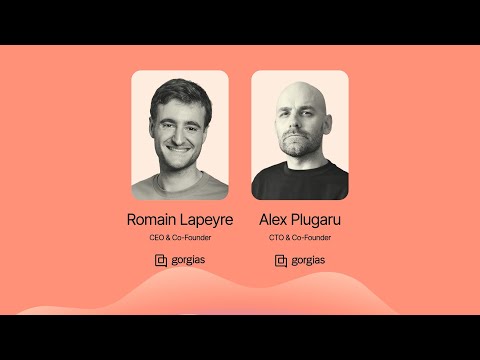
He turned "where's my order?" into a business worth over half a billion dollars.
Romain Lapeyre • Gorgias
Every Shopify merchant has the same nightmare: a support inbox drowning in "Where is my order?" tickets during Black Friday. Romain Lapeyre looked at that chaos and saw not a problem to endure, but a product to build.
Lapeyre co-founded Gorgias in Paris in March 2015 alongside engineer Alex Plugaru. The idea was specific: ecommerce brands needed a helpdesk that understood Shopify orders natively, not a generic ticketing system bolted onto a store. That specificity is what made Gorgias different. Within a year, he'd relocated the company to San Francisco to be closer to Shopify's ecosystem. Within a decade, Gorgias had grown to serve 16,400 merchants including Glossier, Steve Madden, BruMate, Dollar Shave Club, and Fjallraven.
The company crossed $80M ARR. Shopify became a strategic investor. The valuation peaked at $710 million in 2022 before settling at $530 million after the 2024 Series C-2. Lapeyre built all of it from a thesis that most software companies miss: customer support, done right, isn't a cost to minimize. It's revenue waiting to be unlocked.
"We want to turn customer service from a cost center to a profit center."
- Romain Lapeyre, CEO of GorgiasWhat separates Lapeyre from the average SaaS founder isn't the fundraising - it's the acquisition engine he built. Gorgias reached 10,000 SMB customers without a single cold call. The method: data. Lapeyre identified patterns in which stores would benefit most from the product and built outreach around those signals. It became the most-rated session at SaaStr Annual 2019, where the talk wasn't about venture capital or product vision - it was about spreadsheets and targeting precision.
That instinct for data extends to how he runs the company. He treats meetings as an organizational health metric: more than 25 hours per week in meetings is a warning sign, not a signal of productivity. He sleeps 8 hours every night. He devotes 4 hours per week to sports. He has two young children. These aren't incidental details - they're operational choices made by someone who understands that a depleted founder makes worse decisions.
The Gorgias of 2025 looks different from the Gorgias of 2016. The company launched Gorgias AI Agent, powered by GPT-4o, which autonomously handles 60% or more of customer support for many merchants. Lapeyre's bet on ecommerce has expanded into a bet on conversational AI. The help desk became a platform. The platform is becoming an AI-powered revenue engine. The Platonic dialogue the company is named after - Gorgias, about rhetoric and persuasion - has turned out to be unexpectedly on-brand.
Alongside Gorgias, Lapeyre has made angel investments in companies including Polar Analytics, Shogun, and Strapi - a quiet portfolio that tracks his core thesis: tools that make ecommerce operators more effective. He's not trying to build a venture portfolio. He's backing the ecosystem his company depends on.
He studied management at HEC Paris with a specialization in entrepreneurship, spent a semester at Fudan University in Shanghai, and did his first internships in San Francisco - at Scalr and Work4 - before the city was a home base. There's a through-line from the HEC student who interviewed Carlos Ghosn and Dan Serfaty for the debating society to the CEO who turned "What's your order status?" into a product used by 16,400 brands. Both versions were paying very close attention.

The best salespeople are your customers - we scaled to 1,000 merchants by letting data tell us who to talk to.
- Romain Lapeyre • SaaStr Annual 2019 (Top-rated session)
Gorgias is a customer experience platform built specifically for ecommerce. It centralizes support from email, live chat, SMS, phone, Instagram, Facebook, and TikTok into a single inbox - then connects directly to Shopify, WooCommerce, Magento, and BigCommerce so support agents can see order details, edit orders, issue refunds, and apply discounts without ever leaving the support interface.
The core insight: generic helpdesks like Zendesk were built for software companies. They had no concept of an order, a product variant, a shipping status, or a return. Gorgias built those integrations natively. An agent handling a Shopify merchant's tickets can see the customer's full order history, apply a discount code, and cancel an order from inside the same thread where the customer sent their complaint.
The AI layer came later but accelerated everything. Gorgias AI Agent, launched with GPT-4o integration, trains on a brand's knowledge base and historical conversations. For many merchants, it autonomously resolves 60% or more of incoming tickets. The remaining 40% - the complex, emotionally charged, or high-value interactions - reach a human agent with full context already assembled.
The company's 2024 research showed AI now handles 31% of all customer interactions across ecommerce broadly. Gorgias is betting that number keeps rising, and that the brands who wire up AI properly will handle more customers with fewer people - not as a cost-cutting exercise, but as a competitive advantage in response speed and personalization.
Most B2B SaaS companies grow with SDRs, outbound sequences, and conference booths. Lapeyre built Gorgias's early customer base differently. He identified signals in Shopify App Store data and public ecommerce data that predicted which merchants would have the highest support volume and the most to gain from automation.
The approach: find the stores that were clearly drowning in tickets (high order volume, active social channels, lots of reviews mentioning "contacted support") and reach out personally with a specific, relevant message. It worked. By SaaStr Annual 2019, Lapeyre was presenting the methodology to standing-room audiences of SaaS founders - one of the conference's top-rated sessions that year.
He later scaled the approach by doubling down on partnerships. Shopify's ecosystem of agencies, app partners, and Plus merchants became Gorgias's distribution channel. When Shopify invested in Gorgias directly, it wasn't just a vote of confidence - it was a strategic alignment between the platform and the support layer that sat on top of it.
The company also runs the annual Gorgias Connect conference - a gathering of ecommerce brands, agencies, and operators focused on CX strategy. The 2025 edition in Los Angeles included sessions on AI implementation, customer journey mapping, and the economics of support automation.
"Hiring has a very human aspect to it - you can't fully automate it."
- Romain Lapeyre on building teams at scaleDespite running a 520-person company with two young children, Lapeyre maintains eight hours of sleep per night. He's public about this - not as a humble-brag but as a systems argument. Depleted founders make worse decisions. The math isn't complicated.
Lapeyre tracks his meeting hours and treats anything above 25 per week as an organizational warning sign. When the CEO is in back-to-back calls, something in the company's decision-making structure is broken. He prefers to fix the structure rather than fill the calendar.
Four hours per week dedicated to sports isn't a wellness routine - it's a management practice. Energy management at the executive level determines how clearly you think in the seventh hour of a difficult hiring decision. Lapeyre builds the recovery time in by design.
One of Lapeyre's consistent operating principles: fill executive roles by promoting high-performers from inside the company before looking outward. He's described it as both a retention strategy and a culture signal - the people who built the company know it better than outside hires ever will.
Gorgias was founded in Paris, relocated to San Francisco in 2016 to be inside Shopify's ecosystem, and Lapeyre eventually settled in New York. The moves track the company's priorities: first get product-market fit, then get close to the platform partner, then build the team in the city with the deepest talent pool.
At HEC Paris, Lapeyre served as treasurer of the debating society - a role that required interviewing senior executives including Carlos Ghosn (then running Renault-Nissan) and Dan Serfaty (founder of Viadeo, LinkedIn's French rival). The access was unusual. The instinct to ask good questions stayed.
Lapeyre's angel investments cluster around the same operator stack that Gorgias serves. He's not building a venture portfolio for yield - he's backing the companies that make ecommerce merchants more effective, which makes Gorgias more valuable in the process.
Hiring has a very human aspect to it - you can't fully automate it. The relationships you build with candidates matter as much as the process.
- Romain Lapeyre • on scaling teams at Gorgias
The name "Gorgias" comes from a Platonic dialogue about rhetoric and the art of persuasion. For a company built on customer communication, the naming turned out to be more on-brand than the founders probably planned.
While a student at HEC Paris, Lapeyre interviewed Carlos Ghosn - then running Renault-Nissan at the peak of his power - for the debating society. Most students practice on case studies. He practiced on the people who ran them.
Gorgias was founded the same year Shopify's App Store hit critical mass, giving Lapeyre a compounding advantage: every new Shopify merchant was a potential Gorgias customer, and the market kept growing beneath him.
Lapeyre caps his meetings at 25 hours per week - a hard limit for a company with 520 employees across four cities. The constraint isn't discipline. It's a structural signal about whether the organization has learned to make decisions without the CEO in the room.
The 2019 SaaStr session on data-driven customer acquisition wasn't a keynote - it was a breakout that became one of the conference's top-rated talks. The founders who showed up expecting a product pitch got a spreadsheet methodology instead.
Shopify is a strategic investor in Gorgias - the same platform Gorgias integrates with most deeply. It's a rare structural alignment where the platform's success and the helpdesk's success run on exactly the same track.