Before Rodger Levenson had a bank to run, he had bags to carry. At the St. David’s Inn, now the Radnor Hotel, the teenager moved between luggage, room service and kitchen work. He called himself the gopher. The shift offered a practical education: notice what needs doing, find somebody who can help, and get on with it. A job description would have spoiled the suspense.
He grew up in Broomall, Pennsylvania, with an educator for a mother and an insurance broker for a father. Summer work included being a camp counselor. He remembers learning discipline, time management and teamwork through those early jobs. The future chairman, president and chief executive of WSFS Financial Corporation was accumulating experience long before he was collecting titles.
That is the useful thread through Levenson’s career. His route to the corner office involved learning several other offices first. Lending, finance, corporate development and operations each supplied a different view of the same institution. By the time he became CEO in January 2019, he had spent more than twelve years inside WSFS. His appointment was the public moment in a much longer apprenticeship.
A local banker takes the long route
Levenson graduated from Temple University with a finance degree in 1983. The first attempt to enter a major bank’s training program did not work out. He persisted, eventually joining Philadelphia National Bank in 1986 as it became part of CoreStates. Two years of classroom instruction and work assignments gave him experience across commercial lending, from small businesses to larger companies.
Seventeen years followed across CoreStates and its successors, First Union and Wachovia. As those institutions grew, he felt further removed from the customers and communities that had attracted him to banking. In 2003, he moved to Citizens, joining former colleagues who were building its commercial banking operation in the region. Three years later, WSFS called.
The attraction was specific: a commercial banking leadership job at a bank rooted in the Delaware Valley. Mark Turner was assembling the team for his own tenure as CEO. Levenson joined in November 2006. Geography had become a career criterion. He wanted responsibility close enough to the customer that he could still see what it was for.
- 1986Philadelphia National Bank / CoreStates
- 2003Citizens Bank
- 2006Joins WSFS
- 2019President & CEO
- 2020Adds board chairmanship
Four jobs before the fifth
His WSFS résumé is unusually helpful for understanding the eventual appointment. He led commercial banking until 2015, served as interim chief financial officer into 2016, moved into corporate development, then became chief operating officer in 2017. Each move changed the questions on his desk. Who should receive a loan? How does the whole bank earn its return? Which businesses belong together? How do the parts work every morning?
There is a temptation to read that sequence backward, as an inevitable procession toward the CEO title. It was also a series of distinct responsibilities. Commercial banking puts judgment about borrowers near the center of the job. Finance widens the view to the institution. Corporate development adds negotiation and integration. Operations makes execution everybody’s daily concern. Taken together, the assignments explain the breadth of preparation.
His education continued alongside work. He earned his MBA at Drexel in 1989 and later completed leadership programs associated with Wharton, the Center for Creative Leadership and Harvard Business School. The undergraduate finance student had kept studying. The subjects had expanded from the numbers on the page to the people responsible for them.
A succession with the patience to rehearse
Turner raised the possibility of Levenson succeeding him more than five years before the transition was announced. Preparation included conversations with the board, meetings with individual directors, feedback and leadership development. Becoming COO gave Levenson time to assume more of the daily work before he inherited the final responsibility. The organization had room to recognize the change before it appeared in a press release.
For a bank, this is a revealing choice of tempo. Institutions lend for years and cultivate customers for decades; changing the person in charge on a similarly deliberate schedule has a certain internal logic. Levenson spent roughly eighteen months as COO before taking over. There was time for directors to assess him and for him to begin shaping his team.
On January 1, 2019, he became WSFS’ thirteenth president and CEO. Turner moved into the executive chairman’s role. A year later, Levenson also became chairman. His first announcement as CEO promised continued investment in employees and the bank, alongside a role in the region’s economic prosperity. The ambition was broad, but its address remained familiar.
The hometown bank gets a bigger map
Levenson’s early CEO years came with a test of that local ambition: consolidation. WSFS completed the Beneficial acquisition in March 2019. The combination extended its Philadelphia presence and gave the company a larger platform. For a banker who had left an expanding institution because he felt less connected to its customers, growth presented an interesting obligation. The company would have to keep making its regional identity useful as its scale increased.
The next major combination was Bryn Mawr Bank Corporation. Announced in March 2021 at approximately $976.4 million, it brought a wealth and trust franchise into the same organization as WSFS’ banking business. The acquisition closed on January 1, 2022. A larger customer base could support investment in people and technology. It also meant more work bringing systems and organizations together.
The relationship behind the transaction had developed over time. Levenson and Bryn Mawr’s Frank Leto had known each other as competitors and periodically compared notes. They had discussed how the franchises might fit before the timing aligned. That detail makes the deal easier to understand. A merger arrives as a number; it often begins as a conversation that somebody remembers to have again.
After the combination, Bryn Mawr Trust became the predominant brand within WSFS’ wealth management division. The 2022 strategic plan emphasized integration and optimization. Those words are less festive than acquisition, but they describe the work customers actually encounter: whether their new institution functions coherently after the announcement has aged.
Being local requires leaving the office
Levenson’s public responsibilities extend into the machinery of regional economic development. He serves on the Greater Philadelphia chamber’s board and executive committee and participates in its CEO Council for Growth. His roles also include the Federal Advisory Council and the Delaware Business Roundtable’s executive committee. These are places where banking connects with the wider business environment it depends on.
In August 2025, Delaware Prosperity Partnership announced Levenson and entrepreneur Robert Herrera as its board co-chairs. The organization recruits businesses, supports retention and expansion, and connects economic development efforts across the state. Its expanded focus on innovation and entrepreneurship puts established finance beside younger enterprises. Levenson’s co-chair is also a founder of The Mill, Delaware’s coworking community.
Another connection took him to Chester’s waterfront. In April 2023, he joined the Philadelphia Union’s leadership and local officials at the groundbreaking for WSFS Bank Sportsplex. The project brought a banking partnership into the daily geography of youth and professional soccer. His stated interest was the effect on Chester and the surrounding community. The bank’s name would be visible on something people could use.
The awkward skill of saying no
By October 2025, Levenson was discussing leadership with Jamie Hopkins and Kate Duffy on the Planning Perspectives podcast. The subjects included mentorship, communication, delegation and learning to say no. It is an instructive list for someone whose early work involved doing whatever was needed. As responsibility expands, usefulness starts requiring choices about which work belongs with somebody else.
The conversation also covered entrepreneurs’ resilience and the connection between employees’ work and a larger purpose. Those themes fit the career without requiring a legend about it. He learned inside established organizations, changed employers when the work drifted from his interests, and took on unfamiliar functions before becoming chief executive. Experience supplied opportunities; other people supplied instruction and judgment.
Recognition has followed. The American Jewish Committee’s Philadelphia and Southern New Jersey community leadership award came in 2021. Drexel named him Business Leader of the Year in 2022. In 2026, Temple included its 1983 graduate in the Gallery of Success. The institutions that helped educate him now place him among the people they point students toward.
A bell, a balance sheet, and the people beside him
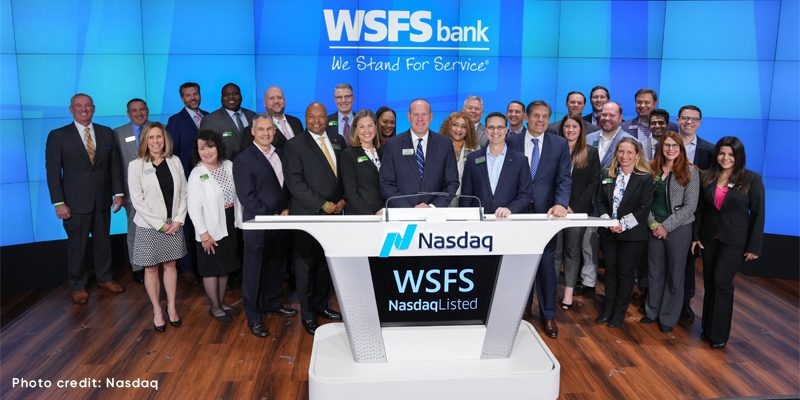
On June 2, 2026, Levenson rang Nasdaq’s closing bell for WSFS’ fortieth anniversary on the exchange. Long-serving employees joined the celebration. Among them was Leslie Herrick, whose career across Bryn Mawr Trust and WSFS stretched beyond five decades. A corporate anniversary can become a parade of executive titles. Here, the group included people whose service predated their CEO’s arrival.
“A company is only as strong as the people who build it.”
Rodger Levenson · Nasdaq celebration, June 2026
The latest operating snapshot arrived on October 22, 2026. WSFS reported third-quarter diluted earnings of $1.75 a share, compared with $1.37 a year earlier. Wealth and trust fees rose 30% year over year. At September’s end, the company reported $22.1 billion in balance-sheet assets and $109.5 billion under management and administration. These measure different things; the latter is not money owned by the bank.
Numbers provide the current score. The longer story concerns the kind of institution Levenson has spent his career trying to work in: large enough to do more, close enough for the region to matter. His path has required both expansion and attention to ordinary work. The teenager at the inn would recognize the second part. Somebody still has to notice what needs doing.