Before Kevin Blair had a larger bank to explain, he had a page. During his early tenure as Synovus chief executive, his office sent directors a dense, one-page update every two weeks. Board meetings, once held six or seven times a year, became monthly. Each opened with a strategic discussion lasting between half an hour and an hour. Nobody was being invited to arrive pleasantly uninformed.
It is a revealing detail in a career that has since acquired much grander scenery. On January 13, 2026, Blair stood with colleagues at the New York Stock Exchange to ring the opening bell. Pinnacle and Synovus had combined. He was president and CEO of the resulting firm. There were cameras, applause and a bank name large enough to read from some distance.
The one-page update and the exchange podium belong in the same story. Both concern the distance between a leader’s intentions and everyone else’s understanding. Blair’s present assignment is to run a larger regional bank while keeping its relationships close. The arithmetic of the transaction was settled in legal documents. The arithmetic of belonging is more troublesome.
An analyst learns the whole bank
Blair began his banking career in 1995 as a strategic planning analyst at Signet Bank in Richmond, Virginia. He earned a bachelor’s degree in economics and management at James Madison University and an MBA at George Washington University. GW identifies him as a member of its MBA class of 1996. His professional starting point was the work of studying how a bank fits together.
At SunTrust, he accumulated experience in corporate strategy, credit risk, finance and business management. He led its commercial specialty segment and served as chairman and chief executive of its Georgia/North Florida region. In 2015, he became corporate treasurer. These roles put him on different sides of the same institution: assessing risk, directing a business and managing its finances.
In August 2016, he joined Synovus as executive vice president and chief financial officer, succeeding the retiring Tommy Prescott. Kessel Stelling, then chairman and CEO, welcomed a banker with both financial experience and an appreciation of the bank’s place in its communities. Blair had spent nearly two decades at SunTrust. The move gave him a new institution to learn.
His responsibilities widened quickly. He became chief operating officer in December 2018 and president in December 2019. By the time Synovus announced its CEO succession in December 2020, his brief covered the major banking and specialty businesses as well as technology, operations, credit, human resources, marketing, customer experience and strategy. A job description of that length leaves few places to hide.
- 1995Signet
Strategic planning analyst - 2016Synovus
Chief financial officer - 2021Synovus
President & CEO - 2026Pinnacle
President & CEO
The succession was a conversation
Blair became Synovus CEO on April 22, 2021. He had joined its board the previous December; he would become board chairman on January 1, 2023. The progression looks tidy when arranged as dates. The selection itself involved colleagues watching how he thought, what he proposed and whether they trusted him with a broader responsibility.
Tim Bentsen, Synovus’s lead independent director, later explained that Blair had been recruited as someone who might become a CEO candidate. His case strengthened as he described his vision and strategy, particularly after becoming COO. The board’s confidence developed through exposure to his work. His appointment was the outcome of that process.
The increased meeting frequency and fortnightly written updates give that confidence a practical setting. Directors had more chances to discuss strategic choices and less need to spend their meeting learning what had already happened. A single page requires selection. Someone has to decide which developments matter enough to occupy the available space. Brevity, in this case, came with homework.
“Banking is a noble profession.”
Kevin Blair, on why he chose the work
Blair’s own description of banking is unusually earnest. He has spoken of the daily opportunity to help clients reach their financial objectives. His civic commitments extend that idea beyond a commercial relationship: his board service includes United Way of the Chattahoochee Valley, the Metro Atlanta Chamber and the Georgia Historical Society. These are institutions concerned with the places where business happens.
A bell, then a much longer calendar
The Pinnacle-Synovus combination was announced on July 24, 2025. By January 2026, Blair had moved from leading Synovus to leading the combined Pinnacle. Terry Turner, Pinnacle’s founding CEO, became board chair. Founder Rob McCabe took the chief banking officer role. Blair inherited an assignment involving an established leadership culture as well as a balance sheet.
The holding-company merger closed on January 1. The combined holding company is headquartered in Atlanta, while Pinnacle Bank remains headquartered in Nashville. Those distinctions can sound fussy until a city wants to know which jobs, decisions and relationships will remain nearby. Geography has a habit of becoming personal.
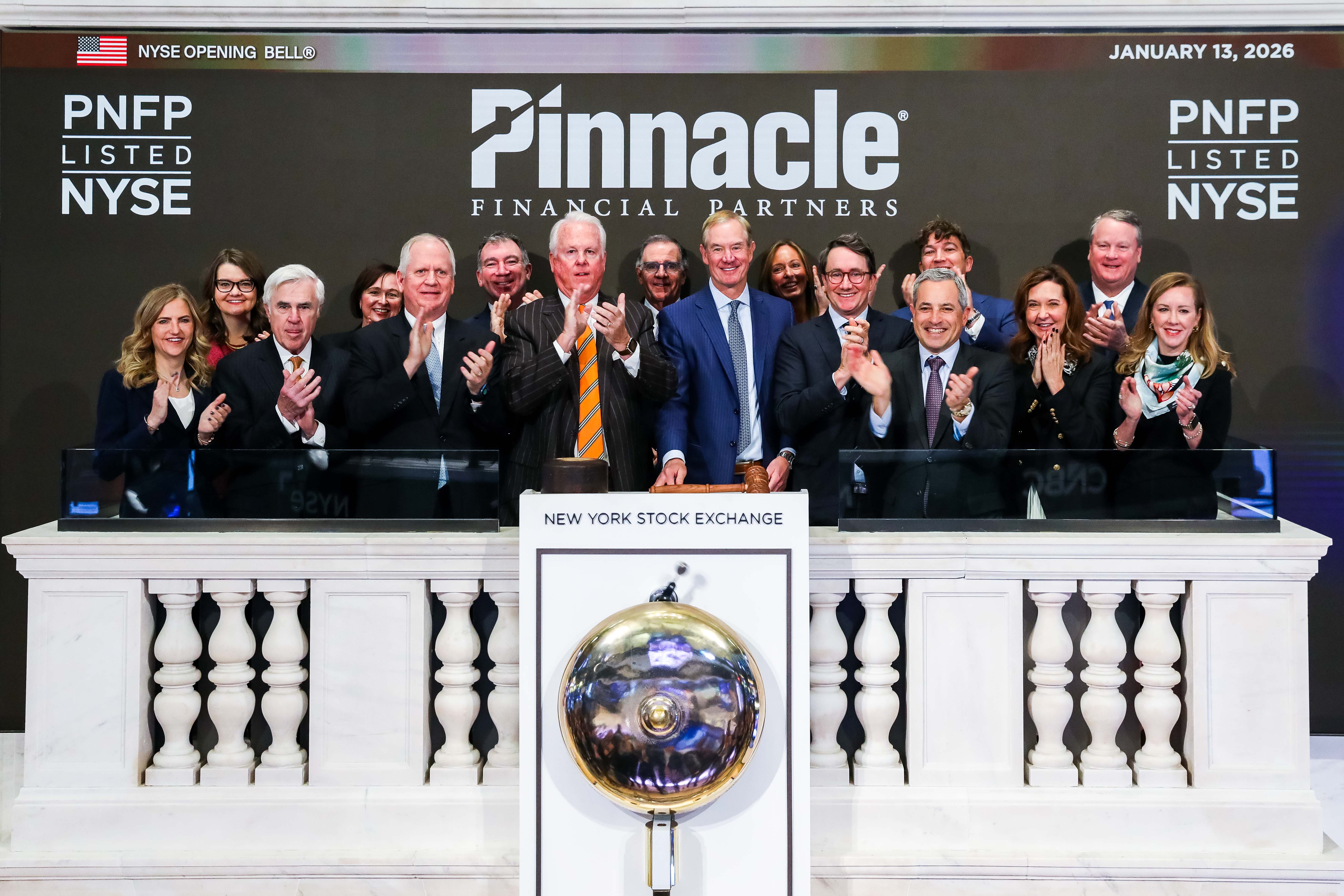
When the leadership team visited the exchange, the firm described a network of more than 400 offices across nine states. It also said the two brands would continue operating independently until brand and systems conversion in early 2027. A ceremonial bell can announce a new company in seconds. Moving clients and employees through its systems requires a different kind of timing.
The final milestone is a stated plan, not a completed event.
In a joint video after the announcement, Blair and Turner discussed the employee response and the need to keep serving clients during the months before approval. Blair said Synovus had already tried to emulate aspects of Pinnacle’s approach. It was an acknowledgement that the two leaders were bringing together practices they had studied, alongside organizations they had run.
That exchange adds texture to the formal leadership chart. Turner brought the experience of building Pinnacle; Blair brought knowledge of Synovus and a willingness to adopt the other firm’s operating model. Their public discussion returned to employee engagement, client experience and maintaining momentum. Agreement at the top would have to become everyday working arrangements across the business.
Columbus wants particulars
In Columbus, where Synovus had its roots, the merger raised questions that no opening-bell photograph could answer. People wanted to understand employment, branches, philanthropy and the significance of the headquarters move. Blair discussed those concerns publicly in January. The conversation required a different vocabulary from an investor presentation.
He described roughly 850 employees in the Columbus area, many working in technology, operations and corporate services. He said frontline bankers would remain and explained that some corporate functions would overlap. He also described maintaining community commitments. These were statements about the intended effects of the combination, with consequences residents could judge as the work proceeded.
That exchange helps explain the demands of his role. A bank’s employees are also neighbors, volunteers, customers and contributors to local organizations. Moving an organizational box on a chart creates questions well outside the chart. Blair had to address the place Synovus came from while making the case for the company it was becoming.
Who gets invited in
By August, Blair was discussing another practical component of his plan: hiring. For revenue-producing positions, he described a requirement for ten years of experience and validation from someone already at the firm who could speak to the candidate’s performance and cultural fit. The recruitment model depends on people who know other people’s work.
That preference has a clear relationship to his strategy. Experienced bankers bring judgment and established relationships. Local decision-making gives them room to use both. The market and specialty leadership structure he and McCabe announced before closing explicitly emphasized local hiring and decisions. A larger organization would still need credible people acting in particular markets.
There is an obligation built into that approach. If the proposition rests on experienced bankers and personal service, the institution has to support those bankers when a customer needs an answer. Recruiting a familiar face creates an expectation. Clients will soon discover how much that face can actually get done.
An unfamiliar book club
Among Blair’s public updates is a smaller admission: the combined company’s first book club was also his first experience of being in one. The selection was Dan Heath’s Reset. Blair connected the choice to helping teams develop a common language, identify priorities and take ownership of change. The CEO was joining a new activity while asking colleagues to learn together.
It is a modest detail, useful precisely because a merger supplies so many large ones. A shared reading discussion gives people something more specific to talk about than the abstract virtue of teamwork. It also makes learning a visible activity. The leader has a book to read, just like everyone else.
In May, he also spoke about culture during a team-building orientation in Columbus. The choice of location mattered to the unfolding story: employees were coming together in the city where Synovus began. Alongside the formal merger calendar was this quieter schedule of gatherings, explanations and introductions. People were meeting the company they now belonged to.
The work after the announcement
Blair has made his ambitions for Pinnacle explicit: growth, engaged employees and trusted client relationships. He wants the combined firm to compete on financial performance and the experience of working there. Those remain ambitions to pursue. In its first-quarter 2026 announcement, the company reported hiring 50 revenue producers while moving ahead with integration. Its financial comparisons also carried the substantial effects of the merger.
Later appearances put Blair and CFO Jamie Gregory before investors to explain the business. An October announcement scheduled a November 5 discussion in Boston. The work of explaining continues, alongside the work of operating. Different audiences will ask different questions, and a convincing answer for one will not necessarily satisfy another.
The most revealing thread in Blair’s career may be the repeated effort to make the next step understandable: a strategic update for directors, an answer about Columbus, a hiring standard, a book discussed across a newly combined company. The distance between people increases easily as an institution grows. Keeping them informed takes appointments, pages and conversations. Even after the bell, there is another page to write.