On January 27, 2024, two bank executives met at a conference in Scottsdale, Arizona. Jeff Jackson ran WesBanco. Gary Small ran Premier Financial. Their first conversation was an introduction. By the next day, directors were joining the discussion over lunch. A day later, the conversation included the regulatory and operational challenges of becoming a bank with more than $10 billion in assets. The machinery of a merger had begun moving.
- Premier added 73 branches to WesBanco in 2025.
- A separate $200 million equity raise helped prepare the balance sheet.
- The customer proposition combines local access with banking, wealth and insurance under one group.
That sequence, recorded in the merger filing, makes a useful opening to WesBanco’s story. Regional banking grows through conversations about geography, people and capital. The headline arrives much later. In this case, the acquisition closed on February 28, 2025, valued at approximately $1 billion at closing.
01 The charter keeps moving
WesBanco’s own history begins with a January 1870 charter for The German Bank in Wheeling. Operations began that April. The name changed in 1918. Mergers followed. The present holding company was incorporated in 1968, and affiliate banks adopted the WesBanco name in 1991.
There is something instructive about that distinction. The institution’s continuity rests partly in a charter; its shape has repeatedly changed. Buying another bank is consistent with its history. The question is whether each new combination leaves customers with a useful institution, accessible people and services worth keeping together.

02 First, find the capital
One early hard constraint in the Premier negotiations was capital. In March 2024, WesBanco’s board concluded that an equity raise would be necessary to preserve strong regulatory capital in a transaction. That made additional funding part of the deal’s design.
WesBanco raised $200 million of common equity that August. Wellington Management supplied a $125 million anchor investment; Glendon Capital Management and Klaros Capital also participated. The proceeds helped pay down Federal Home Loan Bank borrowings. For another business studying the transaction, the practical lesson is straightforward: work out how expansion will be financed before celebrating its size.
Compatibility also had a wonderfully unromantic detail. WesBanco and Premier used the same FIS IBS core banking system. Shared infrastructure could make integration easier. The transaction assumptions projected $41.4 million in annual cost savings once fully implemented, alongside $71.6 million in pretax, noncapitalized merger charges. Those were planning estimates, with execution still required.
February 28, 2025
August 1, 2024
Premier Financial
03 The customer has a longer story
For a household, WesBanco can hold the checking account, provide a mortgage, accept savings and help plan retirement. Its mobile app handles check deposits, transfers and debit card controls. An Allpoint partnership provides more than 55,000 surcharge-free ATMs, although those network machines generally do not accept deposits. Convenience has footnotes.
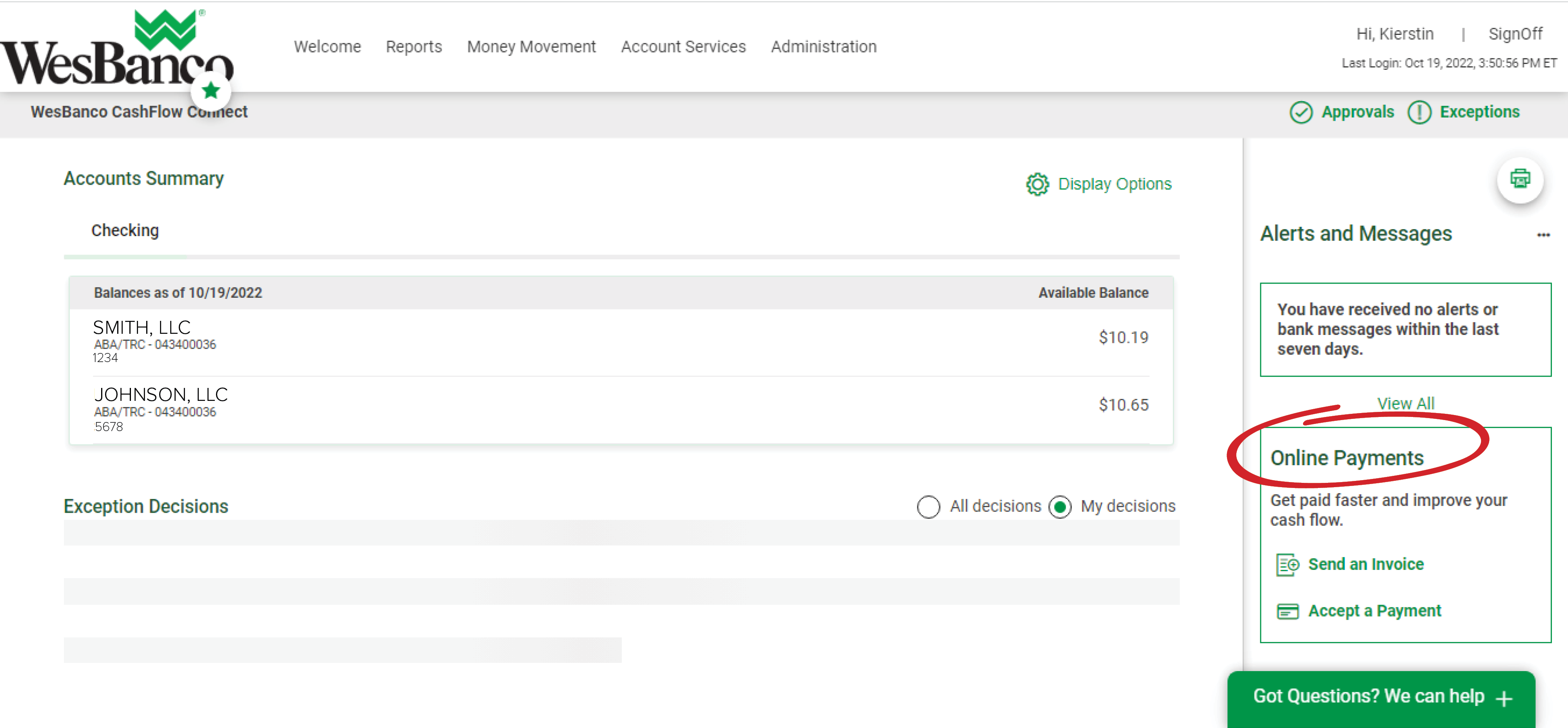
A business owner encounters a different set of problems: collecting invoices, paying suppliers, moving payroll money and borrowing for equipment. WesBanco offers commercial loans and treasury tools alongside business checking. CashFlow Connect includes ACH and wire approvals and Positive Pay exception decisions. These features address the awkward stretch between having money and getting it to the right person.
Autobooks makes the proposition particularly tangible. Enrolled business customers can send invoices and collect payments into their checking accounts. One option has no monthly fee; the $9.99 monthly option adds payables, accounting and reporting. Processing fees apply to both. A small business with uncomplicated bookkeeping needs can compare that package with the cost and friction of separate tools.
Wealth management extends the relationship further. Trust administration, investment management, private banking and brokerage serve customers whose financial questions have become more complicated than a monthly balance. Insurance adds personal and commercial coverage. In October 2026, Irvin Insurance Services joined the group, bringing an eastern Ohio agency whose roots date to 1979.
04 Relationships have an income statement
The economics are recognizable banking economics. WesBanco earns interest on loans and securities, pays for funding, and collects fees for additional services. In 2025, it reported $814.3 million in net interest income and $166.8 million in non-interest income. Multiple services give the bank more ways to earn from a customer relationship.
Its market position sits between smaller local institutions and larger national banks. The breadth of services can matter to a business that wants financing, payments and wealth advice together. A customer seeking a particular savings rate or a specialized investment service may make a different choice. The useful comparison is the customer’s actual task, including fees, access and the person responsible when something needs fixing.
“We’ve always maintained our community bank orientation”
WesBanco, on its approach to customers
That company description has a measurable counterpart. On October 20, 2026, WesBanco announced its ninth consecutive Outstanding Community Reinvestment Act rating from the FDIC. The evaluation covered lending, investment and service, including approximately $1.6 billion in community development loans. It offers evidence about community credit needs, rather than a verdict on every customer interaction.
Keeping experienced people becomes part of that promise. The 2025 annual filing put average full-time employee tenure at approximately ten years. Published benefits include tuition support and a retirement match. Those disclosures cannot establish how every branch feels to a visitor. They do show that the people side of the model has an operating cost, just as software and buildings do.
The approach also has limits. A merger that loses experienced staff, frustrates depositors or misses its savings targets can weaken the very relationships it was meant to expand. A wide menu helps only when the services work together for the customer.
05 Read the second number, too
The latest quarter supplies a useful check on the growth narrative. At September 30, 2026, assets stood at $28.5 billion. Third-quarter common-shareholder net income rose to $85.3 million from $81 million a year earlier. Adjusted diluted earnings per share, however, fell to $0.89 from $0.94. Different treatments of merger costs help explain why the comparisons point in different directions.
WesBanco’s expansion depends on keeping funding, credit quality and service working together. Shared systems can help; so can a broader product range. Neither guarantees that a customer will stay. The bank’s next test happens in ordinary moments: an invoice paid, a loan explained, a problem handed to someone who follows through.