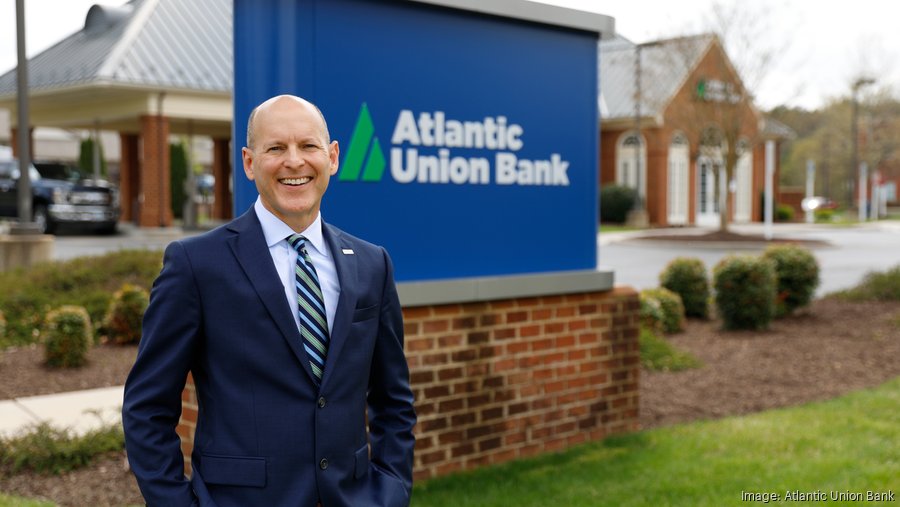
John Asbury came home with a problem to solve. In 2016, a Virginia bank approaching $10 billion in assets needed to decide what it wanted to become. Staying comfortably familiar would soon be expensive. Selling would surrender its independence. Growing would require changing the place. For a banker whose career had already crossed the country, the invitation carried an unusual appeal: here was a chance to build something in the state where he had started.
He arrived at Union Bank & Trust that October and succeeded Billy Beale as chief executive in January 2017. The institution would become Atlantic Union Bank. The assignment was larger than a change of name. Asbury wanted to restore a kind of Virginia banking franchise that consolidation had largely removed: locally headquartered, capable of serving substantial businesses, and able to compete with the national banks.
A homecoming is usually described as a return to something familiar. His involved making the familiar rather different.
A summer job that kept going
Asbury was born in Radford, Virginia. His father worked as a city manager, and the family spent time in North Carolina and Tennessee before returning to Radford when John was in eighth grade. He eventually became student body president at his high school. His own account of those years is pleasantly resistant to executive mythology: he was interested in plenty of things, participated in sports and thought of himself as well-rounded.
Banking entered through a summer job at the local United Virginia Bank branch. At Virginia Tech, where he studied business and graduated in 1987, he also met Wendy Sublett, his future wife. A temporary job became a profession; a college meeting became a partnership that accompanied a long succession of moves.
After graduation, Wachovia's commercial banking training program took him to Winston-Salem. He later earned an MBA at William & Mary. Over 17 years at Bank of America, he worked his way to responsibility for business banking in the Pacific Northwest, based in Seattle. At Regions Financial in Birmingham, he eventually led the Business Services Group, covering the company's business and commercial banking customers.
Those jobs gave him experience of organizations with very different scales. His next move brought a different kind of responsibility. In 2015, he became president and CEO of First National Bank of Santa Fe, with operations in New Mexico and Colorado. Then Virginia called.
The number that changed the job
Ten billion dollars sounds like a pleasant problem. For the bank Asbury joined, it was a strategic complication. Crossing that asset threshold brought additional oversight and a different economic equation. The board wanted to grow. Asbury's task was to make the organization capable of supporting the decision.
There is a revealing exchange in his account of the handover. Beale, who had led the institution for almost three decades, told his successor that the new assignment required different qualifications from his own. Asbury's response was equally frank: “I couldn’t have done what you did.”
That mutual acknowledgment matters. Succession can tempt a new chief executive to treat everything inherited as a problem awaiting his arrival. Asbury instead recognized that a bank could have been well led through one period and still need different skills for the next. The institution's past deserved respect; its future required work.
In his writing on leadership, he has argued for executives who understand multiple parts of a bank and can bring them together. A growing organization needs people who can connect operations, technology, risk and customers. Otherwise, a larger balance sheet may simply purchase a larger collection of misunderstandings.
“I couldn’t have done what you did.”
John Asbury, recalling his conversation with predecessor Billy Beale
Making size earn its keep
Under Asbury, acquisitions expanded Atlantic Union's reach. Xenith joined in 2018, Access National in 2019 and American National in 2024. Each helped extend a franchise whose ambitions increasingly reached beyond its original Virginia footprint. The point of the transactions, in his account, was to add markets and capabilities while creating room to invest.
The Sandy Spring combination made that strategy especially visible. Atlantic Union Bankshares completed the acquisition on April 1, 2025, at an aggregate transaction value of approximately $1.3 billion. On the announcement's pro forma figures, using December 2024 balances before merger adjustments, the combined company had $38.7 billion in assets, $32.1 billion in deposits and $30 billion in loans held for investment.
Those figures describe an institution capable of taking on a different range of business. They also describe a considerable integration assignment. Customers still need functioning accounts, employees need working systems, and a merger must become something more useful than two names in a press release.
The distinction became central to Asbury's next phase. In the 2025 annual report, he described the Sandy Spring systems conversion as completed in October. His attention was turning toward demonstrating the earnings and capital generation of the franchise he had spent years assembling. The construction work had to show what it could produce.
*Pro forma at Dec. 31, 2024, before merger adjustments, reported April 1, 2025. These are two different dated snapshots, not a measure of organic growth.
The banker who still wants a branch
Asbury's view of technology begins with a fairly practical constraint: a regional bank cannot match the technology budgets of the national institutions. Trying to reproduce every offering would be an expensive way to lose focus. He has favored partnerships with financial technology companies and a clear understanding of what customers actually need.
In a 2022 interview, he described branches becoming places for advice and more involved conversations as routine transactions moved online. Atlantic Union had consolidated part of its network. Digital banking could handle more of the ordinary business, leaving a different purpose for the physical office.
By October 2026, he was discussing plans for seven additional branches in the Raleigh area and three in Wilmington. The reasoning followed the same customer logic: people and businesses continued to value a physical presence for complicated decisions and relationships. A useful app and an accessible banker could belong in the same strategy.
North Carolina also offers a personal connection. Asbury has lived in Winston-Salem, Asheville and Charlotte during his career. Expansion there takes him through places he knows, rather than a map of appealing growth statistics alone. He has described the state's population and business growth as reasons for increasing the bank's investment.
Who gets the next opportunity?
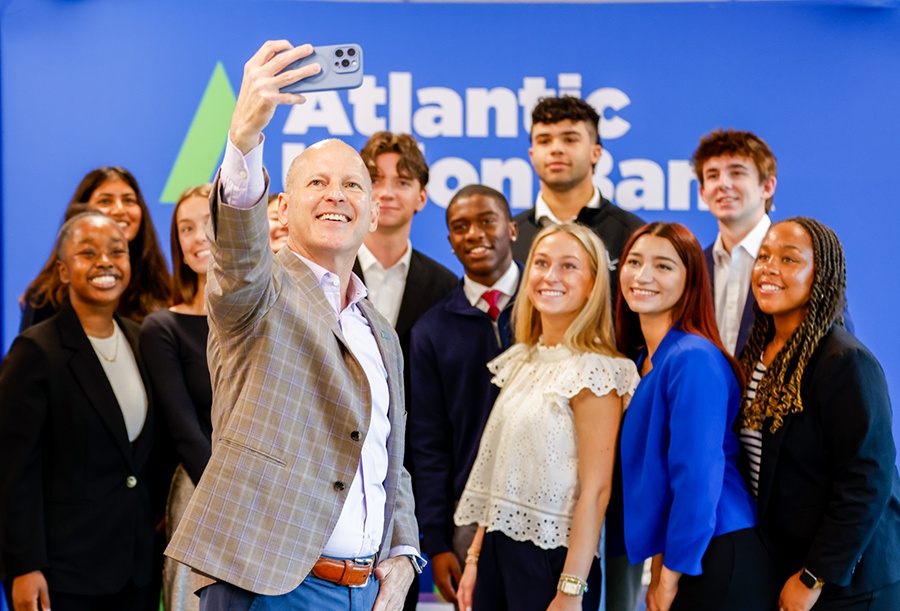
The bank's growth has also given Asbury a platform for a question that reaches back to his own training: how does someone get started? His connection with former Virginia Tech professor George Morgan and fellow alumnus Mike Clarke helped bring the bank into the university's Credit Corps initiative.
The idea was practical preparation. Students could gain credit experience and work toward professional certification before entering the industry. Asbury has described attracting a broader group of young people into banking as part of the purpose. He has also been careful to credit Morgan and Clarke for the idea.
His education work extends to chairing Virginia Learns, which brings business and education leaders together around public schooling and readiness for employment. Its programs include advocacy fellowships, listening tours, reporting on schools and support for educators. The connecting thread is the distance between an education and the opportunities it should make possible.
That concern gives his civic work a recognizable relationship to his day job. Employers need people who are prepared for work; students need access to careers they may not yet know exist. Asbury's own summer at a bank offers a small, concrete example of how consequential an introduction can become.
A public voice, and a public test
Asbury served as American Bankers Association chair for 2024-25, following leadership roles at the Virginia Bankers Association and the Mid-Size Bank Coalition of America. His national agenda included challenging asset thresholds and arguing that regulation should better reflect a bank's complexity. He also advocated changing the tax treatment of credit unions that compete with banks.
These are the positions of an industry advocate with a commercial stake in the outcome. They belong alongside the obligations that come with running a bank. In December 2023, the Consumer Financial Protection Bureau ordered Atlantic Union Bank to provide at least $5 million in customer redress and pay a $1.2 million penalty over its overdraft enrollment practices. The findings concerned the bank's disclosures and consent procedures.
For a leader who emphasizes service, such an order is a consequential part of the record. The quality of banking depends on what customers are told, understand and agree to, as well as how efficiently a company grows. That makes the ordinary encounter between a customer and a bank employee an enduring test of the larger strategy.
The order of the words
In 2026, Radford recognized its native son with a city proclamation following his selection as Virginia Business's 2025 Business Person of the Year. The local recognition fits a career that has ranged widely while returning repeatedly to Virginia. He also serves on the Virginia Port Authority board and the Greater Richmond Partnership board, connecting his banking work with the region's economic development.
Asbury's stated operating priorities put soundness first, profitability second and growth third. After years of acquisitions, that sequence is worth holding him to. Size can be counted immediately. Judgment takes longer to reveal itself.
The summer employee from Radford now runs an institution spanning a much larger territory. His next assignment is to make that reach useful, customer by customer, while preserving the responsiveness that made the regional bank worth rebuilding. A homecoming, it turns out, can keep a person occupied for quite a while.