A bank can buy nineteen branches. It cannot buy nineteen sets of customers deciding, all over again, that they trust the people behind the counter. In June 2024, Paul Williamson was considering both sides of that equation. UMB had announced a roughly $2 billion deal for Heartland Financial USA. In Colorado, the transaction promised to turn eleven UMB branches into a network of thirty. The arithmetic was straightforward. The human work was about to become rather more interesting.
Williamson, newly promoted to president of regional banking, spoke about the opportunity without treating the incoming business as something to be dismantled and improved by decree. He wanted to preserve the value UMB was acquiring. It is an appealingly practical qualification to a merger announcement: before rearranging the furniture, understand why people like sitting there.
That tension gives his career its shape. He has spent more than two decades at one bank, moving from commercial banking into Colorado leadership and then responsibility across its regions. His public work keeps returning to the same problem: getting larger while remaining useful to the particular person who needs an answer.
A career measured in return visits
Williamson joined UMB in 2004. His earlier work as a commercial banking officer involved finding loans and funding for clients, alongside building relationships with existing and prospective customers. The job combined numbers with the more patient business of being remembered when a company next needed its bank.
He earned both a bachelor's degree and a master's degree in business administration at Rockhurst University in Kansas City. In 2016, he became president of UMB's Colorado region, with oversight that also included the bank's entrance into Utah. Denver became the base for a career whose geographical responsibilities would keep widening.
There is a particular education in staying with an institution. Decisions do not disappear into a previous employer's filing cabinet. Colleagues remain colleagues. A customer who once needed funding may return with a different company, a larger project or a much more awkward question. Continuity makes the consequences of advice harder to escape, and potentially more useful to learn from.
His appointment to regional banking leadership in 2024 extended that accumulated experience. Today, his responsibilities include leading Colorado, overseeing all UMB regions and the commercial real estate team. The work connects business development with operations and customer experience. A promise made in a meeting eventually has to survive the machinery of the bank.
Optimism, with a contingency plan
In 2023, Williamson described a Colorado business community that still wanted to borrow and invest, even as recession worries complicated decisions. UMB's Colorado region reported $3.9 billion in average quarterly loan balances in the second quarter, up 17 percent from a year earlier. Those are historical figures, belonging to a particular moment of expansion rather than a statement about today's balance sheet.
The detail that makes his account interesting is the coexistence of activity and restraint. Some clients were considering acquisitions. Others were improving payments and treasury processes. Williamson's advice covered cash reserves, contingency planning, staffing and inventory. His clients could be doing well and still have reasons to prepare carefully.
Economic confidence tends to sound better when delivered in a short, ringing sentence. Business ownership rarely supplies such accommodating material. An owner can have a promising order book and an inconvenient payment schedule. A successful acquisition can create new demands on cash. Williamson's comments allowed for that untidy middle ground, where a business is neither in retreat nor entitled to relax.
That is also where a regional banker earns a place in the conversation. A general economic forecast cannot tell an individual company which payment will arrive late or which investment can wait. The relationship becomes useful when broad conditions meet the specifics of an actual operation.
Q2 2023 · 17% year-over-year growth
Thirty doors, one difficult question
The Heartland transaction gave Williamson a much larger operational test. Its Colorado business, known as Citywide Banks, brought nineteen branches to the proposed combination. He saw an opportunity to gain scale more quickly than organic growth would allow, while bringing additional people into a business where recruiting had constrained expansion.
“We're always hiring,” he said.
His stated concern was preserving responsiveness and flexibility as teams came together. That concern puts a useful limit on the appeal of size. A larger bank has more places to serve customers, but customers still encounter it one conversation, one decision and one problem at a time.
UMB completed the acquisition on January 31, 2025. The company said the transaction would expand its banking footprint from eight states to thirteen and bring total assets to approximately $68 billion, using year-end 2024 figures. This was a change in the dimensions of the institution, with implications well beyond a new sign outside a branch.
In October 2025, UMB announced the completion of the systems and brand conversion. Former Heartland divisional banks were operating on UMB platforms and under its name. The expanded network then comprised 192 branches and 347 ATMs. The distinction between closing a deal and completing a conversion matters: legal ownership can change on a date; working arrangements take a good deal more handling.
For Williamson, regional leadership places him near that junction between ambition and execution. A transaction can establish reach. The daily experience of banking determines what that reach is worth to the people using it.
The evening appointment has music
Another side of Williamson's Denver work appears in a concert program. In 2024, he welcomed audiences to the Summer Concert Series and Evenings al Fresco at Denver Botanic Gardens. UMB was marking its fifteenth year sponsoring the summer series. The setting offers a pleasantly different interpretation of a bank's presence in a city: people gathered to listen, rather than to discuss borrowing.
“We believe in supporting the communities we serve,” he wrote.
His message linked the sponsorship to access to the arts and the cultural life of Denver. It also expressed his own anticipation of attending the performances. Corporate sponsorship has its formal vocabulary, but a returning summer concert gives the commitment a place and a season. People can actually turn up.
“We believe in supporting the communities we serve.”Paul Williamson · 2024 concert welcome
His civic responsibilities extend to boards associated with Denver Botanic Gardens, Metro Denver Economic Development Corporation, ACE Scholarships, Junior Achievement and the Rocky Mountain chapter of YPO. He also serves on the President's Leadership Council at the Denver Museum of Nature & Science. The list places education, economic development and cultural institutions alongside his commercial work.
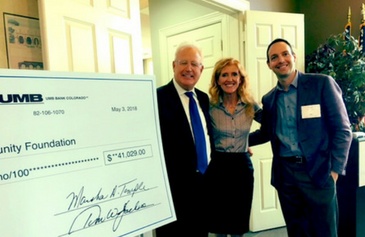
An earlier photograph catches this public role at a smaller scale. On May 3, 2018, Williamson joined a check presentation benefiting The Denver Post Community Foundation following the Denver Auto Show Preview Gala. The amount was $41,029. UMB was the presenting sponsor. It is a modest scene beside a multibillion-dollar merger, but a specific one: three people, an oversized check and a local beneficiary.
The next address, and the next conversation
UMB's plans for Cherry Creek North make its Colorado intentions visible in another way. Announced in May 2026, the future flagship at First Avenue and Clayton Lane is planned as a six-story building with approximately 55,000 square feet. Commercial banking, private wealth and executive teams are expected to share the location, with a full-service branch at ground level.
The bank plans to move in during 2028. The project includes space for clients and events, as well as outdoor terraces. For a business built around meetings, architecture becomes part of the service: where people enter, whom they can reach and whether related teams can work close together. The building remains a plan for the future, rather than an accomplishment to be claimed early.
Williamson's own 2026 writing returns to a less imposing setting: the conversation between an owner and a banker. He urges owners to revisit financial plans, examine cash flow, test budgets against disruption and discuss growth before it requires urgent financing. His agenda also includes fraud prevention and attention to policy changes.
The emphasis is on timing. A conversation held while options remain open can be more productive than one forced by an immediate deadline. It gives both parties room to ask what has changed and whether earlier arrangements still make sense. That is a quiet aspiration for banking, and a demanding one to deliver consistently.
The connection between his old and new responsibilities is especially clear here. Commercial banking asks someone to understand the circumstances of a business. Regional leadership asks that person to help an organization respond to many such circumstances without losing the detail. Neither task becomes easier simply because the balance sheet has grown. The useful question is whether the added capacity reaches the customer in a form the customer can use. An owner should not need to understand a bank's organizational chart to receive a considered answer.
Williamson's career now spans a wider map than the Colorado region he once took over. Yet the question running through it remains close to home. When a company changes direction, when a customer needs help, when a city grows around a bank, can the institution still respond with an understanding of the people involved? More branches create more opportunities to answer. Each answer still has to be earned.