In 2000, a bank opened in downtown Nashville because another bank had effectively left town. AmSouth had acquired First American, moving the center of power to Birmingham. Nashville still had branches. What it had lost was a large homegrown institution making its own decisions. Terry Turner, Rob McCabe and Hugh Queener saw a business hiding inside that distinction.
- The offer: business and personal banking, treasury services and wealth advice across a nine-state footprint.
- The mechanism: experienced bankers, local authority and incentives tied to the firm’s results.
- The test: integrating Synovus while keeping the customer relationship intact.
Pinnacle Financial Partners opened on October 27 at 211 Commerce Street. Its proposition was almost stubbornly ordinary: banking, delivered by people who knew the customer and could act. The interesting invention was the organization behind the counter. A checking account could be copied. A team of experienced bankers, trusted by local business owners, would take considerably longer.
Today that experiment has become a regional institution spanning nine states. The question has changed. Can the bank preserve the freedom that helped it grow while absorbing the machinery required to run something much bigger?
A bonus plan with fewer elbows
Consider a small detail from Pinnacle’s 2017 annual report. Every non-commissioned associate participated in a cash incentive program based entirely on firmwide financial targets. Associates received restricted stock when they joined and annually afterward. The lender and the credit officer had a financial reason to care about the same outcome.
That arrangement matters because banking contains a built-in argument. One person wants to make the loan; another must decide whether making it is sensible. Reward only production and the argument becomes expensive. Pinnacle’s stated approach tied incentives to the institution, while giving local people authority to serve clients. The inference is straightforward: collaboration becomes easier when the compensation system stops paying people to disagree.
There was a time cost, too. Following the BNC combination, Turner personally led ten three-day orientation sessions for 558 associates in High Point. Culture here had a calendar, an instructor and thirty days of the CEO’s attention.
The useful part happens between payments
What does a customer actually buy? Businesses get deposit accounts, credit and treasury management. Individuals can use checking, savings, mortgages and digital banking. Wealth clients can bring financial planning, investments, trusts and insurance into the relationship. The menu resembles those at Regions, Truist or a national bank. Pinnacle competes on how the pieces are connected.
Imagine a business that pays employees before its customers settle their invoices. That is an illustrative cash-flow problem, and Pinnacle’s treasury services address its component parts: collecting receipts, sending payments, managing balances and reducing fraud exposure. Remote deposit, ACH services and payment controls make the relationship useful between loan applications. The expertise lies in arranging those tools around how a particular business operates.
The economics are familiar. Pinnacle earns a spread between interest earned and funding costs, plus service, advisory and other non-interest revenue. Its investment in BHG adds another earnings stream. The customer’s reason to consolidate services is convenience and informed advice; the bank’s reason is a deeper, more durable relationship.
A crisis made the promise measurable
In 2020, the problem arrived with a deadline. Businesses needed Paycheck Protection Program funding while normal commerce was shutting down. In Turner’s February 2021 account, Pinnacle made $2.4 billion of first-round PPP loans to 14,000 businesses. He credited experienced staff, shared incentives and the freedom to move quickly.
That is the company’s explanation, rather than proof that culture alone produced the result. Government funding, lending infrastructure and extraordinary employee effort were part of the story. But the episode gives the operating philosophy a concrete output. A promise about access becomes meaningful when there is an application to process and payroll approaching.
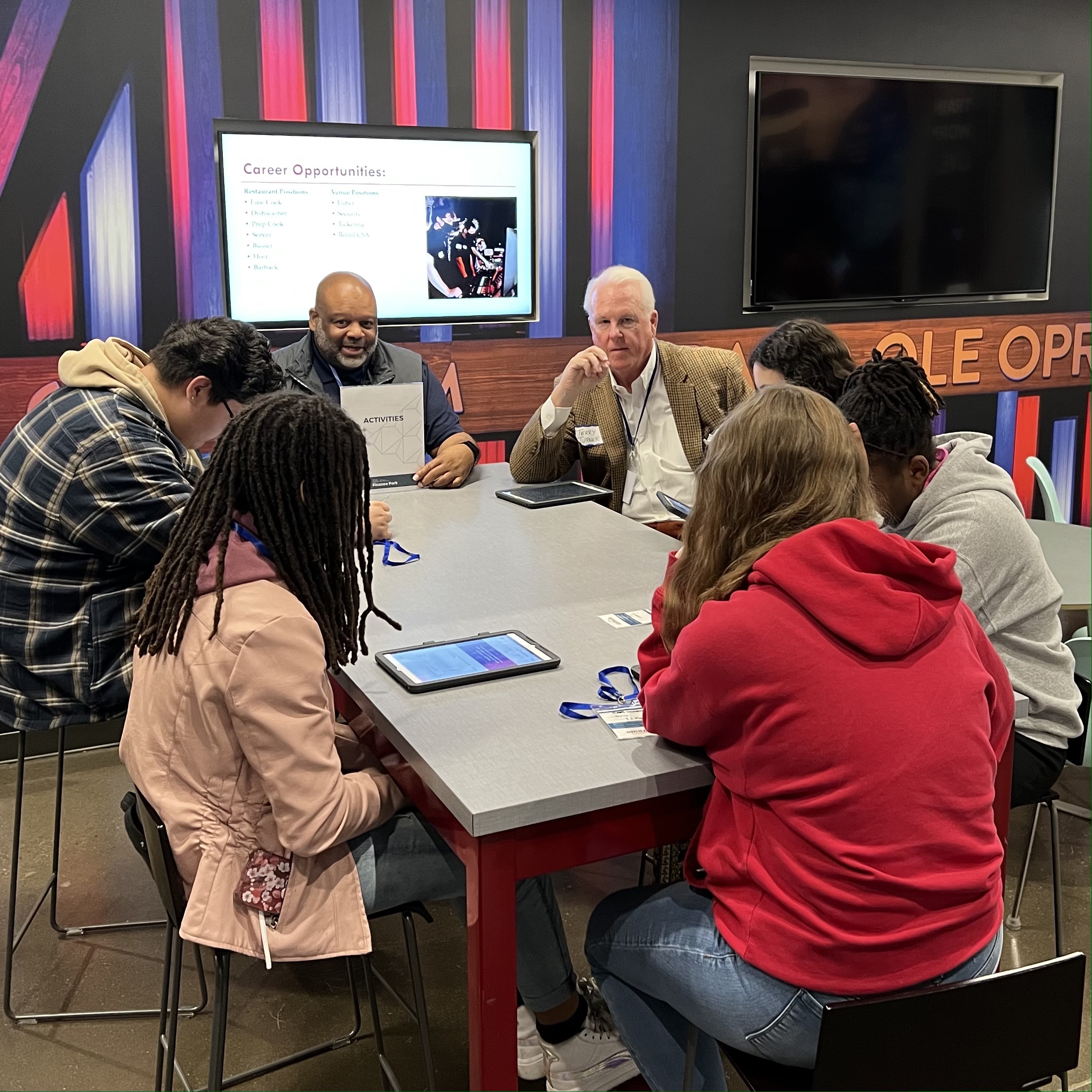
The company’s commitment also shows up away from a credit committee. In 2024, Junior Achievement of Middle Tennessee documented Turner helping students work through personal budgets. The subject was banking stripped of its marble: choices, obligations and money that must last.
“people matter”Pinnacle’s founding tenet
The merger has a bill attached
Pinnacle and Synovus announced their combination in July 2025 at an $8.6 billion all-stock transaction value. The holding companies combined on January 1, 2026; the bank merger followed January 2. Kevin Blair became president and CEO, Turner became chairman, and the corporate headquarters moved to Atlanta. Pinnacle Bank kept its Nashville headquarters.
The rationale was specific. Synovus brought a broader Southeastern presence and experience in risk, compliance, technology and operations at larger institutions. Management argued that these capabilities could support Pinnacle’s recruiting and local-decision model at a scale above $100 billion. This was an expansion of the original strategy, with considerably more infrastructure attached.
The costs are already visible. Reported merger-related expense reached $382 million for the first nine months of 2026. The combination’s announced share value and the subsequent integration expense measure different things; neither should disappear behind talk of cultural compatibility.
By September 30, assets totaled $130.7 billion, with about $103 billion in deposits. Third-quarter net income available to common shareholders was $364 million. These are combined-company figures. Comparing them with the old Pinnacle without accounting for Synovus would turn an acquisition into a misleading growth story.
July 2025
Nine months ended September 2026
The part another business can borrow
What failed first in the founding story was the local ownership arrangement the founders valued: consolidation moved authority away from Nashville. Pinnacle’s response was to build around experienced people and give them reasons to stay. What later changed was the scale of the ambition. The Synovus agreement made a larger balance sheet and broader operating capabilities central to the next chapter.
The transferable lesson is practical. Decide which customer problems require judgment, hire people who have exercised it, and check whether their incentives reward cooperation. Then spend management time teaching the system. A small business can examine those choices without acquiring a bank.
There are conditions. Local authority depends on sound credit standards, capable staff and dependable technology. It loses value when decisions outgrow people’s expertise or integration interrupts service. A customer seeking only a particular rate may find less benefit in an advisory relationship. Pinnacle’s model makes its strongest case when a customer’s finances are complicated enough that knowing the person changes the quality of the answer.
Keep the conversation going
Explore Pinnacle’s website, treasury tools and wealth services. Follow the company on LinkedIn, X and Facebook.
Read the October 2026 results, the company’s origin story and Turner’s Junior Achievement conversation. Watch Turner on workplace culture or visit Pinnacle’s video channel.