When Ernie Pinner handed John Corbett the chief executive’s job in July 2015, he had already spent more than 25 years working alongside him. The recommendation came with a compact assessment: “high energy, hard work and caring leadership.” Banking has a splendid vocabulary for complicated arrangements. Here was a succession that could be explained without a diagram.
Corbett was taking charge of CenterState’s holding company. He had run its banking subsidiary since 2003. That distinction matters: the apparent arrival was another step in a partnership that stretched back to college, through First Union, and into a business the two helped organize in 1999. Pinner became executive chairman. The handover moved responsibility without erasing the person who had helped teach it.
Today, Corbett is SouthState’s chief executive and board chair. His career poses an increasingly awkward question for a growing bank: how do you keep the judgment of people close to customers useful when the organization around them becomes much larger?
A teller’s window in Central Florida
Corbett was born in Miami. His early banking work included a teller’s job at First Union in Haines City, where Pinner, the area president for Polk County, became his mentor. He studied at Bob Jones University, earning a bachelor of science degree. The geography of his working life would remain closely tied to Central Florida even as the institution’s map widened.
A teller’s window offers a rather different introduction to finance from a trading screen. Customers arrive with particular problems. The institution supplies rules; the person at the counter supplies the encounter. It is a useful place to begin thinking about how a bank actually feels to the people using it.
From 1990 to 1999, Corbett worked in commercial banking at First Union in Florida. He then helped organize CenterState, serving as its bank’s executive vice president and chief credit officer from 2000 to 2003 before becoming CEO. The progression put credit judgment near the beginning of his leadership career. Lending money and collecting it are related occupations, although enthusiasm occasionally persuades people to forget the second one.
The arithmetic after the excitement
By 2012, CenterState’s work included the less photogenic business of consolidation. Its annual report described twelve mergers, acquisitions and consolidations over the preceding years. Four banks had been brought into one lead bank, with a single operations center. Fifteen branches were consolidated and closed during the year.
This was growth with a considerable amount of tidying attached. Combining banks produces a new total immediately. Getting the offices, costs and workflows into a useful arrangement takes longer. The difference helps explain why an executive’s account of expansion can sound less like a victory speech than a discussion about plumbing.
CenterState was still working toward a $5 billion asset ambition. It needed loan production and acquisitions, but also better efficiency and improving credit performance. Corbett’s bank was learning to make a larger structure pay its way. In 2012, American Banker named him a Community Banker of the Year; the Florida Bankers Association named him Banker of the Year in 2013. The recognition arrived while the operational work continued.
Thousands of decisions, one direction
In 2014, CenterState’s shareholder letter looked back to the search for startup investors in local communities in 1999. The original vision combined size with profitability: more than $5 billion in assets and at least a 1 percent return on average assets. The pair belonged together. A larger balance sheet was only part of the assignment.
The letter also described a conversation about a successful correspondent banking customer. Someone suggested genius or luck. A colleague supplied a more patient explanation: success emerged from many small decisions over time. The accompanying commitment was explicit: “pushing responsibility to the lowest level!”
That phrase is a useful clue to Corbett’s subsequent career. A bank’s organization chart can show who reports to whom. It says less about who gets to exercise judgment before asking permission. Local responsibility gives experienced people room to act, while making the quality of those accumulated decisions consequential. Over enough years, the small choices become the business.
“Pushing responsibility to the lowest level!”
CenterState’s 2014 shareholder letter, signed by Ernie Pinner and John Corbett
A vault door, and a reason to hesitate
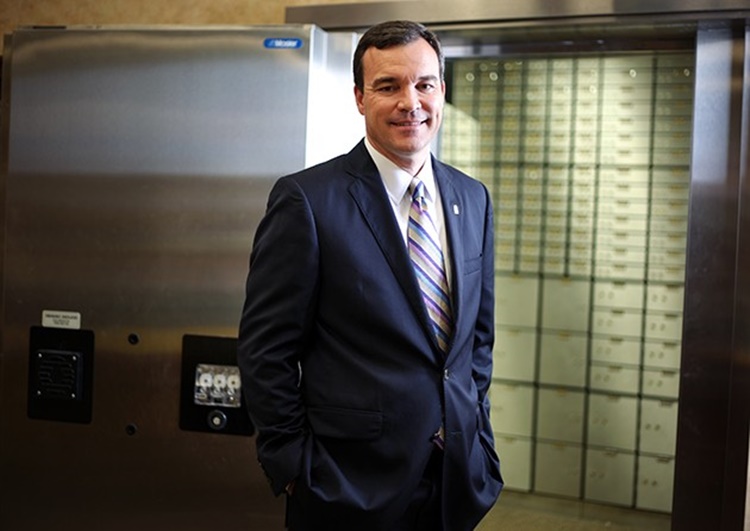
The vault photograph suits the profession: Corbett in a suit, a heavy door, rows of safe-deposit boxes. But one revealing moment from this period concerns money he was wary of sending out.
In 2016, he voiced concern about condominium and multifamily construction in South Florida and other metropolitan markets, including Orlando. He was more comfortable with the prospects in Central and North Florida. The caution was specific to places and lending categories, rather than a sweeping verdict on the state.
That is an important qualification in a career often described through acquisitions. An expanding bank still has to decline opportunities. Local knowledge only earns its keep if it helps distinguish a promising market from an overcrowded trade. A growing population does not automatically make every proposed building a sensible loan. There is room in a banking story for ambition and for a raised eyebrow.
The name changed; the question grew
In June 2020, CenterState combined with SouthState. Corbett became chief executive of the company and president and chief executive of the bank. The merger made the SouthState name the public identity of a business whose senior leadership included people with CenterState roots.
His next geographic chapter extended farther west. On January 1, 2025, SouthState completed its Independent Financial acquisition. The combination expanded its Texas presence, brought it into Colorado and took the company to approximately $65 billion in assets. The closing announcement offered a date and a size. Both were milestones; neither settled the daily management problem.
Each new market requires an answer to a familiar question: which decisions travel through the larger organization, and which belong with the people doing business locally? Corbett’s preference for geographic leadership now had to operate across a wider footprint. A model developed in Florida was taking on more places, more colleagues and more opportunities for misunderstanding.
Freedom needs an operating budget
Corbett’s 2024 shareholder letter connected geographic autonomy with accountability. Local presidents were meant to have room to serve their communities, with responsibility for earnings growth in their regions. Shared interests among employees, owners and local businesses were part of the intended design.
The same letter discussed investments in risk management: staffing, controls and computer systems to monitor operational risk, liquidity, credit and capital. Decentralization, in this version, still requires infrastructure. The people making decisions need support, and the institution needs to understand the combined consequences.
There is a practical bargain here. Scale helps pay for technology and oversight. Local leadership helps interpret customers and markets. Each makes demands on the other. The bank has to fund the machinery without allowing the machinery to become the point of the exercise.
By 2026, the governance arrangements were changing too. The board proposed combining the chair and CEO roles when Douglas Hertz retired, with a lead independent director maintaining independent leadership. The current officer roster lists Corbett as CEO and chair. His responsibilities now encompass both running the institution and chairing its board.
The model meets the next quarter
Other people’s assessments offer a check on the management philosophy. SouthState director Shantella Cooper put one observation plainly: “John does his homework.” Inside the bank, geographic leaders described an ongoing effort to move decisions closer to their markets.
The questions have not disappeared. Analysts have examined expenses, funding costs and whether the local model can continue to scale. Those are reasonable tests of a system whose value depends on its performance after it becomes larger. A philosophy that works at one size still has to earn its place at the next.
In October 2026, the bank reported approximately $224 million in quarterly net income and annualized growth of 9 percent in both loans and deposits. Corbett credited growth across geographies and business lines, helped by recently added bankers. Capital markets activity had softened as Treasury yields rose. The quarter supplied progress and friction on the same page.
A familiar name on the next building
Back in Winter Haven, another chapter was taking physical shape. In September 2026, SouthState announced that a five-story regional support center under construction downtown would be dedicated to Pinner. The $17 million project was designed for approximately 125 technology and operations employees.
It is an apt place to remember the partnership. Support staff do much of the work that allows a banker in another office to keep a promise. Their contribution can be difficult to capture in a portrait, but a growing institution depends on it. The new building connects that work with the city where CenterState began.
Corbett also has a less corporate setting in which to spend his time. He enjoys farm work, and says, “My happy place is on the tractor.” His preferred equipment has air conditioning and a radio. Even a commitment to hard work can accommodate a few sensible improvements.
The bank has acquired new names, markets and responsibilities. The relationship with Pinner still gives the story its human scale. A mentor entrusted him with a job, then with a larger one. Now Corbett leads an institution in which thousands of other people need enough authority to do their own work well. That is a demanding inheritance to carry.