Before Terry Turner could open a bank, he had to persuade the government he knew how to run one. He and Rob McCabe had held senior jobs at First American. Their application nevertheless drew a rather deflating assessment: they might be “country club bankers.” Experience, apparently, could look suspiciously like a handicap. While the paperwork moved between desks, the proposed business was spending money. Turner remembered explaining his impatience to a regulator with a figure that needed no financial glossary: “we’re burning $7,000 a day here.”
That was the beginning of Pinnacle Financial Partners. A quarter-century later, Turner became chairman of the company formed by its merger with Synovus. The startup had grown large enough to face the question that had helped bring it into existence: what happens to the people when banks get bigger?
Ten children. One bathroom.
Turner grew up in Knoxville, Tennessee, the oldest of ten children. Five boys, five girls, one bathroom. It is a household statistic with rather more explanatory power than the usual executive biography. Before anyone entrusted him with a balance sheet, he belonged to an organization in which individual wishes necessarily encountered other people’s schedules.
He attended Catholic school and remembered a childhood in which money was neither plentiful nor a constant preoccupation. The community around the family mattered. In his later telling, so did the possibility of taking opportunities, making mistakes and continuing. It would be too tidy to turn the bathroom into a business-school case study. Still, the eventual banker’s fondness for a workplace that feels like a community has a recognizable setting.
His formal preparation took him to Georgia Tech, where he earned a bachelor’s degree in industrial management in 1976. He then became a consultant at Arthur Andersen in Atlanta. Banking arrived through a client: Park National Bank in Knoxville, which he joined in 1979.
His career followed Park into First American. In Nashville he eventually became president of the General Bank, then president of the Investment Services Group. These were substantial operating jobs. By the time he became an entrepreneur, he had spent years inside the kind of organization his new business would challenge.
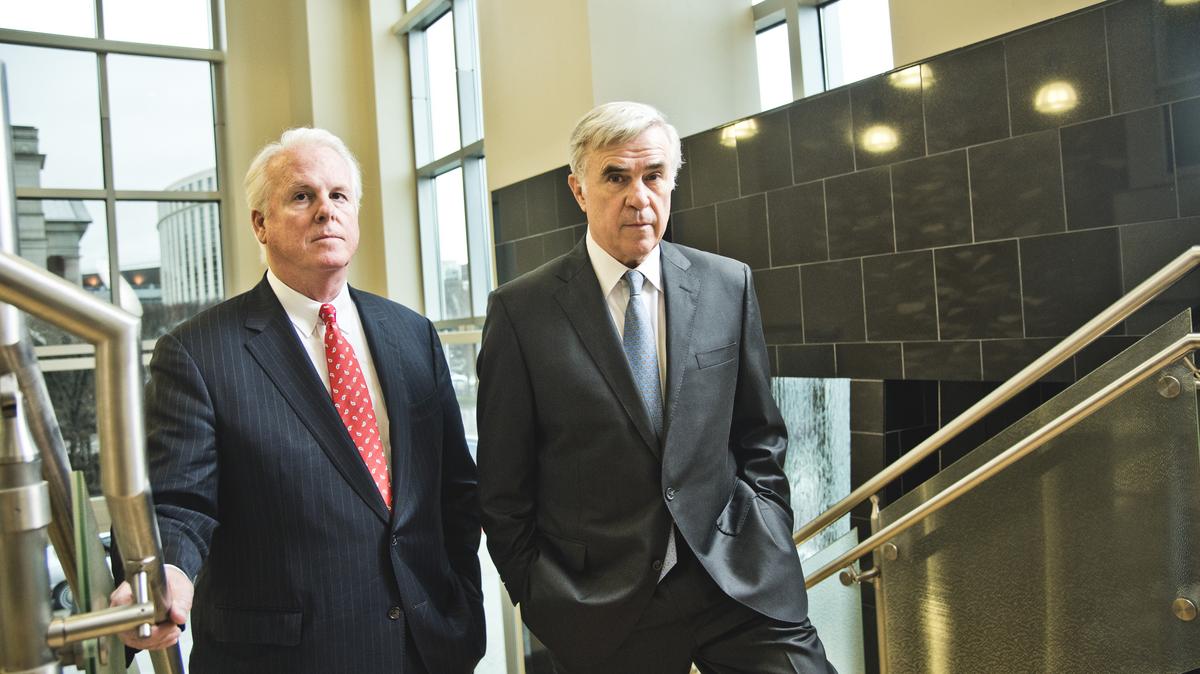
A friendship with a business attached
McCabe was already working at Park when Turner arrived on a consulting assignment. They met early in that engagement and became friends. Their partnership would outlast employers, acquisitions and several changes in the scale of their ambitions. Hugh Queener, another colleague from those earlier banking years, became Pinnacle’s third cofounder and the executive responsible for its operations and systems.
In 1999, AmSouth acquired First American. Turner and McCabe considered their alternatives: running another bank, taking control of an existing institution, or beginning again. They chose the blank sheet. Starting from scratch allowed them to decide what sort of workplace they wanted before an inherited organization decided for them.
They were also making a commercial judgment about Nashville. A city that had lost major locally owned financial institutions still contained business owners who needed bankers. The founders knew the regional competitors, knew their customers and believed there was room for a bank organized around those relationships.
“There’s got to be a better way.”
Terry Turner, recalling the founding idea
The timing was uncooperative. Pinnacle sought $25 million in its initial public offering as the dot-com boom unraveled. It raised roughly $19 million. On October 27, 2000, it opened at 211 Commerce Street in downtown Nashville. Its first client was Don Kennedy Roofing. There is something pleasingly practical about a new financial institution beginning with somebody who knows what happens when a roof leaks.
Turner later recalled an original team of 38 associates and a plan to break even in three years. The bank reached that point in 13 months. By its twentieth anniversary, it had 2,600 associates and 111 offices. The early arithmetic had changed. The argument about how to organize the work remained familiar.
- 1979Joins Park National Bank in Knoxville
- 2000Opens Pinnacle with McCabe and Queener
- 2026Becomes chairman after the Synovus combination
The recruiting department was the growth plan
The Pinnacle proposition put considerable weight on hiring people who already knew their markets. A banker with experience brings judgment, local knowledge and relationships that cannot be installed with the office furniture. Giving that person a reason to move can create a way into an established market.
In the two years through July 2019, Pinnacle hired 189 revenue producers across the firm. They averaged more than 20 years of experience. These were people with professional histories, colleagues and clients. Growth could begin with a conversation between adults who had already worked together somewhere else.
Rick Callicutt, who led Pinnacle’s Carolinas and Virginia business, described how that approach took hold in his region after the BNC combination. Bankers arrived from competitors while those institutions were undergoing changes of their own. The opportunity depended on making Pinnacle a place they would choose, then giving them room to serve clients.
The model gives Turner’s repeated interest in culture a specific business purpose. A valued employee is more likely to stay; an experienced employee who stays can maintain a client relationship. The connection between the two is straightforward enough. Making it happen in office after office is the expensive part.
The CEO teaches the first lesson
For Turner, the expense included his own time. New associates encountered a chief executive willing to spend substantial stretches of orientation explaining the company. Small-business adviser Beth Deering remembered her initial disbelief that he would devote three days to her group of new hires. He did.
A full day went into history, purpose and values. Later came team exercises, including the task of getting colleagues over a 12-foot wall. It is an unusually literal answer to the corporate instruction to help one another. Deering described carrying the trust formed during orientation back into her daily work.
Turner brought the same habit to a much larger audience when Pinnacle combined with BNC Bancorp in 2017. He personally led ten three-day orientation sessions in High Point, North Carolina, reaching 558 associates. Those numbers describe a calendar as much as a management philosophy. A founder can say that integration matters in a minute. Thirty days in the classroom makes the claim rather harder to dismiss.
Orientation sessions Turner personally led for 558 associates following the BNC combination.
Even the published orientation schedule tells the story. Turner’s name appears beside the introduction, company heritage, mission and vision, values, and a session called Indispensable. The instruction came with a recognizable voice. Employees had a chance to hear the reasoning from the person who helped write it.
A bank with a book club
Turner also made communication a routine obligation. His account of building a workplace included quarterly meetings with all associates, weekly meetings with client-facing staff and an internal blog. He treated repetition as part of the job. “You simply cannot overcommunicate,” he wrote.
The company’s customs extended to twice-yearly book clubs and anniversary shows produced by associates. A workplace has to accommodate financial statements and people who enjoy putting on costumes. Turner seemed willing to make room for both. His approach asked managers to take an interest in employees as people with lives beyond their desks.
In 2024, he recorded a conversation with customer-experience author Shep Hyken after Pinnacle chose Amaze Every Customer Every Time for its spring book club. A reading selection became a discussion with the writer himself. It was another way of turning the bank’s stated interest in service into something employees could actually participate in.
Recognition followed the work. In June 2017, Turner received EY’s Southeast Entrepreneur Of The Year award in financial services at the College Football Hall of Fame in Atlanta. He shared the credit with McCabe, Queener and the associates. For someone whose startup involved explaining his credentials to skeptical regulators, an entrepreneurship award supplied a satisfying change in the conversation.
Nashville beyond the loan book
Turner’s involvement in Nashville has included the Sports Council, the Salvation Army, Belmont University, the chamber of commerce and the Nashville branch of the Federal Reserve Bank of Atlanta. Banking put him in rooms where commercial decisions met civic life. His work extended into organizations whose purposes were broader than making loans.
He also volunteered with colleagues at Junior Achievement of Middle Tennessee, teaching financial education to high-school students at least annually. After years spent explaining the bank to employees, he was still making time to explain money to people at the beginning of their working lives.
In his writing about Nashville’s economy, Turner connected the bank’s prospects with those of the city around it. Local businesses needed financing and advice; cultural venues and community organizations helped make the city attractive. A bank’s relationship with its hometown could include where it put its offices, which boards its leaders joined and what its employees did with their time.
Now the founder has to hand it on
The Synovus combination changed Turner’s responsibilities. The holding-company merger took effect on January 1, 2026, followed by the bank merger on January 2. Kevin Blair became president and CEO. Turner became chairman, bringing his experience into a role supporting Blair and the leadership team.
The combined bank began with $117.2 billion in assets. That figure measures the company at the merger’s closing. By July 2026, the company described itself as a $129.1 billion bank. Scale had become a daily operating fact.
The succession arrangements also gave the transition a timetable. Turner’s agreement provided for two years as non-executive chairman, followed by two years as special adviser to the CEO. In July 2026, Pinnacle extended McCabe’s service as director and chief banking officer through the end of 2027. The founders’ experience remained available while the next management team took responsibility.
Turner had offered a compact account of his outlook during an August 2025 conversation with Nashville business leaders: “Focus on the opportunity. Optimism creates resilience.” His career gives that advice some texture. He had started after losing an executive role, raised money during an unhelpful market and repeatedly spent his own time teaching people why the company existed.
As chairman, he now has to help those habits survive a change in who leads the daily work. For a founder who put so much of himself into orientation, that is a personal transition as well as an organizational one. The next lesson will be taught partly by watching him share the room.