Lynn Harton had become rather good at leaving. Ten moves in his first 25 years in banking had made a new address an ordinary consequence of a new opportunity. Then came an evening at Greenville’s Peace Center with his wife, Flavia. They saw friends. He returned to his seat. Another job, in another state, had been looking possible. Suddenly the familiar calculation produced a different answer.
“Why do I have to move?” he recalled asking himself.
Greenville had become somewhere he wanted to remain. In 2012, he joined United Community as chief operating officer and stayed based in the city. What followed offers an unusually concrete way to think about ambition: a career can keep expanding while the person pursuing it finally unpacks.
A credit officer’s education
Harton’s working life began at BB&T in 1983. He spent two decades there before moving into chief credit officer roles at Union Planters and Regions. His bachelor’s degree came from Wake Forest. His subsequent education included the less orderly curriculum of borrowers, balance sheets and decisions that cannot be undone by rewriting the meeting minutes.
Credit is a useful apprenticeship for leadership. The work requires a view of what might happen, alongside the discipline to examine what has already happened. A promising plan still needs repayment. A persuasive person still needs scrutiny. The banker must keep listening without falling in love with the presentation.
One borrower supplied Harton with a lasting example. In the late 1980s, as a newly promoted regional credit officer covering South Carolina, he worked on real estate financing involving Buck Mickel. When projects encountered difficulties, Mickel brought the problems forward himself, sometimes before the bank had spotted them. He offered support when more was needed.
Harton remembered the conduct decades later when he received an award bearing Mickel’s name. The detail worth keeping is the timing. Early candor gives everyone more room to act. A lender can analyze collateral; learning how a partner behaves when things go awkwardly takes a little longer.
Character becomes easier to judge when a project becomes harder to finish.
Greenville, under pressure
He arrived in Greenville in 2007 with The South Financial Group, initially as its chief risk and chief credit officer. In November 2008, the company named him interim president and CEO. That announcement accompanied preliminary approval for roughly $347 million through the Treasury’s capital purchase program. This was banking with the comfort removed.
He went on to serve as president and CEO, raise capital, negotiate the company’s sale to TD Bank and lead its integration. From 2010 to 2012, he held a senior commercial banking role at TD. The sequence put survival, negotiation and the work after a transaction into the same stretch of his career.
There is a difference between announcing a sale and making two organizations work together. Customers still need answers the following morning. Employees still need to know who can make a decision. Harton’s experience covered that unglamorous middle, where the language of a deal meets the ordinary demands of an office.
United Community offered another kind of assignment. He joined an existing institution with an established leader, Jimmy Tallent. The task involved operations and a plan for growth, with succession developing over years. A new chief operating officer could influence the future without pretending the bank had begun on his arrival.
- 2012Chief operating officer
- 2015President and director
- 2017Bank CEO
- 2018Holding-company CEO
- 2019Chairman
The same money, different people
When Harton became holding-company CEO in 2018, he signaled continuity with the strategic plan. Tallent moved to executive chairman. The arrangement mattered: a bank that trades on relationships has good reason to make its own leadership handover comprehensible.
Harton has a succinct explanation for the competitive problem. “Everybody’s money is the same.” Rates and products may vary, but the dollars offer little scope for artistic interpretation. A bank has to make its people, judgment and service worth choosing.
He has described using employee surveys, sharing the findings and creating action plans. Concerns about development helped prompt a leadership academy with Clemson University and a separate program for managers. Executives taught part of the coursework themselves. The practical appeal is straightforward: asking people for feedback creates an obligation to do something visible with the answer.
That philosophy also carries a burden. Trust has to coexist with credit standards. Local knowledge can improve a decision, but familiarity alone cannot make a loan sound. For a banker with Harton’s background, the interesting work lies in keeping both demands present, especially while adding new teams.
“Everybody’s money is the same.”
Lynn Harton
Putting a headquarters where his life was
United’s executive presence in Greenville grew. The Palmetto Bank merger in 2015 expanded its Upstate footprint; the corporate headquarters moved from Blairsville, Georgia, to Greenville in 2021. Geography had become part of the company’s strategy as well as Harton’s biography.
The new headquarters gave that choice a physical form. At the March 2022 groundbreaking, Governor Henry McMaster presented Harton with the Order of the Palmetto. The ceremony linked a corporate construction project with recognition for service to South Carolina. Harton stood beside a patch of earth where a more permanent commitment was taking shape.
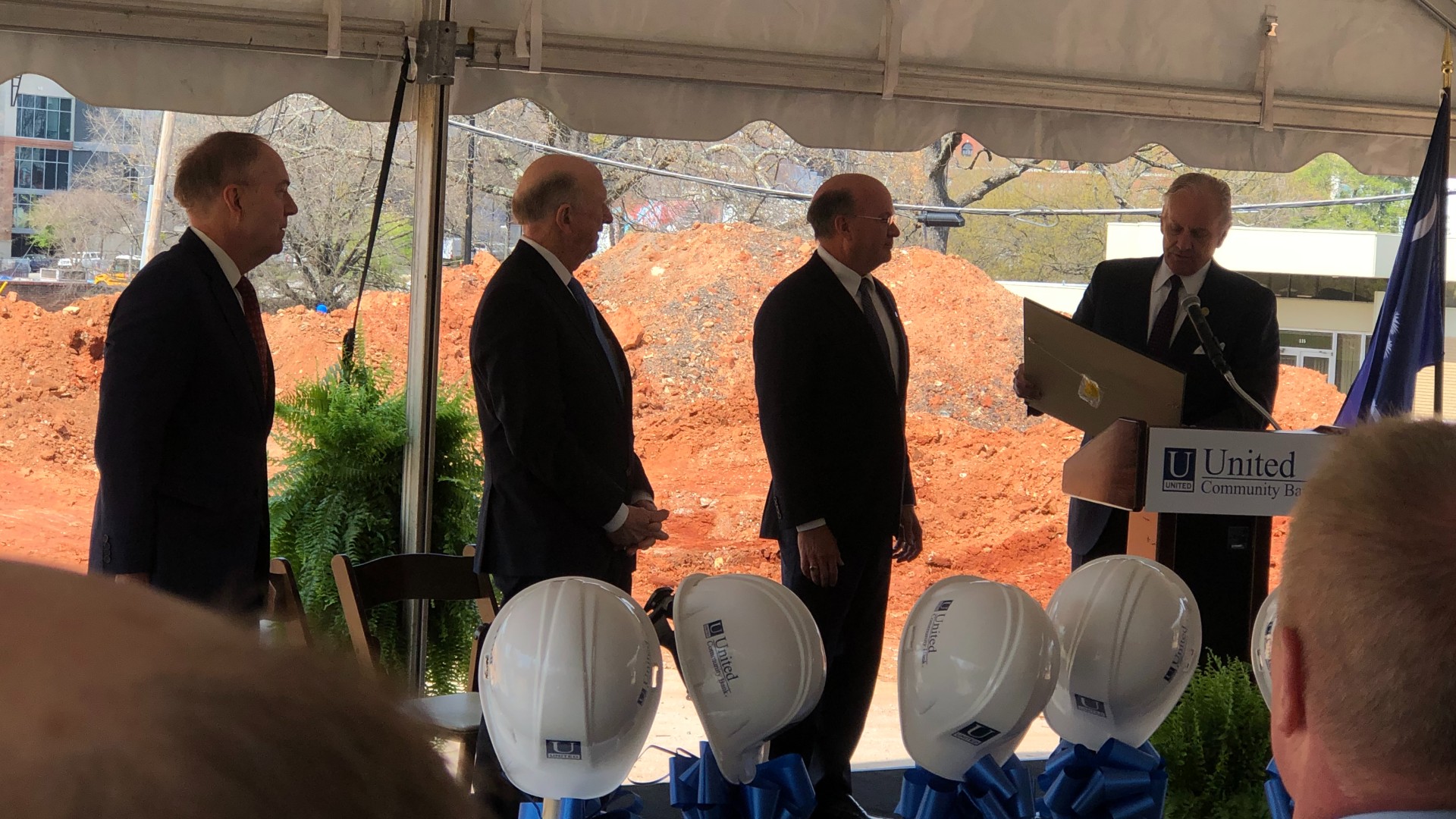
His account of the building’s purpose began with employees. He wanted somewhere people would want to work, with light, shared space and opportunities to be together. The architects’ plans included collaboration areas, outdoor access and public event space. A headquarters can be an expensive business card; this one also had to accommodate a working day.
There is a modestly comic imbalance in corporate architecture. The outside gets photographed. The inside gets used. For the people arriving every morning, the distance to a colleague may matter more than the view from the street. Harton’s emphasis on the employee experience brings the discussion back to that everyday scale.
The hometown extends beyond the office
The Greenville connection has included the arts. By 2018, Harton had served as Peace Center board chair and as president of the Greenville County Museum Association board. Those roles give his attachment to the city a setting beyond a corporate address. The theater where he reconsidered leaving was also an institution to which he gave time.
At United Community, the foundation became another way of connecting employees with places they knew. Established in 2020, it allows employees to put forward grant requests for organizations they support. Its 2025 impact report described 690 partner organizations and almost $2.7 million invested since the foundation’s launch.
The model makes use of knowledge already inside the business. A member of staff may understand a local organization’s work through years of participation. A grant process gives that connection somewhere to go. It also makes community involvement a responsibility distributed across a company, rather than an activity confined to the chief executive’s calendar.
Harton’s recognition has followed several routes: the South Carolina Business Hall of Fame in 2024, then the Greenville Chamber’s Buck Mickel Leadership Award in February 2026. The latter gave him a reason to revisit the borrower whose approach to difficult news had stayed with him since his early credit career.
A season of buying and selling
His current chapter includes decisions that make a simple growth story less simple. United completed its Peach State acquisition in August 2026, deepening its presence in Hall County, Georgia. In September, it sold the Navitas equipment finance business to funds managed by Wafra for approximately $2 billion in cash.
These moves point toward a stated concentration on Southeastern relationship banking. The Peach State transaction added a local franchise. The Navitas sale released capital and liquidity while removing a business. Expansion and subtraction can serve the same strategy, though each has to justify its own economics.
The operating measure adjusts for specified items. It is a non-GAAP measure and does not replace the reported loss.
The October 20 results made the cost of change visible. United reported a third-quarter GAAP net loss of $139.7 million alongside operating net income of $93.7 million. The quarter included a securities portfolio restructuring as well as the acquisition and sale. Harton described the changes as preparation for stronger future performance.
That remains a proposition to be tested by subsequent results. The operating figure helps explain the underlying business; the reported loss records what happened in the quarter. Both belong in an account of the decisions. A chairman’s conviction is useful. The numbers retain their right to reply.
Elephant thoughts, feet on the ground
Among Harton’s more personal explanations of his outlook is advice from his father, Herb: “Think elephant thoughts.” In reflecting on the phrase, he has emphasized doing the present job well, gratitude and concentrating on what can be controlled. His own expression for attention to current responsibilities is “Own your corral.”
It is an earthy vocabulary for someone whose work includes capital allocation and board committees. Perhaps that is its usefulness. A phrase short enough to remember can interrupt the temptation to spend today rehearsing for the next title.
The early moves remain part of his story. So do the crisis years, the succession and the transactions still being judged. But Greenville gave the career a different organizing principle. Harton could choose a place, learn it more deeply and continue working on what came next. For a banker accustomed to assessing the value of an asset over time, staying put has supplied an unusually personal case study.