The first customer arrived by proxy. On April 15, 1818, Rebecca Sutton, a widow, had her late husband’s attorney deposit $100 at the Salem institution that became Eastern Bank. Two centuries later, the amount seems quaint. The arrangement is more revealing. A bank account was possible; handling the transaction herself was another matter. Access could mean being allowed through one door while somebody else still held the key.
- Remove the friction: Eastern’s lending experiments grew from watching customers use alternative lenders.
- Pay for scale: a 2020 IPO raised $1.79 billion before expenses, opening a new chapter of acquisitions.
- Make access practical: its foundation committed $4 million to help first-time homebuyers in three Massachusetts cities.
That small distinction between offering a service and making it usable runs through Eastern’s history. Today, it is a regional bank with personal accounts, business loans and wealth management. But the interesting question is how an institution built around local relationships pays for the machinery those relationships now require.
The clue was leaving the account
By 2013, Eastern had noticed something awkward. Good small-business customers were making payments to alternative lenders, including OnDeck and LendingClub. They already had a bank. They were finding credit elsewhere. Historical reporting on the episode describes the pattern as a wake-up call: the relationship alone had not made Eastern the obvious place to borrow.
Consider what this tells a banker. A customer can like your institution and still dislike your process. The failure begins before the account closes, in the work customers quietly route around you. Eastern’s response was to develop lending technology inside Eastern Labs, using access to real banking data and customers to shape the product.
The express-loan technology launched in 2015. In 2017, the team spun out as Numerated, which could sell its platform to other banks. Contemporary reporting put Eastern’s spending on Labs at about $4 million in the preceding year. That is a useful corrective to the romance of an innovation lab: somebody funds the engineers before there is a business to spin out.
“Everyone has to come together.”Ashley Nagle Eknaian, discussing bank innovation with Independent Banker
Eknaian’s explanation included legal, risk, compliance and information security. The transferable lesson is quite practical: find the customer’s detour, then bring the people who can approve and operate a replacement into the experiment. Faster software without workable credit controls simply moves the problem downstream. A useful experiment needs an operating plan as well as a prototype.
The price of staying in the game
Technology created a larger dilemma. Eastern’s mutual ownership had been part of its identity for two centuries. Yet management argued that keeping pace with increasingly capable phones and digital competitors required more investment. Growth required resources. In October 2020, the parent company completed its public offering and mutual-to-stock conversion.
The offering brought in roughly $1.79 billion gross and $1.76 billion after expenses. Eastern also donated nearly 7.5 million shares to its charitable foundation. Public ownership supplied capital and brought shareholders into the conversation. The tradeoff was real: a bank that prized mutuality had decided it needed another way to finance its future.
Scale, however, does not repeal banking arithmetic. In early 2023, Eastern sold approximately $1.9 billion of securities, recording a $280 million after-tax loss. A bank letter published by the Town of Longmeadow described the liquidity benefits and the resulting reduction in an outside financial rating. A decision can improve flexibility while leaving an ugly number on the income statement.
Then came more consolidation. Cambridge Bancorp joined in July 2024, adding banking and wealth expertise; the combined wealth business retained the Cambridge Trust name. HarborOne followed in November 2025. Eastern’s annual report put that transaction’s value at approximately $550 million at completion. Neither purchase price should be confused with a guaranteed return.
A regional bank with several front doors
For customers, the resulting company has several uses. A household can hold deposits and seek a mortgage. A business can arrange working capital, SBA financing or treasury services. Larger borrowers can use commercial real estate, asset-based or franchise lending. Cambridge Trust adds investment management, trusts and private banking.
The business model is familiar: earn interest on loans and investments, pay for deposits and other funding, and collect service and advisory fees. Eastern competes with national banks, regional lenders, credit unions and digital specialists. Its proposition rests on combining regional relationships with a broader set of capabilities. Whether that helps depends on the product, its terms and the customer’s circumstances.
There is also an unglamorous side to combining institutions. Eastern’s migration FAQs tell former HarborOne customers that external transfer accounts must be set up again and the old mobile app replaced. For a bank, integration is a systems project. For a customer, it can be a Saturday spent rebuilding familiar routines. Those details help determine whether the promised convenience survives the merger.
What $4 million can unlock
The foundation supplies a different kind of financial tool. In November 2024, Eastern and its foundation joined Massachusetts Housing Partnership and the Boston Foundation in launching ONE+. The program began with more than $11 million in combined public and private support. Eastern Bank Foundation’s $4 million contribution specifically supported first-time homebuyers in Lynn, Lawrence and Lowell.
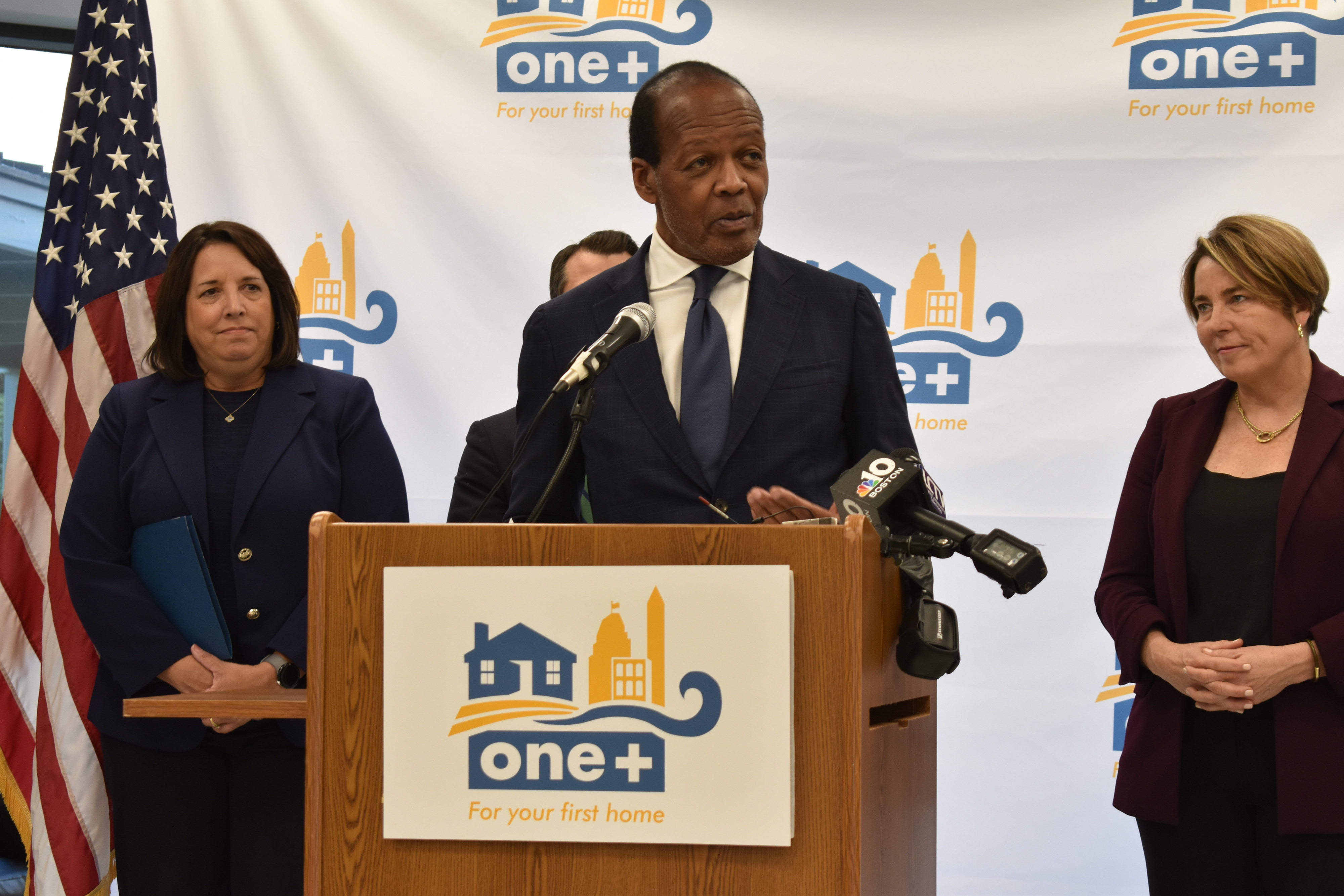
ONE+ paired discounted fixed 30-year mortgage rates with up to $50,000 in down-payment and closing-cost assistance and no private mortgage insurance. The design recognizes that an affordable monthly payment does little for a buyer who cannot assemble the cash to close. It attacks more than one obstacle in the same transaction.
It also has boundaries: designated communities, income and asset limits, credit criteria and homebuyer education. Philanthropic money cannot make every applicant eligible or put an affordable house on every block. Eastern’s broader growth strategy faces its own conditions: acquisitions need integration, loans need repayment, and deposits have a cost.
Rebecca Sutton’s $100 makes a tidy origin story. The more demanding question is what happens after someone is welcomed in. Eastern’s useful idea is to examine the next obstruction: the application, the down payment, the missing service. Getting bigger earns its keep when it helps a customer get past one of those.