Shortly before midnight on July 12, 2024, shares in Cambridge Bancorp became shares in Eastern. For Denis Sheahan, the transaction also meant a new job. After nine years leading Cambridge Trust, he became chief executive of the larger bank. The arithmetic had a precise exchange ratio: 4.956 Eastern shares for every Cambridge share. The human calculation was harder. Two institutions, their customers and their ways of doing business had to become a working whole.
Over that same weekend, Cambridge Trust’s banking products and services moved onto Eastern’s systems. It is an unusually practical setting for a chief executive’s arrival. A merger announcement can be polished until it gleams; a banking conversion has to function on Monday. Somewhere between those two activities lies much of Sheahan’s professional life.
His career has passed through accounting, finance, operations and the chief executive’s office. Its geography is more compact than its responsibilities: Cork for his accounting education, Boston for his MBA, then a succession of Massachusetts banking institutions. The interesting question is how that long apprenticeship travels into a bank with more customers, more branches and more obligations to explain itself.
The education behind the title
Sheahan is an accounting graduate of Cork Institute of Technology, now part of Munster Technological University. He later earned an MBA at Boston University. Before Rockland Trust, he worked at BayBanks, where his roles included vice president of finance. He joined Independent Bank Corp. and Rockland Trust in 1996, beginning a nineteen-year stretch that would give him both financial and operating responsibilities.
By 2000, he was chief financial officer. In September 2013, he became chief operating officer. The second appointment widened a job that already covered residential mortgages, compliance and risk, municipal services, information technology, loan operations and facilities. The finance and marketing chiefs would report to him, too. It was a portfolio with enough moving parts to discourage anyone seeking a purely ceremonial promotion.
Christopher Oddleifson, then chief executive of Rockland Trust and Independent Bank Corp., described him as “disciplined and talented.” The assignment made those qualities useful in specific ways: improving the quality and cost of service, and helping business units deepen customer relationships. In that job description, the customer promise and the operating budget occupied the same sentence.
- 1996Rockland Trust
- 2000Finance chief
- 2013Operations chief
- 2015Cambridge CEO
- 2024Eastern CEO
A shareholder wanted a word
In February 2015, Sheahan accepted the offer to lead Cambridge Trust. He would stay at Rockland through the transition before taking up his new responsibilities in April. Cambridge gave him the combined roles of chairman, president and chief executive. After years helping run an institution, he would now be the person expected to answer for it.
An early test came in June, when he appeared with Albert Rietheimer at a Cambridge Retirement Board meeting. The retirement system held between six and seven percent of Cambridge Bancorp’s shares, making it the third-largest shareholder. The board chair said bank management had not met with the system in more than five years. He wanted more contact and believed the size of the investment warranted a board seat.
Sheahan said he intended to make shareholder engagement a priority. The exchange is useful because it strips the phrase “relationship banking” of its advertising gloss. Here was a relationship with an actual complaint attached. Access mattered to an owner, just as it might matter to a borrower. A new chief executive had been handed a straightforward request: show up more often.
The bank he described that day had twelve Massachusetts branches, four wealth management offices and $1.1 billion in outstanding loans. Its wealth management business oversaw $2.3 billion. Asked about competition from index funds, he said he believed clients wanted full-service investment relationships and saw further room for growth. Wealth management was already central to his account of Cambridge’s future.
The city beyond the balance sheet
Cambridge also brought responsibilities outside the bank. Sheahan became involved with the Cambridge Community Foundation as a trustee and member of its board of overseers. The work included reviewing the foundation’s grantmaking and civic initiatives. Financial oversight had a different destination here: the resources available to organizations serving the city.
A $50,000 gift from Cambridge Trust featured in the foundation’s 2015-16 account of that partnership. The institutional relationship stretched back to 1951, when the bank’s role in overseeing the endowment began. Sheahan supported a broader civic role for the foundation, with collaboration and convening alongside the allocation of money. His own involvement sat within a connection much older than his tenure.
“The Foundation plays an important role in the life of the city”
Denis Sheahan · Cambridge Community Foundation, 2015-16
His current commitments include the Cambridge Community Foundation, the Rian Immigrant Center’s advisory board and the Cambridge Family YMCA, where he is a board member and treasurer. Earlier service included the Massachusetts Housing Partnership and the Old Colony YMCA. These appointments give his civic work a concrete shape: boards, budgets and oversight, rather than an abstract interest in community.
In 2022, he was elected to the Massachusetts Bankers Association’s board. At the time, Cambridge Trust had approximately $5 billion in assets, nineteen locations in Massachusetts and New Hampshire, and $4.7 billion in client assets under management and administration. He framed the appointment around contributing Cambridge’s private banking and wealth management expertise to the association’s work for consumers and businesses.
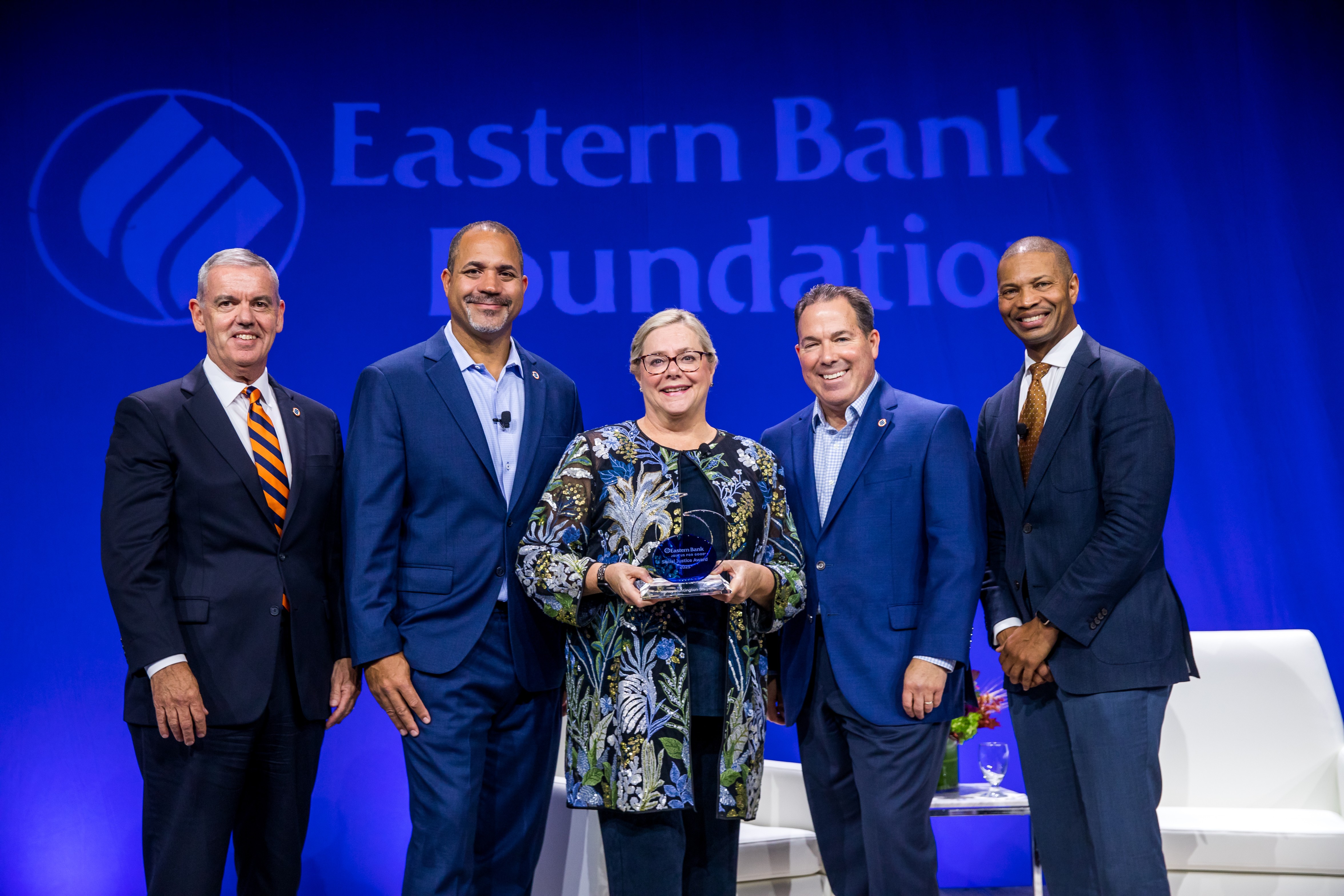
At Eastern’s October 2025 Celebration of Social Justice, he appeared alongside Miller, Rivers and foundation leader Turahn Dorsey to honor Nancy Huntington Stager. More than 1,200 business, philanthropic and community leaders attended. The event recognized Stager’s work expanding the foundation’s approach to include impact investing alongside grants. Its stated priorities included affordable housing, workforce development, early childhood development and the small business ecosystem.
For Sheahan, that gathering placed the bank’s leadership in the same room as the organizations around it. His own foundation and YMCA appointments belong to this wider network of civic institutions. They are part of the context in which Eastern uses the word local, even as its branch network stretches beyond Massachusetts.
Three leaders, one larger institution
When Eastern and Cambridge announced their combination in September 2023, the succession was part of the arrangement. Sheahan would become CEO. Eastern’s Bob Rivers would become executive chair and remain principal executive officer. Quincy Miller would add chief operating officer to his leadership responsibilities. Sheahan and Miller would report directly to Rivers.
That structure deserves attention because the chief executive’s title alone does not explain the organization. Sheahan entered an established leadership group, with Rivers continuing above him and Miller carrying substantial operating responsibilities. The deal also brought Cambridge directors onto Eastern’s boards. Combining the banks involved sharing authority as well as combining accounts.
After the July 2024 close, Cambridge Trust’s name continued in wealth management, and later in Eastern’s private banking division. The banking conversion happened first; the wealth management conversion followed a separate timetable. The arrangement preserved a recognizable name in businesses where clients often build relationships over many years. For Sheahan, the Cambridge chapter continued inside the new institution.
The following year brought another transaction. Eastern agreed to acquire HarborOne, and Sheahan described opportunities to offer its customers a wider range of banking and wealth services. The acquisition became effective November 1, 2025. The practical challenge now extended across another set of customers and colleagues: making the combined bank deliver the services used to explain the combination.
After the acquisitions, a different assignment
By January 2026, the emphasis had shifted. Eastern had faced criticism from activist investor HoldCo, and its leaders were repeatedly discussing organic growth and capital returns. “Simply put, we are not focused on M&A,” Sheahan said on the fourth-quarter earnings call. His stated priorities were growing earnings through the existing businesses and returning excess capital while maintaining appropriate capital levels.
For someone who had reached Eastern’s chief executive office through a merger, it was a consequential change in the conversation. The institution already assembled would have to produce more from its lending, deposits and wealth relationships. Another transaction would not be the answer offered for every question about growth.
In July, Sheahan described a closer partnership between the wealth and banking businesses and new opportunities arising from it. He also discussed competitive deposit markets and the need to balance growth with margin performance. These are the ordinary tensions of running a bank: attract money without paying away the benefit, extend credit, and make the various teams useful to the same customer.
Quarter ended September 30, 2026. Results announced October 22. These are Eastern’s figures, not personal financial measures.
The October 22 results supplied a fresh checkpoint. Eastern reported $111 million in third-quarter net income and $31.7 billion in assets at September’s end. Wealth assets under management reached $10.8 billion. The company returned $89.1 million to shareholders through dividends and repurchases. Sheahan also acknowledged slower-than-expected commercial loan closings as some clients approached investment decisions cautiously amid interest-rate uncertainty.
Those results leave him with a familiar kind of work. The former finance chief has figures to explain. The former operations chief has an institution to make function. The Cambridge leader who promised shareholders more engagement has constituencies expecting his attention. The scale has changed; the requests remain recognizable. A customer needs an answer, a colleague needs a decision, an owner wants a conversation. A local bank earns the adjective through what happens next.