A Rubbermaid shed is an admirably modest place to put a technology company. It makes few architectural demands. It offers little temptation to confuse the office with the achievement. Aaron Cowden started Fusion Audio + Video in one in his backyard, a detail he still includes when describing a business that has grown to more than fifty employees. There is something useful about keeping the shed in the story. Whatever equipment comes next, the starting point remains pleasantly difficult to dress up.
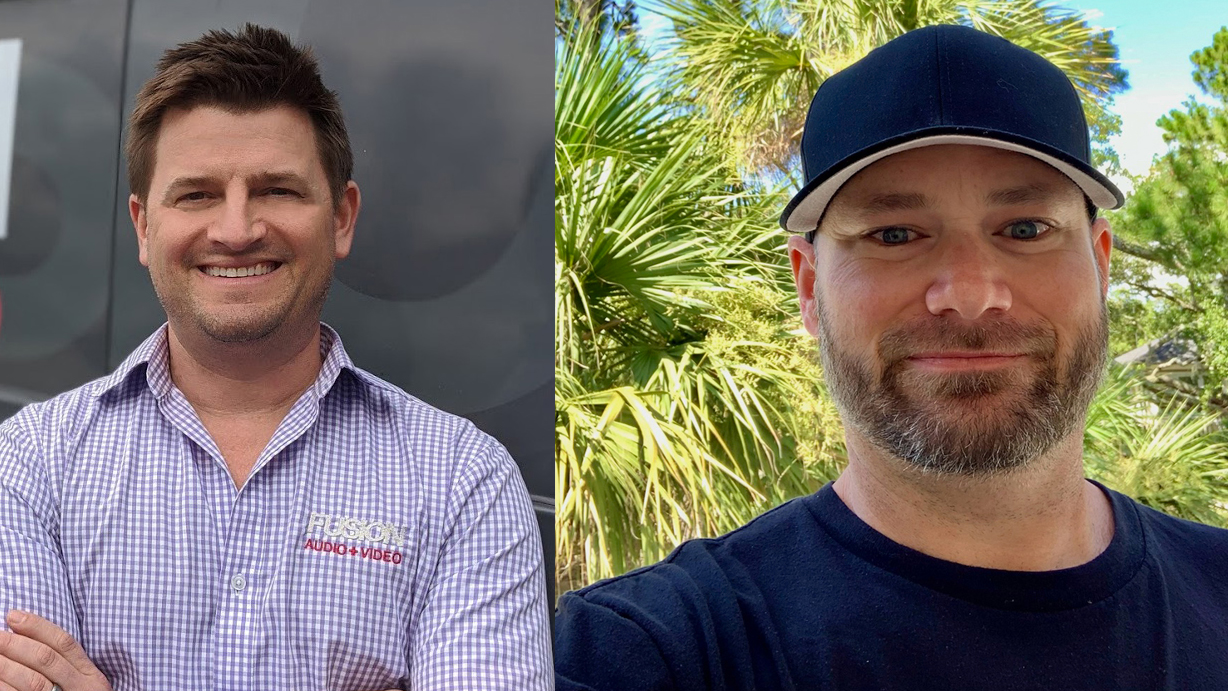
Cowden is Fusion’s co-founder and CEO, based in Greenville, South Carolina. His working territory extends into the homes and businesses where technology meets people who would quite reasonably prefer to get on with their day. A roomful of equipment can be impressive. A room that works without demanding a small seminar from its occupants has a different appeal. His career sits in the space between those two experiences.
The customer changed the assignment
His route into audio and video began with computers. After high school, encouraged by his father, a self-taught programmer, Cowden pursued Microsoft systems-engineering certification. He worked for an IT firm in Spartanburg while attending college. Business clients began asking for help with their home computers and networks. Their domestic technology was becoming a job of its own.
He started the company with friends during his senior year. An early home-wiring customer asked whether they could also handle an audio-video proposal. The young business followed the request, going to an industry expo in Orlando for training. Cowden’s account includes a welcome bit of self-mockery about how quickly they considered themselves experts. The shed eventually gave way to warehouse space.
There is a practical lesson in that beginning: customers do not always divide their problems according to a supplier’s business plan. The network, the music, the screen and the controls all occupy the same house. Someone has to think about how they meet. The opportunity was sitting in the connections.
Somebody has to label the box
By 2019, Fusion had reached more than $6.5 million in revenue and 38 employees. In a sponsored account of its adoption of iPoint business software, Cowden described mapping roughly 400 to 500 process steps. Those are historical figures, but they mark a revealing stage in his development as an operator. Growth had given the business more things to remember than memory could sensibly manage.
He examined the journey from a prospective customer to a proposal, an order and a payment, along with purchasing and inventory. He took responsibility for championing the implementation himself. Proposal turnaround improved from weeks to days. One commercial project, with a tight deadline, could proceed after payment arrived in ten minutes. Paperwork had acquired the power to decide whether work happened at all.
“You have to create the roadmaps for your company”
Aaron Cowden, discussing business processes in 2020
The amusing detail is also the serious one: a box needs a label, and somebody needs to know whose job that is. A business can spend a great deal on sophisticated equipment while leaving this question to chance. Cowden’s attention had moved toward the handoffs. A customer experiences the result of those handoffs even if nobody ever shows them the diagram.
- 01Discovery
- 02Design
- 03Installation
- 04Support
A showroom is also a promise
Fusion’s Greenville showroom appeared in a 2025 industry showcase with 17,000 square feet listed for the location. The equipment roster ranged from audio and home cinema to lighting, controls and golf simulation. It is a considerable distance from a plastic shed. For a visitor, though, the interesting question is more immediate: what would any of this feel like in my own rooms?
A demonstration gives that question somewhere to go. Sound can be heard. Light can be adjusted. A control can be tried by the person who will eventually live with it. The appeal of a showroom is partly its permission to stop describing an experience and let someone have one. Specifications have their uses; they are less skilled at hosting an evening.
In describing Fusion there, Cowden put his emphasis on the people behind the installation and expressed the company’s mission in terms of team, clients and community. Read beside the equipment list, that emphasis gives the place a second purpose. A visitor is also choosing the people who will answer questions when the demonstration has become a system at home.
Learning where to ask for help
Lighting offered Cowden another education. He has openly described how Fusion initially underestimated the differences between selling fixtures and selling speakers or televisions. The details mattered throughout design, quotation and delivery. The business responded by partnering with a professional lighting-design firm to help with designs and fixture specifications.
That is an unusually useful admission from a founder. Expanding a company’s offering can sound effortless in a brochure. Cowden’s explanation included the possibility of a poor customer experience and lost profit when the complexity is underestimated. Bringing in a specialist was a concrete response to both problems.
There is a particular kind of confidence in allowing another professional to improve the work. The client receives the combined result. They have little reason to applaud a supplier for having attempted every discipline alone. A founder’s willingness to describe a learning curve may tell a prospective customer more than a list of disciplines that the company now sells.
A seat at someone else’s table
In May 2019, Cowden joined the board of ProSource, the industry buying group, alongside Admit One Home Systems founder Lance Anderson. At the time, Cowden credited more than a decade of knowledge sharing and strategic planning through the organization with helping Fusion develop. The appointment made his participation in that exchange more formal.
ProSource now lists him as vice chairman of its board. It is a role outside his own company, among other owners and operators with their own customers, constraints and opinions. For a founder, that is a useful kind of room to enter. Someone else has probably already met a version of the problem that seems uniquely irritating on a Tuesday afternoon.
Fusion also received ProSource’s Southeast Member of the Year recognition for 2020. The regional manager’s assessment singled out its combination of custom AV, commercial work and managed IT, along with staff development and community involvement. The award photograph puts Cowden beside fellow owner Daniel Adair. It is a fitting visual for a business whose origin involved friends and whose development has involved a wider circle of colleagues.
That circle also appears in training. At the 2025 ProSource Summit, Cowden joined Jim Pearse, Brett Bjorkquist and Lightworks CEO Troy Dunnington in a discussion of training programs, accountability, retention and employee satisfaction. The subject is less photogenic than a finished theater. It is rather more relevant to who will build the next one.
The house has a past, too
By October 2025, Cowden was discussing a different handoff: what happens when someone buys a luxury home with technology already installed. His conversation with Travis Leo on The Intelligent Estate addressed evaluating the system, maintenance, equipment lifespan, documentation and choosing a provider. It also covered technology offered as a service.
This is a rich subject for someone whose early customers wanted help with their home networks. The house changes hands; the technology carries on being particular. An attractive room tells a buyer relatively little about the age of its equipment or the records needed to maintain it. The paperwork deserves a place in the conversation before an unfamiliar control panel starts making demands.
Cowden’s emphasis on documentation connects the homeowner’s problem to the operator’s problem. Someone has to know what is there, how it fits together and what attention it will need. These are ordinary questions, which is precisely why they can be overlooked when the purchase itself feels extraordinary.
Keeping the next person in mind
Fusion’s published workflow now moves through discovery, design, installation and support. It starts with the client’s routines and plans, includes coordination with builders and designers, and continues into programming, testing and service. Its support offering includes an in-house team and service plans. A completed installation is followed by another stage of the relationship.
The discovery stage can include a site visit and a review of floor plans. Design turns the conversation into decisions about wiring, equipment placement and controls, coordinated with the other professionals shaping the space. Installation includes calibration as well as fitting the equipment. The sequence gives each discipline a place in the job. For a client, that means there is an opportunity to discuss how a room will be used before its technical decisions become harder to change. For the team, it makes the next responsibility visible.
In August 2026, Cowden’s comments accompanying the D-Tools and Portal.io merger returned to the tools behind that work. He said Fusion used Portal.io for proposal speed and quality and welcomed the prospect of combining its strengths with D-Tools. His interest was practical: how software could serve the business doing the installing.
The thread through these episodes is an attention to what happens next. After the sales conversation comes the proposal. After the fixture choice comes the specification. After installation comes service. Cowden’s career has involved learning to make those transitions somebody’s explicit responsibility. The shed makes a good beginning. Keeping a company useful requires quite a few more steps.
Continue the conversation
- Aaron Cowden on LinkedIn
- Meet the Fusion team
- Cowden on documenting 400–500 process steps (sponsored)
- Cowden on entering lighting design
- The 2019 ProSource board appointment
- The current ProSource board
- Fusion’s 2020 regional recognition
- Inside the Greenville showroom
- The 2025 ProSource training discussion
- Listen: evaluating technology in an existing home
- Automation Unplugged: Cowden and Andrew Wactor
- Fusion’s project process
- Fusion’s service and support
- Cowden on the D-Tools and Portal.io merger