A founder can have a product, a pitch deck and a very long contact list, yet still have nobody to call about the decision keeping them awake. Hiring the first salesperson. Disagreeing with a co-founder. Working out whether the customer likes the idea enough to pay. In Greenville, South Carolina, NextGEN has made those conversations part of its job.
The organization offers a practical proposition: bring the business problem, and it will help find the people who understand it. Its services range from brief office hours to recurring mentor-team meetings, with workshops and investor introductions in between. The emphasis is on high-growth businesses and the people learning to run them. There is room here for both a software founder and someone trying to sell a better consumer product.
That makes NextGEN an unusual company to profile. It is a nonprofit whose intended payoff occurs in other businesses: better decisions, stronger companies and, eventually, local employment. Its work is easiest to understand at the level of an individual founder. A useful conversation today might prevent an expensive detour tomorrow.
Eight companies, missing introductions
NEXT began in 2006 as a Greenville Chamber initiative founded by John Moore. The city’s economic-development question was straightforward: how could a region experienced at attracting established businesses become better at helping homegrown ventures?
In a 2014 account, journalist James Fallows described Moore recalling eight software companies in the original program that had not known one another. By the visit, the network had reached 134 companies across several industries, while its main building accommodated only about two dozen. Physical space gave the effort an address. Relationships allowed it to reach beyond the building.
The early obstacle, in that telling, was disconnection. The entrepreneurs existed; the shared network needed building. Moore also remembered uncertainty during the hard economic years. By 2014, he was seeing businesses arrive without recruiting. That offered him a reason to believe the effort was becoming useful on its own terms.
The name changed from NEXT Upstate to NextGEN in 2024, emphasizing the Greenville Entrepreneur Network. The new identity put the surrounding community into the name. In 2025, the organization became an independent nonprofit. Today, executive director Eric Weissmann leads an operation whose ambitions depend heavily on people outside its staff.
A free team for the awkward questions
The Venture Mentoring Service, or VMS, is the clearest expression of that approach. NextGEN participated in MIT’s mentoring immersion program in 2014 and launched its local service the following year. MIT documents subsequent training visits, including one in 2025. This is a borrowed method with a local roster.
Founders of scalable, high-growth Upstate businesses meet in person with volunteer mentor teams once a month. The official program description puts the price at zero. It also stresses trust and advice without conflicts of interest. Topics include hiring, fundraising, co-founder issues, customer discovery and changes in business direction.
The team structure matters. One adviser brings one career’s worth of experience, including its blind spots. Several can question each other’s assumptions. A recurring meeting also gives the founder a reason to return with evidence: what happened after the last conversation, what changed and what remains difficult.
“I don’t feel like I’m on an island.”
Logan LaMance, co-founder of Kanga Coolers, describing NextGEN VMS in MIT’s case history
That remark captures a benefit that does not fit neatly into an investment spreadsheet. The service gives a founder somewhere to admit uncertainty. MIT’s case history reports that 27 participating ventures generated $32 million in revenue in 2023. Those are the companies’ results; they do not establish how much of the performance mentoring caused.
NextGEN’s testimonials also include Designli, Boyd Cycling and Netalytics. Their businesses differ, but their accounts circle similar needs: someone experienced enough to recognize the problem and trusted enough to hear the unpolished version.
The classroom gets smaller
NextGEN’s program menu has evolved beyond the cohort accelerator it piloted in 2023. Growth Labs offer deeper work on a particular challenge. The services page describes groups of four to six founders working with a subject-matter expert across six to eight weeks. That changes the arithmetic of attention: fewer people competing to get their actual business discussed.
The 2025 impact report records a further redesign into milestone-based mini-accelerators. Four cohorts served 36 founders, covering customer discovery, pitching, fundraising and the founder-to-CEO transition. The practical idea is to organize learning around the next piece of work a founder needs to finish.
The broader Growth Labs curriculum shows where NextGEN thinks founders get stuck. Customer discovery asks who the buyer really is and what problem deserves solving. Sales focuses on prospects and closing business. Founder to CEO addresses the shift from doing the work personally to hiring, managing and making strategic decisions.
Readers can copy the structure without copying the program: identify one unresolved question, bring it to a small group with relevant experience, and leave with work that can be checked at the next meeting. The useful unit is a decision with a deadline. A full notebook is a poor substitute.
When the pitch needs another pair of eyes
Fix My Pitch, introduced for 2026, addresses a different bottleneck. A founder may understand the product intimately and still struggle to explain why anybody should care. NextGEN brings marketers, designers, storytellers and investors into the revision process, combining small-group pitching labs with workshops and feedback.
The program targets established, early-stage ventures with high-growth potential across industries. Selected winners receive a grant-funded creative package, and the published plan has them presenting refined pitches at the 2026 Venture Summit. South Carolina’s Department of Commerce included Fix My Pitch among its Relentless Challenge grant recipients.
The eligibility details are revealing. Applicants should be ready to iterate, collaborate and show up consistently in Greenville. A polished presentation is the intended output of repeated work. The practical lesson is to test whether an unfamiliar listener can explain the business back to you before spending more time decorating the slides.
There is a limit to that exercise. Clearer language can expose a weak proposition, but cannot create customer demand by itself. NextGEN’s separate customer-discovery and pitching offerings make sense together: first investigate the business claim, then learn to communicate it.
The introduction is only the beginning
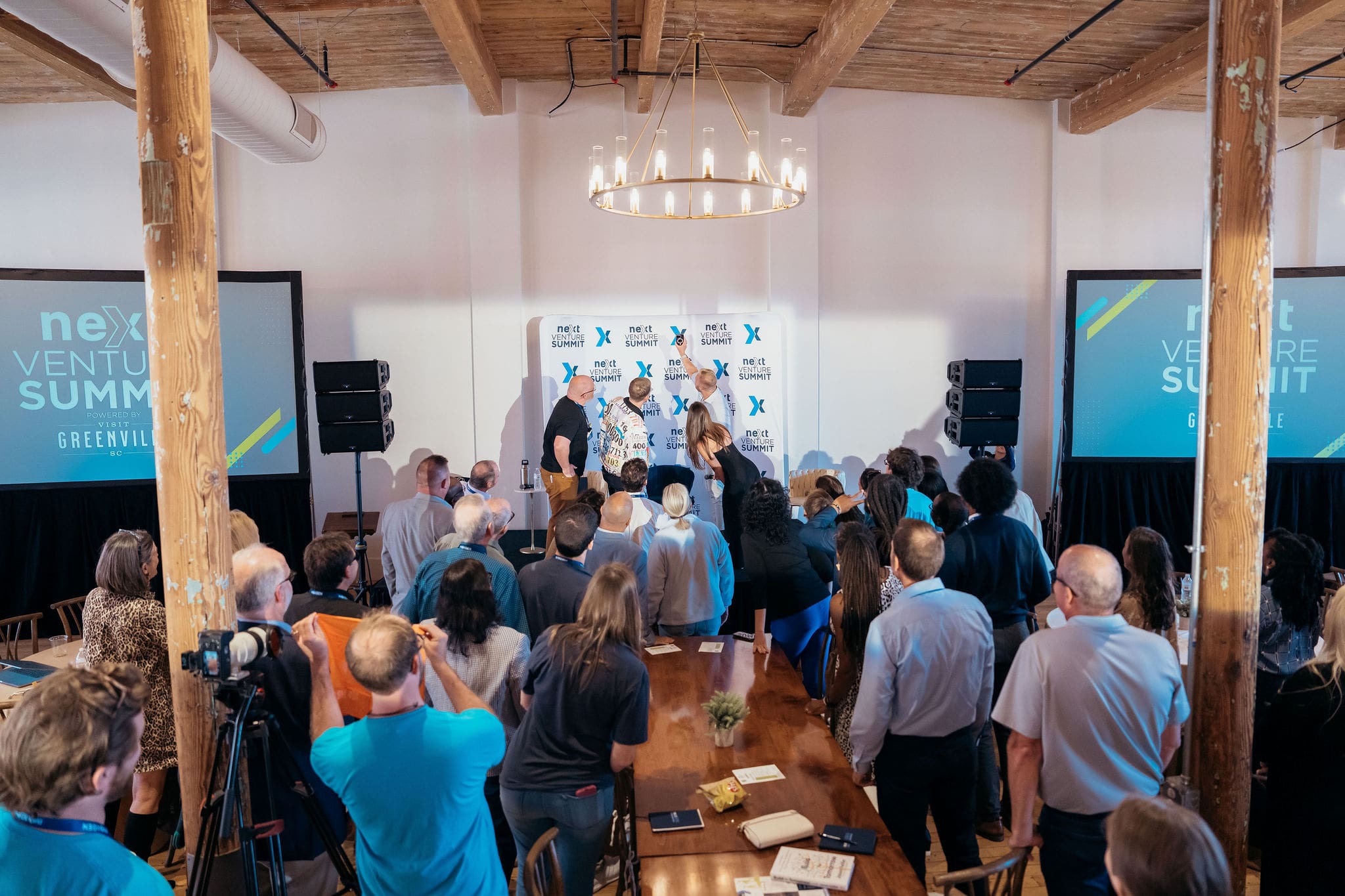
Next Venture Summit gathers founders, investors and operators. Its Match Day requires applications and pairs founders with investors for introductions and pitches. The eleventh Summit is scheduled for September 15 and 16, 2026, at Judson Mill, with Match Day on the first day.
The event page reports 175 curated meetings in 2024 and says participating companies subsequently raised more than $36 million. The wording matters. A meeting count measures introductions; a later fundraising total describes what companies went on to do. It does not turn every conversation into a completed investment.
Founders can use the distinction to prepare better. The goal of a first conversation should be clear enough to fit the time available: establish relevance, learn what the investor needs to see and earn a follow-up. NextGEN supplies an opportunity to meet. The founder still supplies the business and the follow-through.
Less formal events, including Startup Drinks, known as SUDs, offer another point of entry. Industry roundtables narrow the room by business type, giving peers a place to compare operating problems. The organization’s network has several entrances because a founder looking for advice may be months away from looking for capital.
Who pays for the useful conversation?
Free mentoring still requires an organization to arrange it. NextGEN’s support model includes individual gifts, organizational partnerships, program sponsorships and event sponsorships, alongside grants and ticketed events. Volunteers contribute the time and experience that make the mentor service possible.
Its 2025 VMS fundraising challenge brought in $20,600 with help from matching donors, mentors and board supporters. The same report records 470 mentoring hours. These are two different resources: money sustains the operation, while donated expertise is what the founder encounters in the room.
The partnerships extend outside Greenville. NextGEN and the Boyd Innovation Center, powered by GrowCo, collaborated on a South Carolina mentor network with state Commerce support. Its premise is practical: a founder’s useful next contact may live in another city, and manual introductions should not be the only way to find that person.
In the local market, founders also have choices such as Furman University’s GVL Starts. That program offers a nine-week venture-building experience for early-stage entrepreneurs. NextGEN’s combination of short consultations, focused labs and ongoing mentoring gives it a different shape. The offerings can serve different moments in the same company’s development.
Bring a problem worth discussing
NextGEN’s fit is strongest when a founder has something concrete to work on and is willing to hear an uncomfortable answer. Monthly meetings demand time. Small-group learning demands participation. A network is useful only if people are willing to ask clearly, listen carefully and return the favor when they can.
Someone seeking an immediate, guaranteed investment would be asking these services to do a different job. So would someone who cannot participate locally in programs built around in-person work. Choosing the right format matters as much as choosing the organization.
The portable lesson from Greenville is modest and demanding: find the people already building, make their expertise easier to reach, and keep the conversations going after the event. For a founder facing tomorrow’s difficult decision, a person who remembers last month’s problem may be the most useful contact in the phone.
Find your next conversation
Visit NextGEN · Explore programs · Browse events · Read the news
LinkedIn · Instagram · Facebook · Twitter/X
Watch: video from the Summit page ↗
Watch: video from the Match Day section ↗