Before Robin Liss tried to automate dinner, she tried to understand a camcorder. The instrument was her mother's VHS camera. The laboratory was childhood. Liss liked making stop-motion films, liked building web pages, and discovered the small astonishment that accompanies every young publisher: strangers were reading. At roughly 12, she had taught herself HTML. Soon the web pages became a camera and camcorder site, and the site became a vocation before she was old enough to call it one.
The origin story contains no garage mythology and no immaculate business plan. It has claymation, a buzzing BlackBerry, and a teenager taking consumer electronics more seriously than many adults paid to sell them. By her senior year at Tufts University, Liss was running camera-review publications from an office in Davis Square, employing a team, appearing on television as a gadget commentator, and finishing a political science degree. She also wanted classmates to know her simply as Robin, rather than as the student with the website. Even prodigies prefer a night off.
The critic with a color chart
What separated Liss's early publishing from ordinary gadget enthusiasm was method. In 2003, during her first year of college, she arranged to take more than 70 cameras from B&H Photo Video and record standardized images of a color chart. The exercise helped establish a tradition: products would be tested against repeatable measures, not merely admired under flattering showroom light. Her various category sites eventually gathered under Reviewed.com.
This was a useful kind of stubbornness. Consumer technology publishing has always been vulnerable to the seductions of access, novelty, and the review unit arriving in a very clean box. Liss wanted a laboratory. She wanted comparisons. She wanted the interests of readers to survive contact with the interests of manufacturers. In 2007, she put her motive plainly: “What drives me is creating something great and ethical.”
“What drives me is creating something great and ethical.”Robin Liss, on what success meant to her
Her instinct for pushing back had appeared earlier. A high-school newspaper story criticized the decision to clear snow around parking used by teachers and bus drivers while leaving the student area untreated. The dispute nearly brought a suspension. Liss later remembered it as a lesson in standing up to authority. Years later, the authority might be a famous electronics brand and the dispute might concern image quality, but the operating principle remained recognizable: look closely, measure what you can, and do not be intimidated by the label on the box.
Reviewed.com grew into a network of 12 product-review sites covering cameras, televisions, printers, headphones, and other categories. It reached about one million monthly readers by the time USA Today acquired the company in January 2011. Liss stayed on, leading the business inside Gannett until 2015. The teenage publisher had become an executive, and her makeshift tests had become a product-testing operation with dedicated facilities.
A second act with plumbing
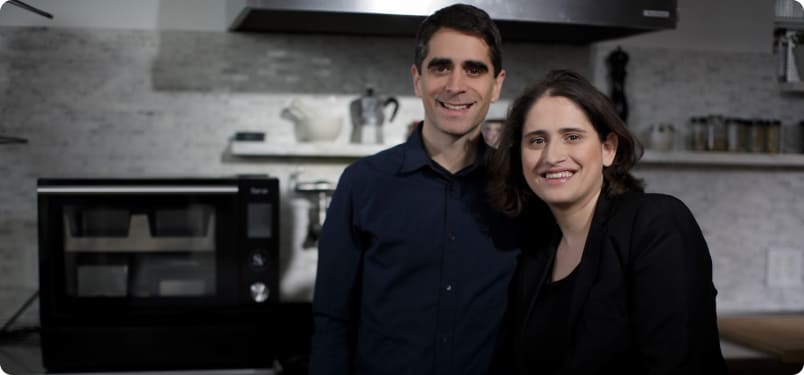
Leaving a company after nearly two decades invites the fantasy of a beach. Liss entertained it. Then sous vide cooking interrupted. She had become fascinated with the technique while at Reviewed.com and began asking how it might be extended. Together with Kevin Incorvia, an engineer who became Suvie's co-founder and CTO, she pursued a countertop appliance that could keep ingredients cold, apply different cooking methods, and bring separate parts of a meal to the finish line together.
It was a reviewer's revenge on the weeknight dinner. Protein, vegetables, starch, and sauce do not share a clock. Rice waits for no broccoli; broccoli forgives no conference call. A conventional oven offers one large heated cavity and leaves the choreography to the cook. The original Suvie divided the work into zones, using methods suited to each component and software to coordinate them. Later versions changed the configuration, but the central problem remained time: how can a machine absorb more of dinner's scheduling without reducing dinner to a snack?
Dinner is a synchronization problem
Different ingredients. Different processes. One promised serving time.
Naming the product a kitchen robot was partly descriptive and partly cheeky. Robotics usually arrives with visible arms, theatrical movement, and a soundtrack supplied by science fiction. Suvie's work is quieter: refrigeration, water, temperature control, algorithms, and the disciplined waiting required to have food ready when requested. Liss once joked that robot cars received more attention, even though she considered cooking an equally important category. Dinner lacks a test track, but it happens every day.
The distance between a review and a factory
A critic can demand elegance in a paragraph. A manufacturer has to negotiate it among thermal systems, safety standards, software, packaging, supply chains, cost, and the counter space available beside somebody's toaster. Liss's move from evaluating hardware to shipping it placed her on the expensive side of every opinion she had published. The old skill still mattered. Reviewed.com had trained her to begin with use rather than spectacle. But knowing what good looks like is only the invitation to discover why it is difficult.
During development of Suvie's first generation, engineers spent long periods in China. Liss moved there for roughly a year and a half. Her reasoning came from a leadership phrase she values: “Leaders eat last.” If the work required her team to be away from their families, she felt she should share that cost. There is nothing abstract about leadership when the meeting is at an unfamiliar hour, in an unfamiliar place, beside a machine that still refuses to behave.
Proximity is a management tool. When the hard part of a company moves to the factory floor, the founder's calendar should notice.
Liss is equally direct about product research. Her advice to people seeking success in appliances is two verbs, delivered in capital letters: “COOK! CLEAN!” Executives who do not perform household chores are studying their market through tinted glass. The sink is a research site. So is the cutting board after the third ingredient. A person trying to improve domestic work should occasionally experience the domestic work.
This is the bridge between Liss's two companies. Reviewed.com asked what products really did after the advertisement ended. Suvie asks what a product might do if dinner were designed around the user's actual evening. Both begin with attention. Both treat convenience as something that can be observed in minutes, motions, and dirty pans. The hardware company adds a severe condition: now Liss is responsible for the answer.
A career spent inside the product
Trust, transported
When travel became difficult in 2020, Liss bought a used 24-foot RV and took Suvie on the road. She nicknamed it Delta II, a nod to the airline status earned during her earlier, relentlessly airborne working life. The vehicle became office, transportation, and rolling conversation starter. Thursdays were for staying near reliable wireless service because that was when internal calls accumulated. Investor meetings happened outdoors along the route.
The stunt had an operator's logic. Liss believed business was built on trust and relationships, and that trust was difficult to establish entirely through a screen. A founder of a refrigerated cooking appliance was making an argument for physical presence. The RV made that presence possible, if not especially spacious. It also supplied an accurate portrait of hardware entrepreneurship: a polished idea traveling inside a cramped machine, dependent on signal strength, schedules, and the next practical place to stop.
Her emphasis on trust also appears in the way she discusses mentorship. Liss credits people from a grade-school theater technician to appliance-industry executives with widening her ambitions. An effective mentoring relationship, she says, requires complete honesty. After Reviewed.com joined USA Today, a difficult corporate moment exposed weaknesses to her boss, Susie Ellwood. Liss's willingness to examine those weaknesses deepened the relationship into a lasting mentorship. Candor became a form of professional infrastructure.
“For a great mentorship relationship you have to be 100% honest.”Robin Liss, on the condition that makes advice useful
The kitchen keeps score
In January 2026, Liss appeared at CES on panels about AI and robotics in the kitchen, disrupted trade, and the pressures surrounding American innovation. The subjects fit the company she chose to build. A connected appliance is software, manufacturing, food, regulation, and global logistics squeezed into countertop dimensions. The kitchen may look domestic, but the route to it runs through factories, freight, code, and policy.
Liss's path can be read as two businesses, but it is more revealing as one long argument. Products should respect the people using them. Evidence matters. The boring details are where promises either become useful or quietly collapse. At 12, that argument took the form of a web page about a camera. At Reviewed.com, it took the form of laboratories and comparison tools. At Suvie, it arrives as a meal whose components are supposed to be ready at the same time.
She has said she is doing her dream job: playing with kitchen gadgets, making food, and helping people reclaim time with their families. It is a pleasantly domestic ambition for a company assembled from thermodynamics and algorithms. Also a demanding one. A gadget can impress during a demonstration. Dinner returns tomorrow, carrying notes.