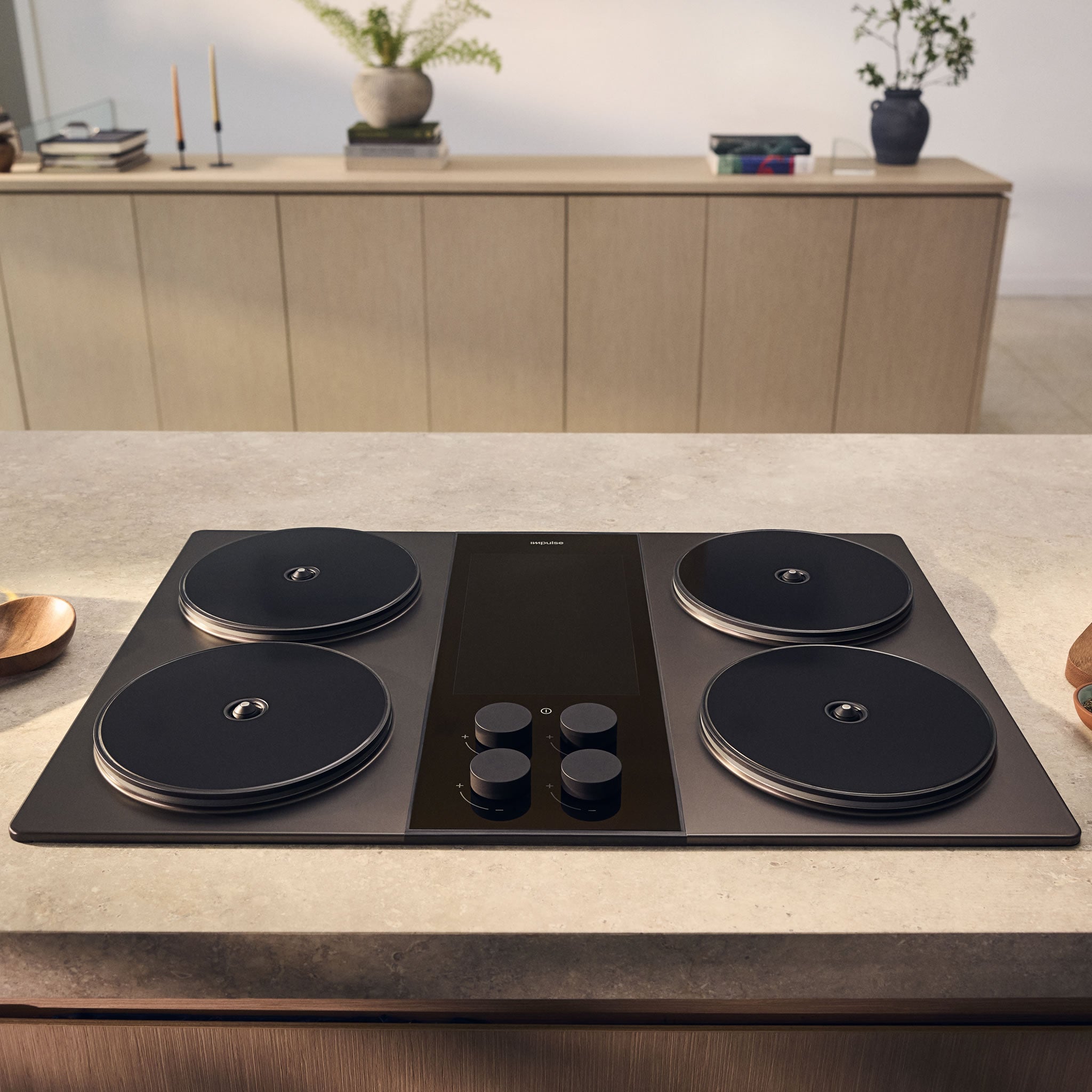
A stainless steel cooktop sits in a renovated kitchen on Minnesota Street in San Francisco. It looks expensive. It looks normal. Under the glass, a 3 kilowatt-hour battery is quietly waiting for the grid to misbehave. This is what climate tech looks like when it stops shouting and just starts cooking dinner.
Who they are, right now
The kitchen appliance pretending to be infrastructure
Impulse Labs ships one product. It is a $6,999 induction cooktop. That is, until you look at the back of it - or rather, you don't, because there is no special back. It plugs into a 120-volt wall outlet, the same one your toaster uses, and most owners install it themselves. The trick is the battery underneath, a 3 kWh slab of lithium iron phosphate cells that lets the four burners pull 10,000 watts apiece without rewiring your house, your panel, or your relationship with your electrician.
It boils a liter of water in under 40 seconds. About five times faster than a high-end gas range, and three times faster than competing induction cooktops. The numbers are the entire point. So is the way the company has chosen to deliver them.
The problem they saw
A grid that flinches, and a kitchen that doesn't know it
Roughly 38 million U.S. homes still cook with natural gas. Most of them sit on circuit panels that were designed when "high-power appliance" meant a hair dryer. Telling those homeowners to electrify usually means a $4,000 panel upgrade, a contractor, a city inspection, and the kind of weekend nobody wants. The result: the climate-friendly induction stove is the appliance everyone agrees is great and almost nobody installs.
Meanwhile the grid itself is having a midlife crisis. Peak demand is climbing. Outages are creeping. Utilities are paying real money for anyone who can shave a kilowatt off the 6pm dinner rush. The fix has been to ship more batteries - bigger walls, bigger boxes, bolted to garages by certified installers. Useful. Slow. Expensive.
Sam D'Amico looked at this and asked a small, slightly heretical question. What if the battery was already in the kitchen?
The founders' bet
From Oculus headsets to omelets
D'Amico is a Stanford-trained electrical engineer who, before any of this, was on the university's solar car team writing battery management firmware. After graduation he did a stint at Google[x], then helped build Oculus VR hardware, then became a product architect on Meta's AR/VR team, where he incubated the Touch Pro controllers. The throughline, if you squint, is consumer hardware with lithium cells and very picky tolerances. The pivot to home appliances is less dramatic than the press release made it sound.
He founded Impulse in 2021 with a thesis that combines three boring observations - LFP batteries got cheap, induction is genuinely better, and the U.S. electrical code lets a 120V outlet quietly do a lot if you cheat with storage - into one striking product. Lux Capital wrote a Seed check in 2022. Lowercarbon Capital and Construct Capital joined a $20M Series A. Total raised: $25 million. Headcount: about 74. Office: the Minnesota Street design district in San Francisco, where you can hear a CNC mill if you stand close enough.
The founder's resume, abbreviated
- Stanford BS & MS, Electrical Engineering. Solar car nerd.
- Google[x] intern. Oculus engineer. Meta AR/VR product architect.
- Started Impulse Labs in 2021 because the grid annoyed him.
- Spends a lot of time arguing online about heat pumps. Charming.
The product
Stainless steel, single-degree, very loud about it
Open the box. Find a 30-inch or 36-inch four-burner cooktop with magnetic removable knobs, a 12.8-inch LCD that runs the show, and LED rings around each burner that match heat to color. Plug it in. The battery handles the surge so the wall doesn't have to. Set 180°F for a sous-vide-style poach, walk away, come back to water that is still 180°F, because Impulse built proprietary Active Temperature Sensing into every burner and the cooktop closes the loop. Try doing that on a gas range. You can't.
The chemistry is lithium iron phosphate, the same boring-on-purpose stuff in Tesla Megapacks and CATL's grid storage. LFP is heavier than other lithium variants but vastly less prone to thermal events, which matters when the battery lives three feet from the chef. The 3 kWh pack can power the cooktop through about three full meals during an outage. It is, in effect, the smallest home battery you'll never call a home battery.
Time to boil 1 liter of water
Lower is faster. Faster is the entire pitch.
Approximate manufacturer figures. Your mileage will vary with cookware, altitude, and the patience of the person watching.
The proof
Bloomberg liked it. So did the people who bought one.
In December 2024, Bloomberg ran a long interview framing Impulse as the rare climate startup that ships a product you can actually touch. Heatmap News, Fast Company, and New Atlas each took their turn. The Cool Down explained the boil time in headlines. Stanford Magazine called it "Hot Stuff," because alumni publications cannot resist that particular pun.
Customer deliveries began in 2024 and have been steadily widening through the U.S. The 30% federal battery tax credit applies, dragging the effective price down toward $4,900 for households that file for it. The Industry Partner Program is courting utilities and installers who want to bundle the cooktop into demand-response programs, the kind of arrangement where your stove and your power company quietly negotiate over what wattage you should pull at 6:47 p.m.
Impulse, in milestones
Five years, one stove, a lot of firmware
- 2021Sam D'Amico founds Impulse Labs in San Francisco.
- 2022Seed round closes, led by Lux Capital. The prototype cookware survives.
- 2023First public reveal of the battery-integrated cooktop. UL certification work begins.
- 2024$20M Series A. Bloomberg profile. First customer shipments.
- 202536" four-burner SKU joins the lineup. Headcount near 74.
The mission
Every appliance, a battery
Impulse's stated mission is to "build the most powerful and precise appliances on the planet and power a clean energy future." Read it twice and the order matters. Power and precision first. Climate as the outcome that falls out of building the better product. It is a bet that consumer hardware companies, not policy memos, are how electrification actually reaches kitchens.
The cooktop is the wedge. The roadmap that everyone in San Francisco assumes Impulse is working on goes something like this: water heaters with built-in storage, dryers, eventually HVAC. Every appliance you replace anyway, but now each one is a grid-friendly battery. Aggregate enough of them and you have the equivalent of a small natural gas peaker plant scattered across a few thousand homes, except it's already been paid for by the homeowners who wanted a faster way to make pasta.
If that sounds like financial engineering wearing a stainless steel hat, that's because it sort of is. It is also the most plausible answer anyone has offered for how to retire the gas hookup without asking 40 million households for a favor.
What you can actually do with one
- Boil pasta water before you finish opening the bag.
- Hold a sauce at exactly 165°F without standing over it.
- Cook three meals in a row when PG&E flips the switch off.
- Enroll in a utility demand-response program and get paid for it.
- Skip the panel upgrade. Skip the gas line. Skip the inspection.
Why it matters tomorrow
The quiet plan to retire the gas hookup
There is a version of the next decade in which home electrification stays niche - too expensive, too disruptive, the province of the kind of households that already have rooftop solar and a Tesla. There is another version where the appliances themselves do the hard work, slipping batteries into kitchens one cooktop at a time, and the grid quietly gets more resilient without anybody noticing. Impulse is betting hard on the second version.
Whether the bet pays off depends on whether enough Americans want a faster stove for slightly more money. Which, framed that way, is the easiest sale in the history of consumer appliances. It just took someone willing to put a battery in it.