The clue arrived as a refusal. At Stonemill Matcha, the San Francisco cafe Eijiro Tsukada had helped create, one regular ordered a cup costing about $15 nearly every day. Tsukada suggested a cheaper arrangement: buy the powder and prepare it at home. The customer declined. He could not make matcha himself.
It was a small exchange, almost rude in its usefulness. Coffee drinkers could buy beans and trust a machine to perform the fiddly parts. Matcha asked its admirers to measure powder, sift it and learn the wristy diplomacy of a bamboo whisk. The customer wanted the drink, not an apprenticeship.
Tsukada had spent most of his adult life thinking about beverages. Yet the answer now appeared to be an appliance: a machine that would grind whole tencha leaves, whisk them with water and deliver freshly prepared matcha with a button. The old ritual would remain old. The labor could become modern.
A memory with a temperature
His pursuit begins with a cup he cannot reconstruct. Growing up in Tokyo, Tsukada drank tea brewed by his grandmother. He remembers the green color, the aroma, the sweetness and the gentle, slightly lukewarm temperature. He does not know which leaves she used or how she prepared them. Taste has preserved what the recipe did not.
After graduating from the University of Tokyo, he joined Suntory in 1998. The soft-drink business was lively, and younger employees were given room to develop products. Tsukada worked on Gokuri, a fruit drink whose unusually wide can opening helped deliver pieces of fruit. Colleagues worried about introducing a new container on a new brand. He argued for a test in Shizuoka. The limited launch worked, and the evidence unlocked a wider release.
When a broad launch met resistance, test sales turned opinion into observable demand.
His formats changed from bottle to cafe to machine. The question of better tea stayed put.
Success on Gokuri brought an opportunity to study in California. At Stanford Graduate School of Business from 2004 to 2006, he noticed how narrow the American beverage shelf felt beside Japan's: water, soda and juice, with little of the unsweetened tea he considered ordinary. The absence looked like a market. Back at Suntory, he joined the international business group and helped release Iyemon in the United States in 2008. He would spend about eight years working across tea development, branding and marketing.
“I have never found anything I’ve tried to be a waste of time. You will only know once you try.”Eijiro Tsukada on learning by doing
The bottle had limits
Bottled tea achieved reach, consistency and convenience. It also demanded heat sterilization and shelf stability. To Tsukada, the freshly brewed aroma became an unavoidable casualty. He did not reject the bottle; he understood why it existed and what large companies could accomplish with it. But he wanted a place where tea could meet the customer without waiting on a warehouse shelf.
That place became Stonemill Matcha. He proposed a cafe inside Suntory, received backing and developed the venture in San Francisco. The opening was an emphatic proof of appetite: Tsukada later recalled first-day sales above one million yen, followed by lines that lasted from opening to closing. A live cup could explain itself more efficiently than a marketing plan.
Then the sponsor who understood the project moved to another role. Company priorities changed. Tsukada was instructed to return to Japan and leave the business into which he had poured himself. He has said he remained downcast for three months. The setback exposed an uncomfortable distinction: Stonemill belonged to a corporation, but his reason for building it did not.
In 2018, after parting ways with the venture, he leaned on Oki Hatta, a university friend of more than three decades. Hatta had roots in Yame, a Fukuoka region associated with tea, and shared concern for an industry losing momentum. The friends founded World Matcha's US and Japanese companies in 2019. Their brief was both narrow and audacious: make freshly ground matcha easier to drink, and make fine Japanese leaves more valuable by creating a new reason to buy them.
Suntory products
Stonemill Matcha
Cuzen launch
Machine Pro
A hardware founder by surprise
Tsukada knew beverage development. He had never built hardware. When he recruited San Francisco product designer Naoya Edahiro, the designer asked whether he had found a mechanical engineer. Tsukada has cheerfully admitted that he did not even know a mechanical engineer was required. Edahiro introduced one, and the division of labor became clear: specialists would solve the mechanics; Tsukada would obsess over the experience.
Before there was a working machine, the team made a concept video and showed it to people. Feedback arrived while the physical object was still negotiable. Five months after founding, they had a home prototype. Manufacturing was harder. The company sought a Japanese partner with experience in tea equipment and cleared patent questions before moving toward production.
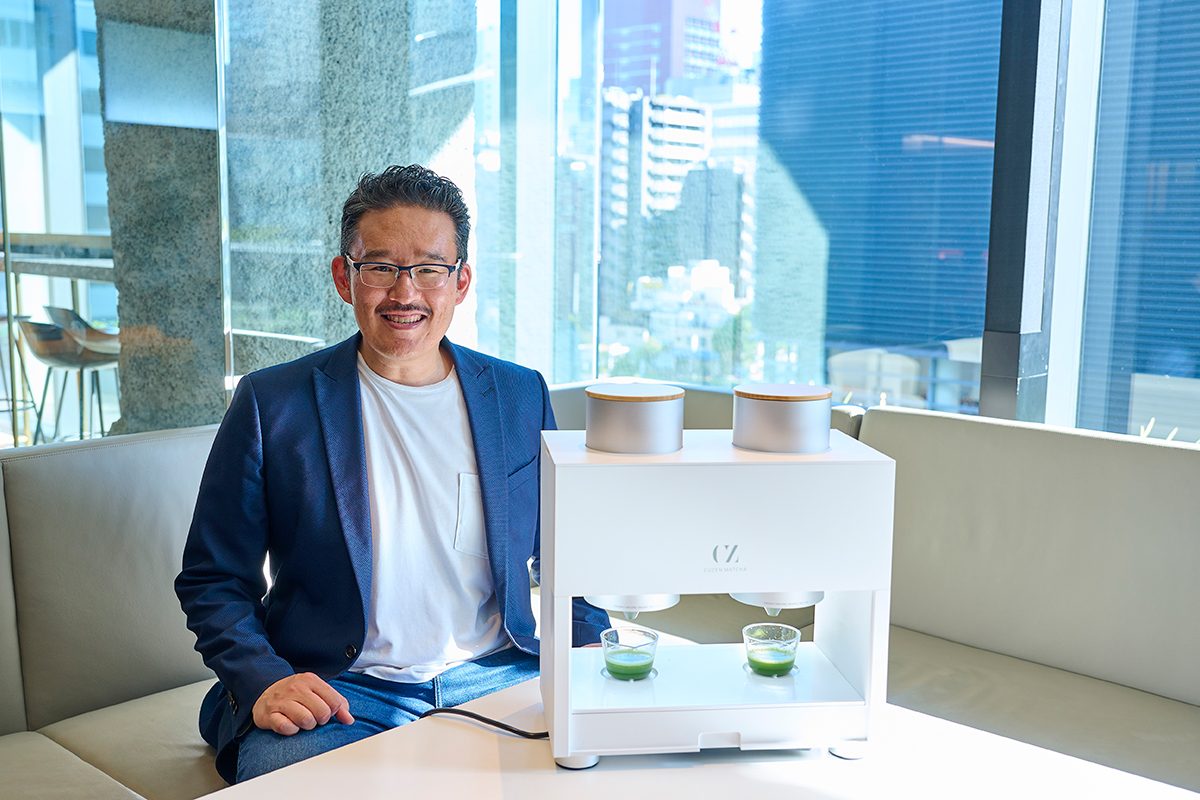
The leaves required their own engineering, only this time the engineers were farmers. Tsukada traveled through Japanese tea regions looking for organic tencha with enough depth and umami to overturn the common complaint that organic matcha lacked flavor. In Kirishima, Kagoshima, he found a producer using organic fertilizer, careful moisture management and the area's foggy conditions to grow the leaves he wanted.
The choice linked machine and agriculture. A countertop mill is interesting once. A recurring supply of whole leaves turns it into a system. By purchasing carefully grown tencha and selling it through subscriptions, World Matcha could translate a daily ritual abroad into repeat demand for growers in Japan.
The useful work of doing everything
Cuzen launched in the United States in October 2020, a year in which the kitchen counter suddenly carried more of daily life than anyone had planned. The machine was named to TIME's 100 Best Inventions of 2020 in the design category, following recognition at CES and San Francisco Design Week. Sales began in Japan in July 2021, and more design awards followed.
Awards decorate a shelf. Operations fill the week. In the company's early stage, Tsukada handled customer support, advertising, fulfillment setup and accounting. His advice to other founders is suitably unromantic: avoid hiring too many people too soon, learn the parts of the company yourself, and delegate after the work is legible. More than 100 investors may reject you, he has warned. Continue anyway, but learn from the refusals.
The point is not heroic exhaustion. Knowing how each function works gave him a clearer basis for managing the people who later took it over. It also preserved a direct line to customers. He has said he enjoys turning those conversations into new products. The regular at Stonemill had already shown him what a useful conversation could contain.
By the end of 2023, Cuzen had sold more than 7,000 home machines and was serving the equivalent of about 60,000 cups a month through its leaves. That June, World Matcha announced a $3.6 million first close of its Series A round, led by Digital Garage Group. The money was intended in part for a commercial machine serving cafes, restaurants, hotels and offices.
Beyond the founder's hands
The commercial Matcha Machine Pro reached the market in 2025 after roughly three years of development. Its arrival changed the scale of the original customer insight. The home machine answered, “I cannot make this.” The professional version answered, “I cannot make enough of this, consistently, for a queue.”
The company also widened its leaves and drinks, including roasted tea and a cold-brew genmaicha blend. Tsukada appeared on the Japanese business video program ReHacQ, where the response was large enough that strangers began recognizing him. Cuzen held a tea gathering at DESIGNART TOKYO and expanded placements of its professional machine.
When asked to choose one kanji for 2025, he picked en: connection, bond, the relationship that links one person to another. It suited a company assembled through a college friendship, a cafe customer's objection, a designer met through Stonemill, engineers in California and Japan, farmers in Kirishima, and investors willing to endure the slow mechanics of a new category.
A founder can grind every leaf for a while. A brand begins when the ritual continues without him.
By early 2026, Tsukada was describing the next transition. Projects had begun moving without his deep involvement. For years, he said, he had handled nearly everything except design. Now Cuzen Matcha needed a character separate from “Eijiro Tsukada.” He could not personally meet billions of people, and a company that spoke only in its founder's voice would travel no farther than he could.
It is an elegant problem for a founder who built a machine to preserve a personal standard. The object makes a precise ritual repeatable. The organization must now do the same with taste, judgment and care. Automation solved the customer's wrist. Delegation may solve the founder's reach.
Through every format, Tsukada's pursuit has remained remarkably stable: the memory of tea served fresh, before distance and storage sanded away its character. First he tried the bottle. Then the cafe. Then a ceramic mill with a button. Careers tend to look tidy only after someone finds the thread. His is green, fragrant and moving very slowly between two stones.