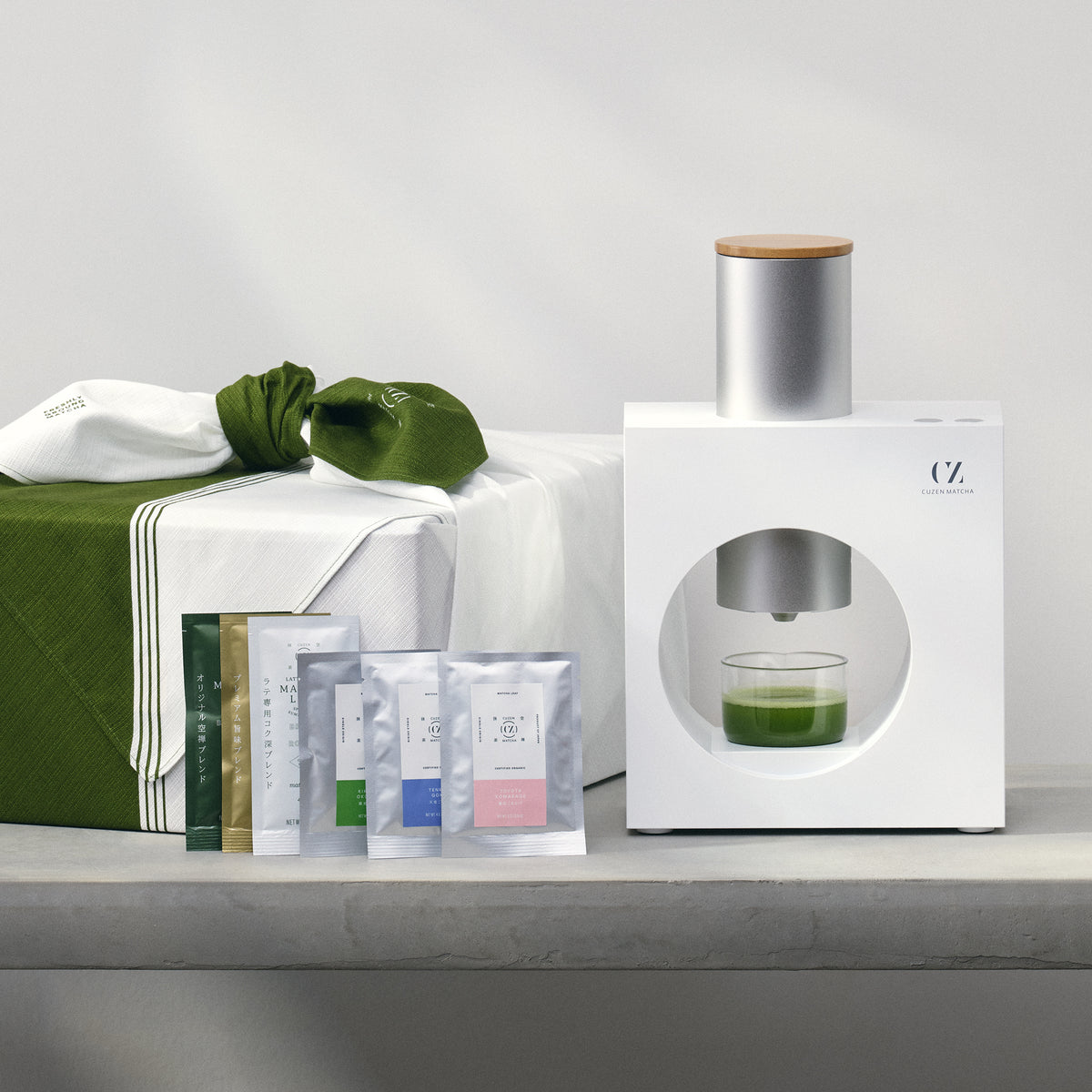
Here is a fact about matcha that the matcha industry would prefer you not think too hard about: it is a decaying product. The moment whole tea leaves are ground into that vivid green powder, oxidation begins, and flavor and aroma start quietly leaking out. By the time a tin reaches your kitchen, the powder inside has often been sitting around for months. It is still matcha. It is just no longer at its best, and it never will be again.
Most companies solve this problem by not mentioning it. Cuzen Matcha - the brand of San Mateo food-tech startup World Matcha Inc. - solved it by building a machine that refuses to grind the leaves until the moment you actually want a cup. This is a simple idea presented as an appliance. It is also, when you sit with it, a slightly radical one: the entire premise is that the industry's default product is compromised, and that the fix is to move the factory step onto your countertop.
The person behind this is Eijiro Tsukada, who spent nearly two decades at Suntory, one of Japan's beverage giants, where he helped launch one of the country's biggest bottled-tea products. Bottling tea, it turns out, is an education in everything that can go wrong with it - high-temperature sterilization is not kind to delicate leaf flavor. Tsukada, a University of Tokyo graduate with a Stanford MBA, left the world of mass beverages and, around 2014, opened a matcha cafe in San Francisco called Stonemill.
The cafe is where the actual idea arrived, in the form of a frustration. Even in a dedicated matcha cafe, with real equipment and real intent, Tsukada could not reliably serve matcha as fresh as he wanted. Traditional stone mills are slow - a proper granite mill weighs around 130 pounds and grinds at a crawl. So he asked the question that companies get built around: could you enjoy freshly-ground matcha at home as easily as coffee drinkers pull espresso?
To answer it he needed someone who understood tea from the other end - the growing and the grinding - and found Oki Hatta, raised in Yame in Fukuoka Prefecture, tea country, with deep roots in the industry. Together, in 2019, they incorporated World Matcha Inc. in California and a sister entity in Tokyo, and set about the unglamorous work of shrinking a 130-pound stone into something that fits between your kettle and your toaster.
The engineering answer is a compact ceramic mill with a complex groove pattern that mimics traditional stone grinding, generating enough pressure to do the job of that granite monster while producing particles around 6.1 microns fine - small enough to whisk into a smooth, frothy bowl. A magnetic whisk handles the froth. Reusable canisters hold the whole leaves, which was not an accident: the founders were bothered by single-use packaging waste and designed it out. You load leaves, press a button, and roughly thirty seconds later you have matcha that did not exist a minute earlier.
The world noticed. In 2020, TIME named the Cuzen Matcha Maker one of its 100 Best Inventions of the year. It collected a CES Innovation Award, then an iF Design Award and Japan's Good Design Award in 2021. For a 14-person company selling a premium niche appliance, that is a conspicuous trophy shelf, and it did the thing trophies are supposed to do: it made a strange product - a matcha machine - legible to people who had never considered wanting one.
The business underneath is tidier than the hardware makes it look. Cuzen sells the machine direct-to-consumer through its own Shopify Plus store and on Amazon, then sells you organic, single-origin whole leaves on repeat - sourced from Japanese terroirs including the farms of Kagoshima and Kirishima. It is the razor-and-blade model dressed in Japanese tea-ceremony reverence: buy the mill once, buy the leaves forever. The recurring leaf revenue is the part that turns an appliance company into something more durable.
In June 2023 the company raised the money to push further. A $3.6 million Series A, led by Japan's Digital Garage Group with Joyance Partners and more than twenty angel investors, brought total funding to about $4.6 million - a deliberately modest number for a hardware company, aimed less at blitzscaling than at expanding reach and, notably, opening a business channel. That same year Cuzen introduced a Matcha Maker Pro for cafes and foodservice, which picked up recognition in the Specialty Coffee Association's Best New Product Awards. The bet there is that if fresh-ground matcha is better at home, it is better in the cafe too, and cafes buy machines and leaves at volume.
What can you actually do with a Cuzen? Make a bowl of usucha in the morning without owning a bamboo whisk or a stone mill or the wrist stamina for either. Pull a fresh shot for a latte. Fold fresh matcha into baking or a cocktail without opening a months-old tin. Give one as a gift - the company leans hard into gift kits, complete with furoshiki wrapping - to the person who has every other kitchen gadget. The through-line is that Cuzen takes a ritual that used to require expertise and equipment and compresses it into a countertop habit, without pretending the ritual was the problem.
There is a version of this story that oversells it, and the honest version resists. Cuzen is a small company in a niche market, selling a premium object to people who care a lot about tea. Its funding is measured, its team is tiny, and matcha's cultural moment - from tea ceremony to Instagram latte - could cool. But the core insight holds up under scrutiny, which is more than most consumer-hardware pitches can say: freshness is not a marketing adjective here, it is the actual mechanism. The machine exists because the alternative is worse in a way you can taste. That is a narrow claim, and it is a true one, and Cuzen built a whole company inside it.