The company that crystallized tea - and then quietly turned a 4,000-year-old ritual into a venture-backed wellness brand.
Tea is one of the oldest, cheapest, most thoroughly commoditized products on earth. You can buy a hundred bags for a few dollars. So the sensible thing, if you are a Stanford MBA with venture ambitions, is to sell literally anything else. Pique's founder Simon Cheng did the opposite, which is the sort of decision that sounds either foolish or brilliant and mostly depends on what happens next.
What happened next is that Pique did not try to sell a better leaf. It changed the question. Instead of "how do we sell more tea," it asked "how much of the plant actually reaches your body?" That is a chemistry question dressed as a marketing one, and it turns out to be the whole company. Pique crystallizes whole-leaf tea into single-serve granules that dissolve in cold water in seconds - no kettle, no bag, no steeping, no waiting. The pitch is not convenience, though it is convenient. The pitch is that its Cold Extraction Technology preserves the polyphenols, catechins and other compounds that cheap, heat-heavy processing tends to cook off.
You can be appropriately skeptical of a brand that trademarks its own extraction method - "Cold Extraction Technology (CET)" and "Full-Spectrum Isolate Synthesis (F-SIS)" are Pique's terms, not the FDA's - while still noticing that the underlying idea is sound. More of the plant, less in the trash. That is a defensible reason for a cup of tea to cost more than a cup of tea usually costs. And it gave a commodity category something it rarely has: a reason to charge a premium that isn't just packaging.
"Each of us holds the codes for self-healing."
The story is unusually personal for a beverage brand. Simon Cheng grew up in Hong Kong with serious pulmonary problems - by his account, three childhood surgeries for collapsed lungs and sleep apnea. That is the kind of biography that makes a person take health seriously and permanently. Later, living in China, he found villages in Yunnan Province - the region where tea was more or less discovered - boiling whole tea leaves into a concentrated resin and eating it. Not steeping. Reducing. He decided that resin was the point.
Turning a village practice into a shippable product took two to three years of work with tea masters and farmers, which in startup terms is close to heresy. The received wisdom is to ship fast and iterate. But some products can't be faked, because the people you're buying from can taste a shortcut. Cheng test-launched an early version in Hong Kong under a different name - the prototype nobody remembers, which is how it's supposed to go - before it became Pique. Along the way he met co-founder Amanda Wee, who left a corporate finance job to join the mission. They built the company together and, later, married. Co-founding is the hardest relationship test there is; most partnerships don't survive it. Theirs became a marriage.
Cheng discovers whole-leaf tea resin in Yunnan Province; spends 2-3 years perfecting a crystallization method with tea masters.
A test product launches in Hong Kong under a different brand name.
Pique formally launches; raises early venture funding from First Round Capital and Khosla Ventures.
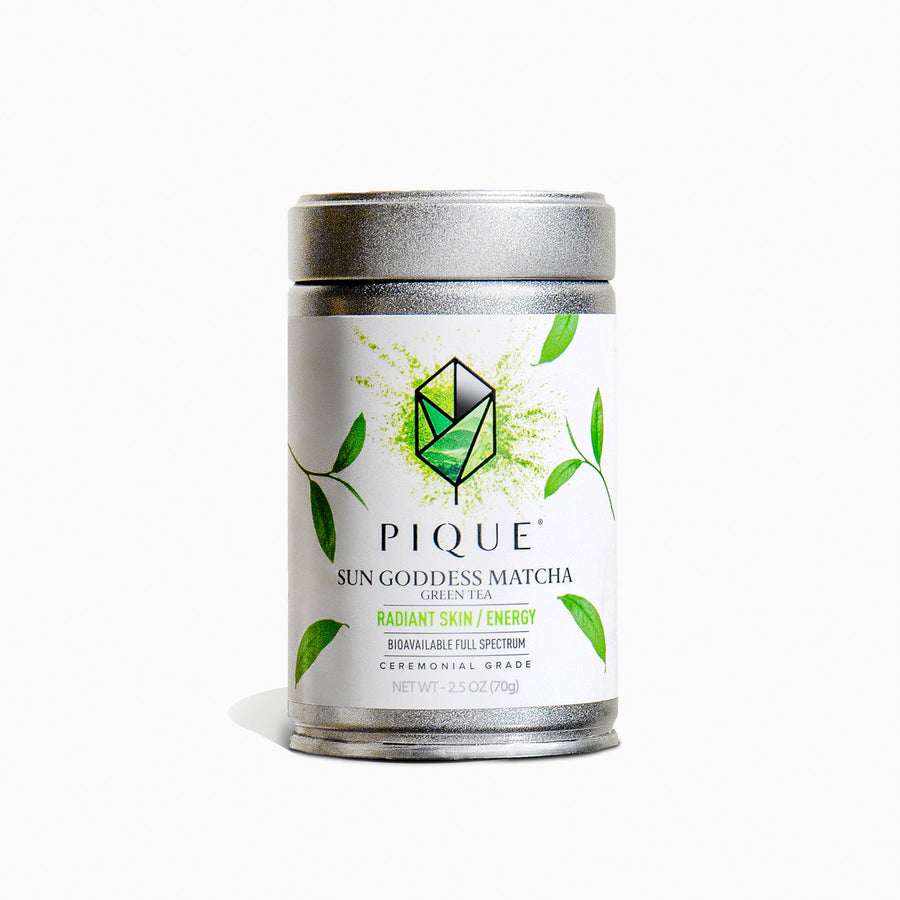
Expands into inside-out beauty with the Radiant Skin Duo - Sun Goddess Matcha paired with BT Fountain.
Brand refresh and new storefront under the "source of radiant health" positioning, now HQ'd in Los Angeles.
Here is the genuinely funny part, in the Silicon Valley sense of funny. Venture capital is built to fund things that scale exponentially - software, marketplaces, network effects. It is not built to fund tea, which grows on bushes at the speed of tea. And yet First Round Capital (early Uber, Warby Parker) and Khosla Ventures (DoorDash, Impossible Foods) wrote checks. Pique raised on the order of $2 million-plus, with additional backers including Blueberry Ventures, Zynik Capital, and StartX.
Why would sophisticated investors fund a beverage? Because they weren't funding a beverage. They were funding a delivery system, a brand, and a recurring-revenue subscription business that happens to contain tea. The leaf is the commodity; the crystal, the ritual, and the monthly re-order are the moat. That distinction - product versus system - is the entire reason the pitch worked.
Pique's whole argument is bioavailability - the share of a plant's beneficial compounds that survive processing and actually reach you. The company frames its cold-extraction and screening methods as the difference between drinking tea and drinking what's left of tea. The bars below are an illustrative sketch of that positioning, not lab data - read them as the story Pique is telling, which is a story about not wasting the leaf.
Pique started with tea crystals and kept asking the same question in new categories - skin, gut, hydration, immunity. It looks scattered until you notice the thread: every product is an attempt to get more of a plant's benefit into your body with less friction. That's the north star that lets the company expand without losing the plot.
Single-serve crystallized whole-leaf teas - green, black, herbal, probiotic - that dissolve instantly, hot or cold.
Organic, ceremonial-grade matcha, quadruple-screened, marketed for calm, clean energy and skin support.
An inside-out hydration and skin supplement built around ceramide and hyaluronic-acid support.
A bundle pairing matcha and BT Fountain - sold as a ritual, not two SKUs.
Immune and antioxidant support formulated for enhanced absorption.
Bioavailable minerals and adaptogenic blends for hydration, gut, and energy.
Nobody wants a supplement; they want a morning. Pique names products like "protocols" and "rituals," which is also how you build a subscription business.
Triple Toxin Screening - pesticides, heavy metals, toxic mold - turns supply-chain transparency into the product itself in a category built on trust.
Doctors, longevity researchers, and endurance athletes who actually use it - the kind of credibility you can't rent.
Removing the kettle, the bag, and the wait from a 4,000-year-old habit. Most real innovation is just taking steps out of something people already do.
Same plant. Different question. That's how you make a commodity disappear.
Founder conversations and product explainers - useful if you want the science-of-sipping pitch straight from the source.