Company Profile — Health & Wellness
GEM.
The daily multivitamin that decided to stop being a pill and become food instead.
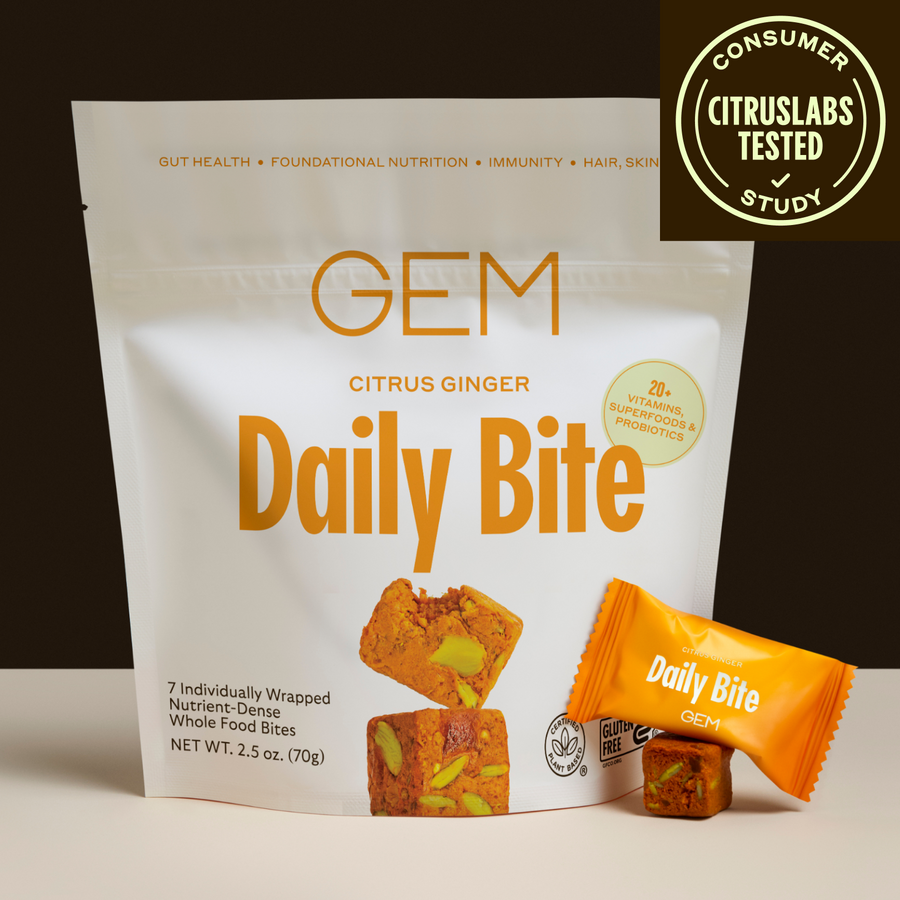
Here is a fact about the supplement industry that GEM would like you to sit with for a moment: most of what you swallow, you do not absorb. You buy a bottle of something isolated in a lab, you take it dutifully, and a meaningful fraction of it passes through you having accomplished not very much. This is not a scandal so much as a design choice. The industry decided, decades ago, that a nutrient is a nutrient - that vitamin C is vitamin C whether it comes from an orange or a beaker - and then it built a very large, very profitable business on that premise. GEM's entire pitch is that the premise is wrong, or at least incomplete, and that the polite word for it is "reductionist."
GEM sells a bite. Not a pill, not a gummy, not a scoop of green powder you have to whisk into water while pretending to enjoy it. A bite - a soft, chewable square of what is essentially food, made from more than twenty whole-plant-derived ingredients: vitamins, minerals, superfoods, prebiotics, probiotics, and, in a detail that will either delight or alarm you, microalgae. You eat one. That's the routine. The company's founder, Sara Cullen, has spent the better part of a decade arguing that this is not a gimmick but a correction.
The correction has some biographical weight behind it. Before GEM, Cullen worked as a food researcher for the United Nations and the World Bank, which is to say she spent time thinking about food at the scale of nations and supply chains and women-led farming networks, rather than at the scale of a Whole Foods vitamin aisle. Then, in her twenties, her own body staged a small rebellion - inflammation, fatigue, digestive trouble, skin problems - and the diagnosis, roughly, was that she wasn't getting the right nutrition. She was, by her own account, also sensitive to the artificial fillers in conventional supplements. So the person who understood food systems globally could not find a daily vitamin she trusted personally. That gap is the company.
GEM launched in 2018, and its early history is worth noting because it is a small master class in how to build a consumer brand backwards. Cullen did not begin with a factory and a marketing budget. She began with hundreds of beta testers in a Facebook group - people who ate prototype bites and told her, presumably with the unvarnished honesty that only a free-sample recipient can provide, what worked and what tasted like a compost heap. The formulations that survived that gauntlet were built with a somewhat unusual committee: scientists, doctors, and functional-medicine specialists on one side, and hundreds of ordinary people with opinions about texture on the other. Nutrition by peer review, then nutrition by focus group.
A GEM routine is not cheap. A full daily stack - the foundational Daily Bite plus targeted formulas - runs in the neighborhood of $5.50 a day, and the monthly subscription plans climb from roughly $55 to around $130 depending on how many functions you're stacking. You can, reasonably, look at that number and decide it is a lot of money to chew. Plenty of reviewers have. The complaints about GEM are real and they cluster in predictable places: the bites can taste earthy, they're larger than a gummy, results vary from person to person, and - the eternal DTC sin - some customers found the auto-shipment easier to start than to stop.
But here is the thing about a $5.50 daily habit: it is not really priced as a vitamin. It is priced as a ritual. The most durable consumer-health brands don't sell a SKU, they sell a small daily act that a customer folds into their morning and stops questioning. GEM's flavors give this away. Sleep is chocolate cherry. Calm is banana cinnamon. Energy is chocolate sea salt. When your product is something a person actually tastes, flavor isn't decoration - it's the retention strategy. You come back tomorrow because it was pleasant today, and pleasantness compounds into a subscription.
The strategy has worked well enough to be measurable. GEM says it has sold more than twenty million bites. In 2020 - a year when a great many businesses were doing the opposite of growing - the company grew more than 400%. That is the kind of number that gets you a term sheet, and in May 2021 it did: a $10.5 million seed round led by Pat Robinson at CircleUp Growth Partners, with S2G Ventures, Pentland Ventures, Collaborative Fund, and 37 Angels along for the ride. The stated use of funds was the least glamorous and most important thing a DTC brand can spend money on: getting off the internet and onto a shelf.
Direct-to-consumer is a wonderful way to start a brand and a difficult way to keep one. Acquiring a customer through a Facebook ad is expensive, and it gets more expensive every year, and eventually the math that looked so clean on a founder's spreadsheet starts to buckle under the cost of convincing one more stranger to try a $55 subscription. Retail is the escape hatch. A jar of GEM on a store shelf, or a variety pack on Amazon, reaches people who will never see the ad and never join the Facebook group. The seed round was, in essence, a bet that whole-food nutrition could survive contact with a supermarket - that the thing which sounds artisanal in an Instagram post can also sit next to the gummies and win.
It's a live question. The wellness-supplement category is crowded and getting more so: Ritual with its transparent capsules, Care/of with its personalized packs, AG1 with its ubiquitous green powder, Olly with its candy-shelf gummies, Seed with its probiotics. Each of them is, in its own way, selling trust in a category that has spent decades earning skepticism. GEM's differentiator is the most old-fashioned one available - it's food - and old-fashioned differentiators have a habit of aging well precisely because they don't depend on a technology anyone can copy next quarter.
Who buys this? The honest answer is a particular kind of person - health-conscious, skeptical of pills, willing to spend on wellness, and skewing, at least in the brand's audience, toward women. GEM's Instagram following sits north of 100,000, which is not a mass-market number but is a devoted one, and devotion is the currency that consumable subscriptions run on. The tagline the company puts in front of that audience is not a claim about milligrams or clinical outcomes. It is three words: eat your nutrients. That is a belief, not a spec sheet, and the best consumer-health brands have always understood that they are in the business of selling beliefs that happen to come with a product attached.
The belief has a planetary dimension too, which is where Cullen's earlier career quietly resurfaces. GEM talks about sustainable sourcing and plant-based ingredients not as a marketing garnish but as a through-line from the founder's years working with women farmers and sustainable food networks. Whether a chewable multivitamin can meaningfully move the needle on planetary health is the sort of question that invites eye-rolling, and fair enough. But the framing matters for the company's identity: GEM positions itself less as a supplement startup than as a food company that happens to make its food nutrient-dense enough to replace your vitamins. The distinction is subtle and it is also the entire brand.
What can you actually do with GEM? Concretely: you can replace a shelf of bottles with a small routine you eat. The Daily Bite is the foundation - a multivitamin with immunity, gut, and even GLP-1 support baked in. The Sleep Bite leans on valerian root, L-theanine, magnesium, and GABA for people whose nights don't cooperate. The Calm Bite carries adaptogens for the stressed. The Energy Bite is for focus. You mix and match, one bite per function, and the whole thing arrives at your door on a schedule. It is, deliberately, less a purchase than a subscription to a habit.
Whether that habit is worth $5.50 a day is a question only your own morning can answer, and GEM would probably be the first to admit that the answer isn't universal. But the company has managed something genuinely hard in a category built on hype: it made a coherent, food-first argument, stuck to it through hundreds of beta testers and twenty million bites, and got sophisticated food-and-agriculture investors to write checks against it. In an aisle full of promises, GEM is selling a premise - that the difference between a nutrient in a beaker and a nutrient in a bite is real, and worth chewing on.
The flagship real-food multivitamin - 20+ vitamins, minerals, superfoods, prebiotics and probiotics, with immunity, gut and GLP-1 support. Citrus Ginger and other flavors.
Chocolate Cherry, built to help you fall asleep and stay there - valerian root, L-theanine, magnesium, GABA and calming botanicals.
Banana Cinnamon, formulated with adaptogens and calming ingredients for mood and stress support during the day.
Chocolate Sea Salt, designed for natural energy, focus and mental clarity - no crash, no jitters promised.
GEM's $10.5M seed round (May 2021) drew a food-and-agriculture-heavy syndicate - investors who bet on supply chains, not just software.
Bars indicate role in round, not dollar allocation. Total round: $10.5M seed.
"GEM crafts delicious, real-food bites filled with 20+ essential vitamins, minerals, superfoods, prebiotics and probiotics."
Sara Cullen launches GEM as a real-food replacement for the daily multivitamin, seeded by hundreds of Facebook beta testers.
The business grows more than 400% year over year as DTC wellness accelerates.
Forbes profiles GEM's pitch to trade synthetic vitamins for real food.
GEM closes a $10.5M seed round led by CircleUp Growth Partners to fund retail expansion.
Refreshed line and branding expand targeted Sleep, Calm and Energy bites alongside the Daily Bite; distribution grows on Amazon and retail.
| Legal Name | GEM Health, Inc. |
| Founded | 2018 |
| Founder & CEO | Sara Cullen |
| Headquarters | 1410 Abbot Kinney Blvd, Venice, Los Angeles, California |
| Category | Health & Wellness · Real-Food Vitamins · DTC Subscription |
| Total Funding | $10.5M (Seed, May 2021) |
| Team Size | ~120 (third-party estimate) |
| Contact | sara@dailygem.com · +1 323-406-7017 |
| Website | dailygem.com |
Video note: GEM does not maintain an official YouTube channel; the "Watch" link opens founder interviews and product walkthroughs indexed on YouTube. For a product demo, see the reviews and unboxings on the brand's Instagram and Amazon listings.