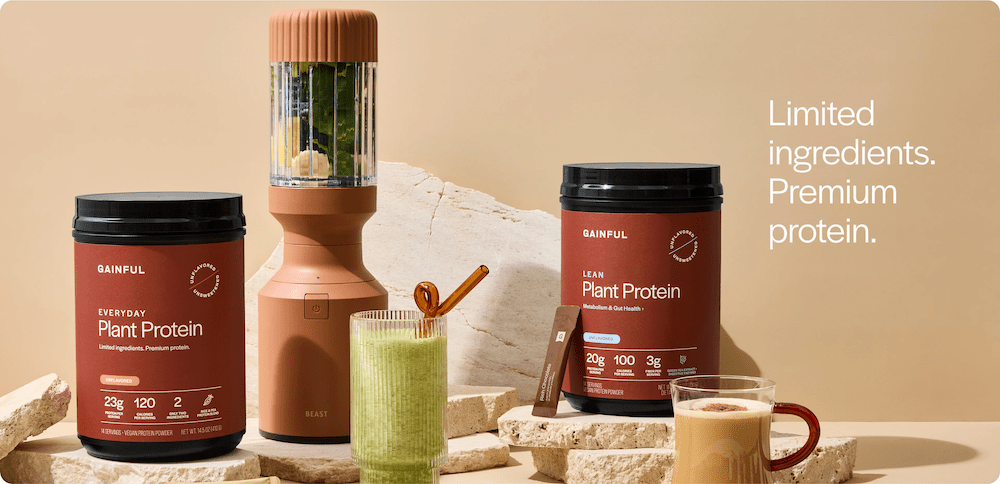
Open the box and your name is on the bag.
A Gainful order doesn't look like the supplement aisle. No 40-character compound you can't pronounce, no tub the size of a paint can promising to do everything for everyone. Instead: a pouch formulated against a quiz you took - your weight, your training, your gut, your goal - and a flavor packet you picked yourself. Somewhere in the app, a registered dietitian is on standby to tell you whether you actually need the creatine.
That's the company today: a profitable, New York-based nutrition brand that sells personalization as the product, not the marketing. It started direct-to-consumer. It now lives on Target shelves, inside fitness clubs, and on the start line at Hyrox races. The constant across all of it is the same stubborn idea - that your body is a sample size of one, and your supplement should know that.
Above: a brand that turned "what are you trying to do?" into a business model. Most companies sell a tub. Gainful sells a sample size of one.
The supplement aisle was built for nobody in particular.
Walk into a nutrition store and the message is loud and contradictory. Every tub is the best. Every label shouts. None of them know anything about you. The industry's default setting - one formula, sold to millions of different bodies - is either a marvel of efficiency or an admission that nobody bothered to ask. Gainful's founders decided it was the second.
The math never worked. A 200-pound powerlifter and a 130-pound marathoner do not need the same protein, the same dose, or the same anything. Yet they were handed the identical scoop, priced the same, flavored the same, and left to guess. The "personalization" on offer was a choice between chocolate and vanilla.
The supplement industry spent decades perfecting the one-size-fits-all scoop. Turns out one size fit no one - it just fit the warehouse.
Two soccer captains, a dorm room, and a stubborn algorithm.
Eric Wu and Jahaan Ansari met in high school as co-captains of their soccer team. The supplements their teammates were buying came from companies with murky ingredients and zero interest in the individual. In his last year of college, Wu started mixing protein formulations in his dorm room. Ansari built the algorithm that could turn a person's answers into a personal formula. It was, by any reasonable measure, an absurd thing for two undergraduates to attempt.
It worked well enough to get into Y Combinator's Winter 2018 batch on a $120,000 check. By 25, the pair had done what very few first-time founders do - raised millions on a single, unfashionable conviction: that custom beats generic, even when generic is cheaper to manufacture and easier to ship.
Dean Kelly, who had built consumer brands at Walmart's e-commerce arm and at Zola, joined as CEO in early 2020. Wu moved from CEO to COO; Ansari stayed on as CTO. The dorm-room experiment now had operators.
Eric Wu and Jahaan Ansari: still arguing about formulas, just with a board of directors now. The soccer team was good practice for the cap table.
The Gainful Timeline
Eric Wu and Jahaan Ansari turn a dorm-room protein experiment into a company.
Joins Y Combinator's Winter batch on a $120K seed check.
Dean Kelly joins as CEO; founders shift to COO and CTO.
Raises $7.5M Series A led by BrandProject and Courtside Ventures.
Reaches profitability, lands Target retail, partners with Hyrox & Chelsea Piers.
Series B led by District Ventures Capital; Arlene Dickinson joins the board.
A quiz in, a formula out, a dietitian on call.
The mechanism is almost boringly simple, which is the point. You answer questions. An algorithm matches you to a base - whey, plant, collagen whey, isolate, lean, performance, or a keto-friendly blend - and a dose that fits your body and goal. You pick your flavor, or buy it unflavored and use Gainful's naturally flavored packets to taste it your way. Then, if you want, you text a registered dietitian who works for the company, not for an ad budget.
Personalized Protein
Custom blends across whey, plant, collagen, isolate and keto bases - matched to your body and goal.
Hydration
Tailored electrolyte formulas, including options that ease GI side effects tied to GLP-1 use.
Pre-Workout
Formulas dialed to your training and your tolerance, not a one-size jolt.
Performance Boosts
Add-on creatine, fiber and collagen peptides - stacked only if you need them.
Performance Greens
An everyday greens supplement for the days the diet doesn't cooperate.
Dietitian Access
Real RDs over email, chat and text - the part competitors can't ship in a box.
Over 70 ways to build a blend at Target. The hard part wasn't the powder - it was convincing an industry that "it depends" is a feature.
Personalization isn't a vibe. It shows up in the numbers.
Skeptics will say personalization is a marketing word. Gainful's counter is data. Customers who actually use the registered-dietitian service stay around about 20% longer than those who don't - which is what happens when a brand answers questions instead of just selling answers. The company crossed a million orders, created more than a million personalized blends, and turned profitable in early 2023, an unfashionable achievement for a venture-backed DTC brand.
The case for personalization
The believers followed the numbers. The Series A came from BrandProject and Courtside Ventures. The 2024 Series B was led by District Ventures Capital, after which Dragons' Den investor Arlene Dickinson joined the board. Hyrox made Gainful its official supplement partner; Chelsea Piers Fitness brought it into the clubs; Target put a customizable version on 1,800-plus shelves.
A million blends and a profitable P&L. The least surprising chart in supplements: when someone answers your questions, you stick around.
Elite nutrition, minus the velvet rope.
Customized performance nutrition used to be a perk of being a professional athlete - the kind of thing that came with a team, a budget, and a nutritionist on payroll. Gainful's mission is to take down the velvet rope: clean, personalized, science-backed nutrition for every body, developed with registered dietitians and guided by evidence rather than the loudest label on the shelf.
That mission keeps widening the catalog - hydration, gut health, and formulas aimed at people managing the side effects of GLP-1 medications. Each addition follows the same logic: find a place where the market shrugs and says "it depends," then build the product that actually depends on you.
The aisle is changing. Slowly, then all at once.
Personalization in health is no longer a fringe pitch - it's the direction the whole category is drifting, from wearables to bloodwork to the medicine cabinet. Gainful's wager is that the supplement shelf will be the last holdout to fall, and that the brand that got there early, profitably, with a dietitian attached, has a head start that's hard to copy. Anyone can print "personalized" on a label. Staffing real RDs and shipping a million distinct blends is the part that doesn't screenshot.
Five things worth knowing
- The founders met as co-captains of their high-school soccer team.
- The first formulas were mixed in a college dorm room.
- Y Combinator backed it in Winter 2018 with a $120K seed.
- At Target, you can build a blend in three steps with 70+ options.
- It markets hydration and gut-health products to people managing GLP-1 side effects.
Return to the box on the doorstep. Your name is on the bag, the dose is yours, the flavor is the one you chose, and the dietitian's reply is sitting in the app. That used to be a luxury reserved for people with a team behind them. Gainful's quiet ambition is to make it the most ordinary thing in the world - the new default for a shelf that, for decades, was built for nobody in particular.