A customer ringing a contact centre is unlikely to spare a thought for the network underneath it. Richard Pennington has built much of his business around the consequences of that indifference. The caller wants an answer. The organisation wants the conversation to happen securely. Somewhere between them sits a collection of systems, suppliers and contracts, each capable of producing a perfectly reasonable explanation when something goes wrong. Pennington’s career at FourNet has increasingly been about accepting responsibility for more of that journey.
On 15 October 2026, the Manchester business he co-founded acquired Glasgow’s SVL Business Solutions. The combined operation has more than 230 people, over 450 customers and revenue of around £65 million. The figures put a useful distance between the present business and its starting point: four founders, one customer.
Four founders. One customer.
In 2005, Pennington founded 4net Technologies with Frank Jennings, Mike Jervis and Steve Tyrrell. Their proposition was plain enough to fit into an ordinary conversation. Larger competitors were leaving room for a supplier that could deliver communications technology with greater care. The founders brought substantial experience; collectively, they had more than 75 years in the industry. This was an experienced team choosing to start small.
The early work involved technical systems installed on customers’ premises, together with the services that kept them useful. In his account of the first fifteen years, Pennington credited reputation, relationships and credibility with helping the company grow. His retrospective also contained a small flash of satisfaction: “I think we did a good job of it!” A founder is allowed an exclamation mark after fifteen years.
That first customer matters to the story because it makes the original promise tangible. A small supplier has relatively few places to hide. Its next conversation may depend on how well the previous job went. Pennington’s later decisions would make the organisation much larger, while increasing the number of things for which it could be held accountable.

A shareholder changes. The founder stays.
Outside investment arrived in September 2017, when YFM backed the business. Iain McKenzie joined as non-executive chairman. By then, FourNet was supplying enterprise and government customers and providing its ANTENNA communications platform to central government departments. Its customers presented a demanding examination of the founders’ original service promise.
In June 2021, Palatine acquired a majority stake. YFM exited with a sixfold return for its investors in less than four years. Jennings and Jervis also left the business as founding shareholders; Pennington continued as CEO, with Tyrrell remaining involved. McKenzie stayed as chair. A change of ownership can be a closing chapter for a founder. Here, it financed another stretch of the story.
At the time, FourNet reported annual revenue of £38 million and employed more than 100 people. Its customer list included 10 Downing Street, the Cabinet Office, HM Treasury and the Bank of England. These were relationships in which a communications failure could have consequences well beyond an inconvenient afternoon. Pennington had travelled some distance from the first account without leaving the practical business of keeping people connected.
The new spelling was the easy part
In May 2020, on the company’s fifteenth anniversary, 4net Technologies became FourNet. Pennington explained that the old identity no longer described the work. Customers wanted different ways to communicate, systems that worked together and teams able to collaborate securely from different locations. Cloud services, automation and AI were becoming part of those conversations.
His description of the relationship had changed too. The company was moving from installing a technical solution to working alongside customers and being assessed on the results their organisations achieved. The new name was short; the operational implications were considerably longer. Once a supplier promises a result, the boundaries between its responsibilities and everybody else’s become a daily management problem.
Buying the pieces beneath the promise
Pennington’s response involved bringing more of the underlying technology within reach. In 2022, FourNet acquired C>Ways, adding networking, cybersecurity, cloud and business continuity expertise. He connected that decision to the convergence of communications and IT: people working across locations needed secure infrastructure wherever they happened to be sitting.
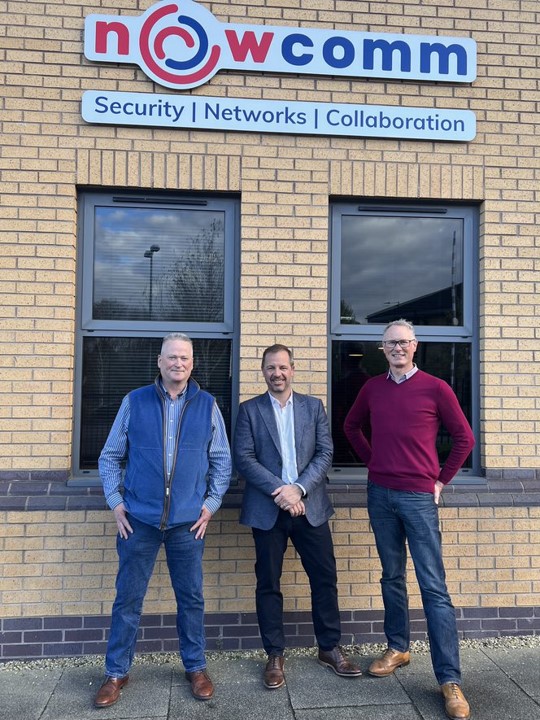
Nowcomm followed in April 2023. The Derby company brought 34 employees and Cisco credentials in networking, security and collaboration. Its founders had previously worked for Cisco. For Pennington, this added technical depth beneath the services customers could see. Security and the contact centre were becoming parts of the same delivery problem.
In November 2023, FourNet acquired 01T, a specialist in high-speed international networks. Pennington explained the purchase in terms of the connectivity underneath communications, customer experience and security services. Owning more of that layer reduced dependence on outside network aggregators. A supplier could have a closer view of the connection as well as the application running over it.
These purchases give his growth strategy a recognisable shape. Each brings additional skills into an organisation expected to answer for an increasingly complete service. There is an unglamorous logic to acquiring the plumbing: it is difficult to take responsibility for the upstairs bathroom while insisting that the pipes are somebody else’s department.
- 2022C>WaysInfrastructure + security
- APR 2023NowcommCisco expertise
- NOV 202301TGlobal networks
- OCT 2026SVLCustomer experience
Different purchases, a connected service. Selected milestones, not every acquisition.
The work behind the growth figures
The financial record deserves more attention than a straight ascending arrow. FourNet’s revenue for the year to June 2023 was reported at £38.8 million, with an early contract termination contributing to a fall on a pro-rated basis. Gross profit nevertheless increased, and recurring revenue accounted for 81% of the total. Growth involves the mix and durability of work as well as the number at the top of the accounts.
There was internal work to do as well. During YFM’s investment, employee feedback exposed weak engagement and relatively high staff turnover. FourNet set itself a two-year target of earning a place in the Best Companies survey. It received a one-star award in 2020 and a two-star award in 2021, based on employee feedback. The episode gives substance to a subject that corporate biographies often dispatch with the word “culture”.
Pennington’s responsibilities include the people delivering the promise. Engineers, consultants and support teams must stay, learn and work together if customers are to experience continuity. The improvement in employee recognition belongs to the organisation and its staff. It also makes the founder’s continuing task clearer: expanding the business requires attention to what it feels like to work inside it.
Government has an awkward question
By June 2026, FourNet described a public-sector practice serving more than 30 government departments and agencies. Pennington’s discussion of that market concentrated on access to services, demand and the people dealing with citizens. He was wary of treating the purchase of software as the whole assignment.
“Too often, procurement is treated as a technology exercise.”
Richard Pennington, June 2026
His argument puts service design and operational performance at the beginning of the conversation. How will a person reach the service? What happens after contact? Which avoidable interactions could be removed? Those questions are less convenient than a catalogue of software features, because they require understanding how an organisation actually works.
They also explain the appeal of customers in housing, financial services and other regulated markets. The requirements overlap: continuity, security, compliance and a service people can use. Pennington’s ambition is to build trust through demonstrable effects on customers, citizens and colleagues. The practical test arrives whenever a service has to perform outside the demonstration room.
AI arrives with an implementation problem
In May 2025, FourNet launched IntellAIgent, its agentic AI platform. The company described software designed to coordinate tasks across systems, including scheduling and updates to customer records. Those are stated product capabilities; the attraction for Pennington’s customers is the possibility of completing work across the gaps between applications.
By the SVL acquisition announcement in October 2026, his emphasis was on organisations bringing AI into everyday customer service. They needed to establish where it would help, change the surrounding processes and implement it securely. The shift suits the business he has been assembling: introducing automation requires both knowledge of the service and control of the systems supporting it.
SVL brings 41 employees and expertise in recording interactions, analytics and workforce management. The companies had worked alongside each other for nearly a decade. This was an acquisition of a familiar team, with experience in many of the same sectors and relationships with shared technology partners.
“This acquisition is about three things: people, customers and technology.”
Richard Pennington, October 2026
FourNet + SVL / announced 15 October 2026
A bigger business, the same caller
Pennington has also connected responsible business to the services FourNet sells. Its December 2025 report described work on digital inclusion and helping people avoid cybercrime. He presented these activities as extensions of the company’s priorities. That gives the social ambition a practical setting: participation and security are part of whether digital services work for people.
Twenty-one years after starting FourNet, he remains its CEO in Manchester. The technology has changed, the shareholder register has changed and the team has grown through investment and acquisitions. His recurring problem has become larger with them. A company promising a complete result must keep developing the expertise, relationships and internal discipline to deliver it.
The person making the call will probably never know how many companies were acquired to support the conversation. If the system works, they have no particular reason to ask. That ordinary lack of interest is a demanding standard for a founder to spend two decades trying to satisfy.
Continue the conversation
Profiles, a presentation and further reading.