Samantha Moss’s thank-you contained a small detail that a project announcement could easily have left out. Before the new Oxford Properties retail websites, before the headless content management system and the integrations, she had called Aly Hemraj for help. He said yes. When the first phase launched for Square One District and Scarborough Town Centre, she remembered to thank him for it.
There is a whole business vocabulary available for a moment like that: partnership, engagement, relationship management. The phone call is better. It gives the work a person and a beginning. Hemraj is the founding partner and CEO of Tru, a company whose assignments stretch across technology, marketing, data and customer experience. In this instance, the beginning was someone knowing whom to ask.
The call before the launch
The Oxford project makes his professional world unusually tangible. The launch brought together retail websites, a more flexible approach to different kinds of visits, centralized infrastructure and connections to mall directories, engagement applications and a customer data platform. A visitor encounters the website. Behind it sits a group of systems expected to cooperate.
Moss credited the Tru team for its work and singled out Hemraj’s response to that earlier request. Other people received their own thanks, including technical stakeholders, retail teams and creative collaborators. It was a shared undertaking, with a personal acknowledgment tucked into the account of what had shipped.
“Yes” when I called him up for help
Samantha Moss, thanking Aly Hemraj after the Oxford Properties retail website launch
That detail is useful because a CEO’s responsibilities can become abstract very quickly. Strategy is a word capacious enough to hide almost anything. Here, there is a visible connection between agreeing to help and a team delivering a working project. Hemraj’s contribution is named without pretending he personally built every component. The distinction gives the compliment its weight.
A website was the beginning
Tru dates its beginnings to Canada in 2012, as a web-development startup. Hemraj’s title still carries that beginning with it: founding partner. The company’s chronology places its first enterprise client, Empire, in 2013 and its North American headquarters in Toronto in 2014. By 2016, its brief had expanded into a full-service digital agency.
The geography expanded too. Tru records an Indonesian office in 2018, another office in India in 2023 and a Riyadh opening in 2024. Today its delivery network spans Canada, the United States, India, Indonesia and the Middle East. Hemraj’s company has accumulated more disciplines and more places in which those disciplines have to work together.
A founder’s title stays comfortably short while the assignment underneath it grows. Hemraj now sits at the head of an organization that describes work across enterprise platforms, experience design and AI. The journey from a website to that wider brief is also a journey into coordination: more specialties, more dependencies, more people needed to finish the same job.
The customer at the other end
Consumer intelligence is the emphasis in Hemraj’s professional biography. His stated academic background combines information systems management and business administration. The pairing fits a brief that asks technical choices to answer business questions: what customers need, how they encounter a brand and whether the experience helps them do what they came to do.
Retail makes those questions concrete. Tru’s digital-strategy work includes Sobeys, where a website brings together weekly offers, recipes, featured products and campaigns relevant to a visitor’s region. Searchability matters because the information has to be found before it can be useful. A beautifully arranged page has limited charm if the customer never reaches it.
The Beer Store appears in that same digital-strategy portfolio. Grocery and beer may make for an agreeable shopping list, but they also supply rather practical assignments for a technology business. People arrive looking for information, products and a next step. The work involves organizing that journey and giving the organization behind it a way to understand what happens.
Tru’s Retail Council of Canada relationship, announced in November 2025, places Hemraj alongside colleagues Nicole Hemraj, Kimberley Carrera and Dhruv Dhanda in the company’s retail leadership story. The connection extends an existing area of work into an industry network. Grocery websites, shopping destinations and retail conversations occupy the same professional neighborhood.
There is a useful continuity here. The customer experience might begin with a search result, a shopping-center visit or a weekly offer. Hemraj’s brief keeps returning to the relationship between that ordinary intention and the systems a business uses to respond to it. The vocabulary changes more often than the underlying obligation.
The next assignment has agents
Hemraj’s current direction at Tru includes a shift toward agentic transformation. The company describes him as setting the vision for deploying agentic orchestration at scale. That is an ambition with a substantial practical burden: software expected to act across a business needs somewhere to act, information to work with and a defined job.
Tru’s agent-development offering describes integrations with platforms including Salesforce, Adobe and Contentful. It includes natural-language interfaces through which employees can query information or complete tasks, alongside workflow automation. The company’s stated development process begins with identifying suitable processes, then moves through design, development, integration and continued refinement.
Commerce gives those services a more familiar setting. Tru proposes agents for merchandising, pricing, personalization, fulfillment and support. Its commerce offering includes connecting them to order, product and enterprise systems. These are descriptions of the work the company offers, rather than a scoreboard of results. They show the territory Hemraj is asking the business to enter.
Shopper intent + data↓Connect
Commerce + enterprise systems↓Act
Merchandising + workflows
Another part of that direction is Axis AI Discover. Tru positions the product around brand visibility in AI search and traffic associated with those discovery channels. Its modules cover mentions, citations, competing brands, page readiness and AI-referred visits. For a leader whose brief includes consumer intelligence, the product puts another place of customer discovery on the map.
The connection to his earlier work is straightforward. A customer still has to find the brand, understand an offer and reach something useful. The entry point now may involve an AI answer. Hemraj’s company is offering tools to observe that entry point and services to connect what follows it.
Someone still has to own the decision
The surrounding organization matters. Tru has published an AI council structure with Kimberley Carrera as chair, Nicole Hemraj as vice chair, Devanshu Goyal as technical lead and Richa Kumar as governance lead. Advisors bring data, delivery, creative, marketing and user-experience perspectives into the arrangement.
The structure puts named responsibilities beside the company’s AI ambitions. Architecture, business priorities and policy belong to people with different jobs. For Hemraj, steering the broader direction sits alongside a leadership group assigned to make decisions about how the work is governed and implemented. Even software with a taste for autonomy arrives with an organization chart.
Professional relationships show up in less formal ways too. When account director Christine Anandappa described joining Tru, she thanked Hemraj and several colleagues for their welcome and support. Her early weeks included Toronto, Atlanta, an Adobe roadshow and client programs. The account adds a working colleague’s perspective to a role otherwise described in titles and service offerings.
The paper-airplane department
Then there is the Canadian offsite. Tru brought colleagues together in a coworking space to discuss strategy, improve sprints and work on collaboration. Neelan Rach of More Than Human joined as facilitator. His account of the session included an Agile Paper Airplane Game, with communication, adaptation and iteration among its purposes.
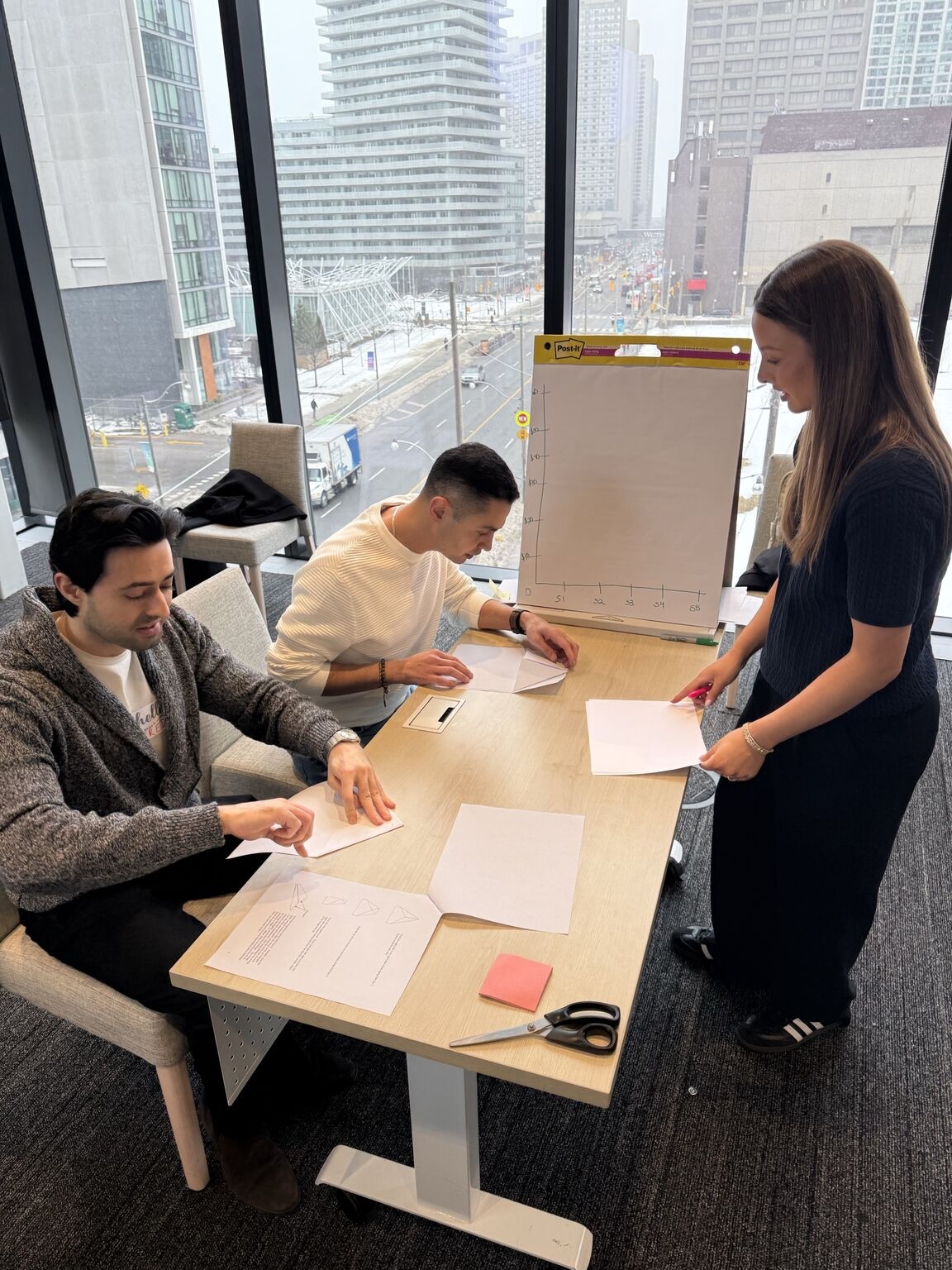
The photograph has scissors on the table, folded sheets and a flip chart beside the group. It is a pleasantly literal picture of people making something together. Rach thanked Hemraj for bringing his organization into the session. Tru, meanwhile, attributed a concise statement about execution to its CEO.
“When teams work smoothly together, execution becomes effortless.”
Aly Hemraj, on Tru’s Canadian team offsite
The exercise also supplies a scale that a technology brief can lose. Everyone at the table can see the paper, the folds and the next attempt. Collaboration has something concrete to work on before the conversation returns to a larger assignment.
The sentence gives the workshop its place in his story. An enterprise project needs people who can coordinate; the same is true of the organization selling the service. Hemraj’s working world reaches from customer intelligence to AI orchestration, but this scene returns it to a table, a shared task and an opportunity to improve the way colleagues work.
Put the offsite beside the Oxford thank-you and the portrait becomes more specific. A client remembers that he answered a request for help. A facilitator remembers being invited to work with the team. Between the initial yes and the finished assignment, there are people to bring together. The paper airplanes have earned their place.