The modern customer-service desk has a peculiar view of capitalism. Everything arrives there eventually: the package that vanished, the mortgage question nobody can parse, the password reset that became a minor existential crisis. For more than 25 years, Konecta has been paid to stand at that intersection. The Madrid company began in 1999 as a telemarketing call center with seven clients, less than €2 million in annual sales and 50 million pesetas of capital. It now reports roughly €2 billion in revenue, more than 500 clients and 109,000 employees spread across 28 countries.
That scale makes Konecta easy to mistake for a very large collection of headsets. The better description is a company that takes responsibility for the untidy middle between a brand and the people who buy from it. Konecta acquires customers, answers service questions, provides technical support, runs back-office processes, handles collections, manages employee help desks and designs digital journeys. It does this in more than 40 languages for sectors where a poor interaction can be costly: banking, telecoms, energy, healthcare, mobility, travel, retail and e-commerce.
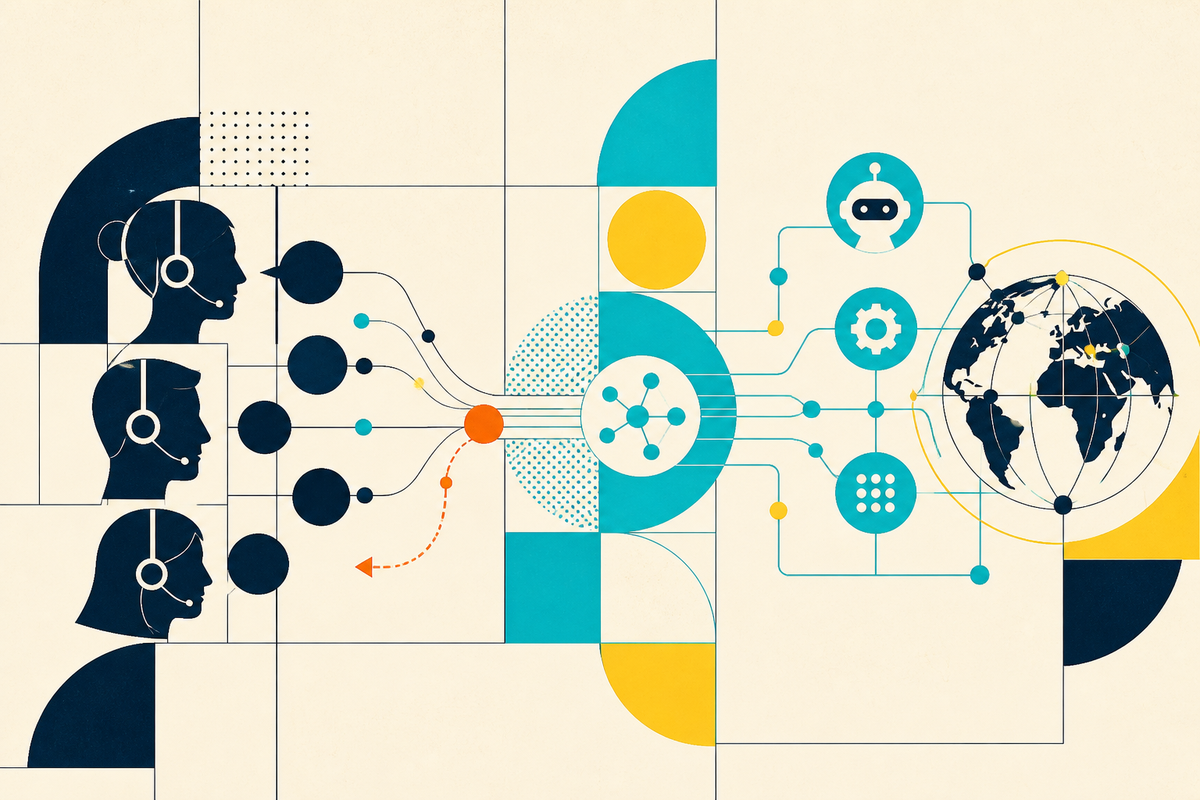
Now the work is changing. Chatbots can answer routine questions; generative models can summarize a conversation; software agents can update a record, issue a refund or chase a payment. For an outsourcer whose historic product was organized human labor, that is both an uncomfortable threat and an unusually large opportunity. Konecta's response is Katalyst 2028, a three-year program announced in January 2025 to rebuild the business around generative AI, international expansion and workforce training. The company is targeting €2.5 billion in revenue by 2028. More revealing than the target is what it now wants to sell: the management of a combined human and digital workforce.
The product is the handoff
In June 2026, Konecta gave this strategy a product name: Kolibri. The agentic-AI platform offers a catalog of workflows for claims, billing, technical support, appointments, collections, refunds, order tracking and email triage. Konecta says a standard use case can arrive as much as 80 percent pre-built, with the remaining 20 percent adapted to the client's systems, rules and industry. The goal is deployment in 30 to 90 days, not another immaculate demo marooned in a conference room.
The distinction matters. A chatbot returns an answer. An agentic workflow may read the request, consult account history, update a customer record, trigger a transaction and record each decision. That introduces more value and more ways to fail. Kolibri connects CRM, contact-center, data, incident-management and communications systems, while keeping human supervisors inside the loop. Its pitch includes audit trails, observability, cybersecurity controls and FinOps dashboards that expose model and computing costs. The platform is designed to swap among models and vendors, rather than lock a client into one stack.
“We are not here to sell software and walk away.”Nourdine Bihmane, chief executive officer
That sentence is Konecta's clearest competitive argument. Software companies sell licenses. Traditional BPO companies sell staffing and service levels. Konecta is trying to sit between those models: advise on the process, integrate the technology, supply the people, operate the digital agents and accept responsibility for a business outcome. Kolibri is priced by use case rather than by a fixed license per agent or the raw number of tokens consumed. In growth marketing, the company also offers outcome-based lead generation and conversion. The old unit of value was a staffed seat. The emerging unit is a resolved claim, retained customer or completed sale.
Digital agents handle
- Routine identification
- Record lookup and updates
- Email triage and summaries
- Repeatable transactions
People handle
- Ambiguity and exceptions
- Empathy under pressure
- Quality and supervision
- Judgment in regulated work
A moat made of messy conversations
Konecta does not build the largest foundation models, and it should not pretend to. Its expertise lives elsewhere: in the edge cases accumulated while resolving more than one million customer requests each day. A bank's collections workflow, a telecom operator's technical escalation and a retailer's return policy all look simple in a flowchart. They become specific, emotional and regulated when a real person arrives. Twenty-five years of handling those moments creates an operational memory that a model vendor does not automatically possess.
The company has assembled a conspicuously broad technology coalition around that memory. A three-year Google Cloud alliance covers Vertex AI, the Customer Engagement Suite and certification for up to 500 Konecta engineers. Uniphore contributes enterprise AI and sentiment capabilities; the companies announced a joint five-year revenue ambition of $500 million. AWS granted Konecta Select Tier Partner status in 2025. CrewAI participates in its agentic ecosystem. In 2026, Salesforce added Data 360 and Agentforce for multi-agent operations, while Lenovo joined on an integrated digital-workplace offer that treats internal IT support more like consumer service.
The partnerships also reveal a deliberate hedge. Konecta wants to be the conductor, not one more instrument. An open architecture lets clients retain existing CRM, contact-center and data systems while changing models as price and performance move. This is useful for regulated companies anxious about vendor lock-in. It also leaves Konecta with the difficult integration work, which is precisely where a services firm expects to earn its keep.
Who buys the invisible machinery
Konecta's customers are large organizations with too many interactions, systems and jurisdictions to manage casually. Public case studies include Kia Iberia, Sanofi, PFU, Hotel Chocolat, Edison Energia, Legálitas, Iberostar and mortgage lender UCI. The tasks range from multilingual scanner support across 36 European countries to B2B customer care for a pharmaceutical group and an AI-assisted room-assignment engine for a hotel company. These are not consumers downloading Kolibri with a credit card. They are enterprises purchasing managed transformation, usually through long contracts and implementations tied to service levels or commercial results.
Traditional BPO
Teleperformance, Concentrix and Foundever compete on global delivery, talent, language and operating discipline.
IT services
Accenture, Capgemini and Genpact bring consulting, systems integration and transformation depth.
CX platforms
Genesys, NICE and CRM vendors supply the software enterprises use to manage interactions.
Konecta's position
A managed layer spanning advice, software orchestration, human delivery and measurable outcomes.
Scale arrived partly through consolidation. In 2022, Konecta combined with Italy's Comdata under the KronosNet structure, with Intermediate Capital Group taking control and management shareholders retaining a minority interest. The transaction created a group approaching €2 billion in sales. In 2025, shareholders and lenders supplied another €150 million, split evenly between equity and debt, to accelerate Katalyst. That April, Konecta bought assets from France's SPEAK33 and Italy's Sales Performance to expand AI-assisted lead generation. Digital marketing revenue had already exceeded €60 million in 2024.
The history makes Konecta an incumbent attempting to disrupt its own billing logic. Automation can lower the amount of human work required for each interaction. That may improve margins and client economics, but only if the company can sell the technology, integration and outcome at sufficient value. It also has to retrain a workforce larger than many cities. Konecta says employees completed more than 11 million hours of training in 2024, and its Katalyst plan emphasizes AI skills and hybrid operating models through 2028.
The human question does not disappear
Labor is not a side note here. Women comprise 65 percent of Konecta's workforce, and the company says 12 percent of employees come from groups at risk of exclusion. Its social enterprise Konecta PRO reports that more than 85 percent of employees are people with disabilities. The Konecta Foundation, created in 2005, says it has invested €20 million in social projects and helped more than 16,000 vulnerable people enter the workforce. An automation strategy at this scale will be judged not only by faster handling times but by the quality of the work left for people and the pathways offered into it.
Governance is the other test. In June 2026, Konecta's global operations and Kolibri received ISO/IEC 42001 certification for AI management. The company also joined the EU AI Pact. Certifications do not guarantee a polite bot or a fair collections decision, but they impose a system for risk, accountability and auditability. In banking, energy and healthcare, those controls are part of the product.
Konecta's future therefore turns on a subtle promise. It is not that AI will answer every call. It is that the company can decide which work should be automated, connect the agent to the systems where action occurs, measure what happened and bring in a person before efficiency becomes absurdity. The contact center is becoming a control room. Konecta has the scale, client access and operational scar tissue to run one. Whether it can capture the software-like economics without losing the human knowledge underneath will determine if Katalyst is reinvention or simply a better headset.