The most revealing OneReach.ai customer story begins with six failures. A Fortune 50 company with roughly 300,000 employees had assembled six conversational-AI vendors. Each did something useful. None could stretch across the company. Employees still had to remember which portal handled a password reset, which chat window knew about retirement documents, and which department owned the next dead end. The buyer spent a year evaluating its way out of the mess.
What changed its mind was not a seventh, more charming bot. It was the realization that the company needed a platform - one place where different teams could build, share, govern and improve automations without waiting for six separate product roadmaps. The eventual rollout identified 29 chatbot experiences, moved in phases over 12 months and created a 15-person center of excellence staffed by the customer and OneReach.ai. Training videos came first. Production bots came later.
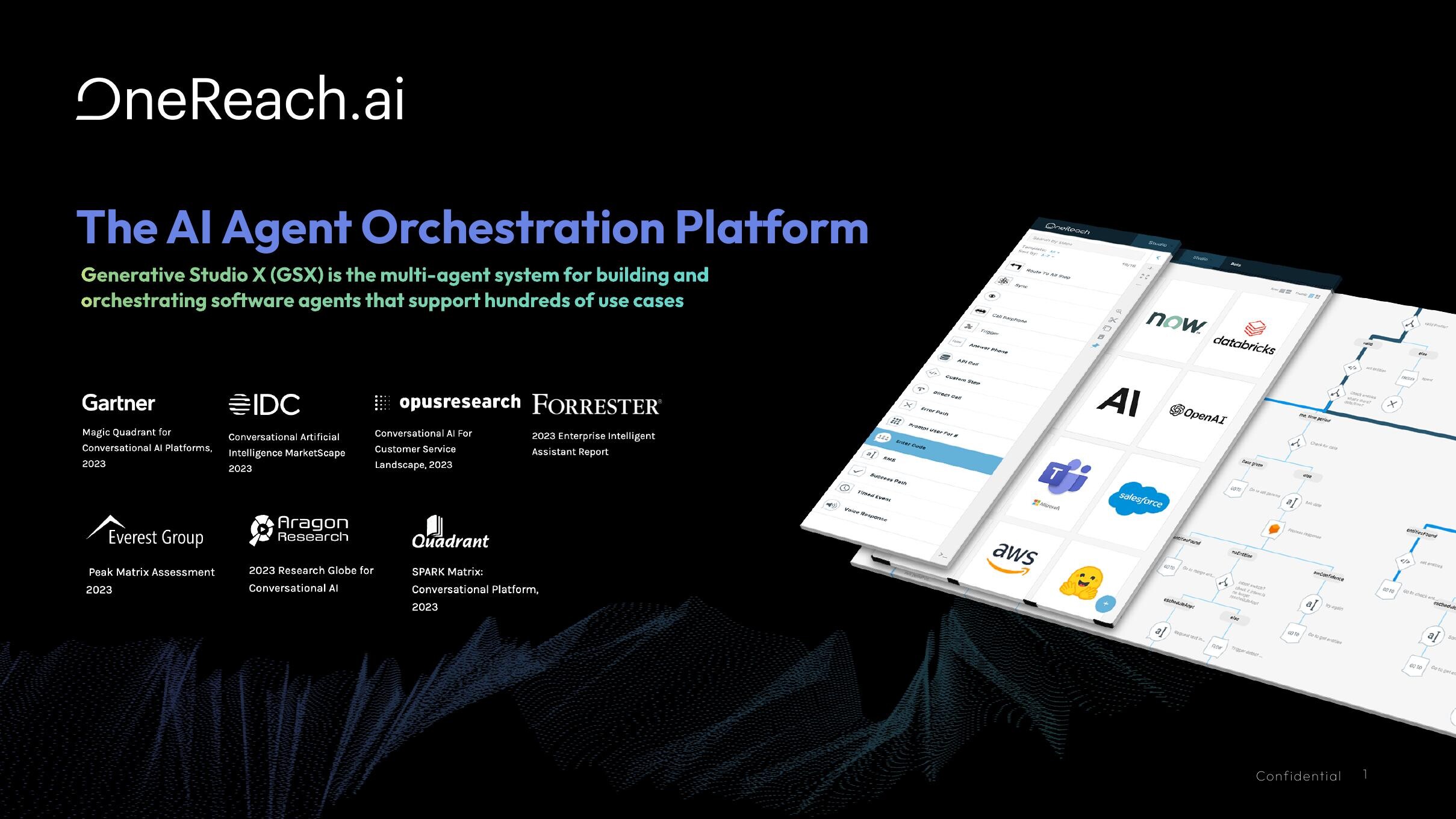
That is the cleanest way to understand the Denver-and-Berkeley company. OneReach.ai makes Generative Studio X, or GSX: part agent builder, part runtime, part switchboard and part control tower. Companies use it to create AI agents, connect them to old and new systems, move conversations among voice, text, email and workplace apps, preserve context, test behavior, meter cost and keep a human available when the software reaches its limits.
The chatbot is the visible bit. OneReach.ai is selling all the plumbing you only notice when it breaks.YesPress analysis
The product is what happens between the prompt and the outcome
AI demos tend to end at the answer. Enterprises care about what happens next. Can the agent authenticate the customer, check the billing system, change a plan, send a confirmation, preserve the interaction for an auditor and hand the case to a person without making the customer start over? GSX is built around that longer chain.
Its toolkit spans no-code drag-and-drop, low-code configuration and full JavaScript or JSON. A library of more than 1,200 reusable steps handles integrations and pieces of workflow. Agents can call different large language models, speech engines and company knowledge sources. A private dedicated environment can sit in OneReach.ai's AWS infrastructure or the customer's cloud tenant. The company also sells the people around the software: design, implementation, training, managed operation and round-the-clock support.
OneReach.ai's unusual definition of an agent sharpens the distinction. Rather than imagining a permanent digital employee with a fixed script, it describes agents as temporary functions assembled around an objective. The system can activate the right skills, models and permissions for the job, then orchestrate their collaboration. A customer-service agent might authenticate a caller, retrieve an account, interpret policy, trigger a refund and ask for human approval at the expensive step.
Lebara replaced repetition with memory
Lebara offers the most legible named example. The telecom operator serves more than five million customers across nine countries. Its support stack had become a familiar enterprise collage: multiple ServiceNow instances, a web FAQ bot, regional telecom deployments, separate CRM and billing systems, and customer identity that vanished whenever the channel changed. More than 87 percent of digital interactions still needed a human.
The GSX deployment replaced the FAQ bot with skill-based agents for jobs such as SIM swaps, port-ins and balance inquiries. A dedicated verification agent authenticated the customer once. Context survived the handoff to a person. Retrieval-based answers could draw from company material while agents acted in billing and provisioning systems. According to the published case study, the containment rate moved from 17 percent to 30 percent, AI agents handled 62 percent more sessions and Net Promoter Score rose 41 points.
An anonymized Fortune 50 retailer supplies the bigger dollar figure. The company had no centralized contact center and too many calls landing in stores. OneReach.ai says the program introduced AI phone handling, a new contact center with human-in-the-loop tools and SMS across customer applications. It moved through 350 production releases. The reported result was 47 percent fewer store calls, a 65 NPS, 9.7 percent more new-sales calls and a $77 million annual improvement in gross profit.
Those numbers come from OneReach.ai's own case studies, so they deserve the same caution as any vendor-published result. Still, the operating pattern is more interesting than the victory lap: an executive sponsor, hundreds of releases and an expansion tied to measured customer behavior. The first thing that failed in both the retailer and Fortune 50 employee stories was fragmentation - disconnected channels, narrow bots and technical debt. The fix was organizational as much as technical.
The business model tells you what OneReach.ai believes
Most software pricing smuggles in a theory of use. Charge per seat and collaboration becomes expensive. Charge per agent and the vendor benefits from agent sprawl. Mark up model tokens and every inefficient prompt becomes revenue. OneReach.ai says it avoids all three. GSX pricing is based on the concurrency and processing capacity of a private dedicated environment. Users and solutions are unlimited, while model tokens, cloud compute, telephony and storage pass through at cost.
The number the website does not provide is the number procurement wants: an actual list price. Contracts are quoted after sizing the environment. That makes direct comparison difficult, and private infrastructure plus implementation services are unlikely to be the bargain option for a small team. OneReach.ai argues that the curve improves as use expands because capacity tiers flatten and the customer owns the source code, orchestration logic and configurations it builds.
That model places GSX in a crowded but shifting market. Kore.ai, Cognigy, Amelia, Parloa and PolyAI approach from conversational automation. ServiceNow, Salesforce, Microsoft, Google and IBM arrive with enormous installed bases. Engineering teams can assemble their own stacks with cloud models, LangChain, CrewAI and a growing shelf of open protocols. OneReach.ai's defense is accumulated connective tissue: multimodal sessions, identity, model routing, reusable workflows, testing, observability, private deployment and governance in one system.
A decade of being early - and the danger of being too much
Founded in 2012, OneReach.ai traces its technology to five years of research with roots in a DARPA program from the same broad lineage that produced Siri. Chief executive and co-founder Robb Wilson came from user-experience design, not the post-ChatGPT gold rush. That history explains why the product is obsessed with conversation, channels and designing around people. The company says its remote team includes engineers and data scientists alongside linguists, anthropologists and UX specialists.
Its market language has evolved with the industry: bots became intelligent digital workers, conversational AI became agentic orchestration, and automation became a route toward what Wilson calls organizational AGI. The durable elements beneath those labels are less fashionable: connect the systems, preserve context, let specialists reuse capabilities, and keep the work observable.
The company now claims more than 1.5 billion agent interactions a year and over 10,000 enterprise agent deployments. It has a 2022 growth investment from LoneTree Capital, with the amount undisclosed, and recent distribution partnerships with Sinch and Crexendo. Sinch contributes global messaging, voice and email reach. Crexendo brings a communications-platform ecosystem serving more than 300,000 businesses and six million end users.
“The greatest value agentic AI can deliver is not found in any individual agent.”OneReach.ai's stated view of connected agents
There are conditions under which this approach will not work. If a company has one bounded automation, few integration requirements and no regulated data, a full private agent platform may be too much machinery. If internal data is unreliable, ownership is vague or nobody can define success before launch, orchestration merely connects the confusion faster. No-code tools do not erase process design. Governance does not rescue a workflow no employee wants.
The copyable lesson is smaller than the platform pitch. Start with a painful workflow whose baseline can be counted. Include the people who own the process and the people who answer when it fails. Connect enough systems to finish the job, not merely discuss it. Preserve the path to a human. Release in increments. Record which model, tool and step produced the outcome. Then turn what worked into shared infrastructure.
That is also OneReach.ai's central wager. Building an agent is becoming cheap. Coordinating a fleet inside a real institution remains slow, political and technically fussy. The winner may not be the company with the most human-sounding bot. It may be the one that helps all the bots behave like a system - and gives the humans a clear view of the runway.