The most revealing thing about TP is how easily its work disappears. A customer gets help with a banking app, a technical problem or an overdue bill. The brand on the screen gets the credit, or the complaint. Behind that exchange may sit an employee of a French company whose own name never enters the conversation.
For decades, that was a useful place to build a business. TP, formerly branded Teleperformance, organized the people and processes that other organizations needed but did not necessarily want to run. Now it faces a more awkward assignment: automate parts of that work while convincing clients to keep paying it to take responsibility for the result.
The stakes are substantial. TP reported €10.209 billion in revenue for 2025. Its investor website describes nearly 490,000 employees working across nearly 100 countries. A company with that many people cannot reinvent itself with a product announcement. Every new tool eventually meets a roster, a training session and an actual customer.
Ten telephone lines, then a €3 billion purchase
Daniel Julien started Teleperformance in Paris in 1978 with ten telephone lines. The detail has the charm of a museum exhibit: an international service business before the cloud, before the smartphone, before a support conversation could begin in a chat window.
Expansion followed the customers and the telephone network. Belgium and Italy came in 1986; a US call center followed in 1993. Acquisitions later accelerated the spread. In November 2023, TP completed its purchase of Majorel, a transaction valuing the rival at approximately €3 billion. The deal added operations and expertise to an already sprawling group.
Buying that reach made strategic sense in a business where a multinational client may need several languages, delivery locations and operating hours from one supplier. It also made the AI question more expensive. A large delivery network is valuable when customers need it. Automation changes how much of that network they might need for each task.
2023 · acquisition
2025 · speech technology
One bought operating reach. The other bought a stake in technology for the conversation itself. Different currencies; figures are not plotted to scale.
The work continues after “How can I help?”
Calling TP a call-center operator captures the familiar part and misses much of the invoice. Its customer-facing work includes support, technical assistance, sales and retention. Its back-office offering extends into finance, accounting, HR, document handling and data processing. There is also Trust & Safety work, including content moderation and protection against online abuse and fraud.
The specialized businesses widen the picture further. LanguageLine provides interpreting services. TLScontact supports visa application processes. These activities require their own expertise, even when the common commercial proposition is similar: let an outside operator manage a process that must happen reliably, repeatedly and across organizational boundaries.
TP sells to enterprises and public-sector organizations. Its industry coverage includes banking, healthcare, technology, travel and retail. The person seeking help is often the end user; the organization commissioning the service is the customer paying TP. That distinction explains why consumers can encounter the business without ever deciding to buy from it.
Its business model is built around negotiated service engagements. For a buyer, the practical budget includes the work transferred, staffing, languages, operating hours, technology integration and oversight. Comparing that with a chatbot subscription alone would miss much of the assignment. Someone still has to connect the systems, manage exceptions and take responsibility when a process stops working.
Four ways to put AI to work
In February 2025, Teleperformance adopted TP as its commercial brand. In June came Future Forward, a strategy that included TP.ai FAB, short for Foundational AI Backbone. The proposed role was to coordinate AI, automation and human expertise across operations.
The product names are easier to understand as jobs. Connect coordinates work among AI agents and people. Assist supports employees as they carry out tasks. Growth applies AI to sales operations. Collect focuses on debt recovery. The portfolio gives TP several ways into a client’s operation, from helping an existing employee to handling part of an interaction automatically.
A question, a payment issue, a support case.
AI handles suitable tasks; people take complex or sensitive cases.
Systems, records and quality checks must support the answer.
A published TP case makes the proposition concrete. Sparda-Bank West faced more than 150,000 calls during an online banking migration. TP says its Connect deployment achieved 46% first-call resolution while supporting digital onboarding. That is a defined use case with a reported result, rather than a promise that any bank can replace its service team.
Another company-published case describes a 38% increase in sales conversions for an unnamed American technology provider using interaction analytics. The client’s initial problems included flat conversions, repeat contacts and slow manual quality assessment. Here, the first bottleneck was the feedback process: managers needed to understand conversations quickly enough to coach the people conducting them.
These figures are TP’s case-study claims, not universal benchmarks. They nevertheless point toward a useful buying question: which specific failure in the current operation will this deployment fix?
The microphone is part of the strategy
TP is assembling technology from partners as well as developing its own offerings. Its approximately $13 million investment in Sanas accompanied a speech-technology partnership announced in February 2025. Sanas works on real-time speech understanding, including noise cancellation and accent translation. The attraction is unusually tangible: improve what a caller can hear and understand while the conversation is happening.
Other partnerships reach further into the machinery. Microsoft Azure supports cloud services; Parloa supplies AI agent technology; Ema focuses on agentic automation. Future Forward included plans for up to €100 million in AI partnership investments during 2025 and the acquisition of Agents Only, a platform for sourcing skilled specialists. Planned spending should not be confused with a final bill.
The combination suggests where TP wants to sit in the market: close enough to the technology to shape its use, and close enough to the operation to run it. The strategy depends on clients valuing the integration and delivery work, even as individual software components become easier to obtain.
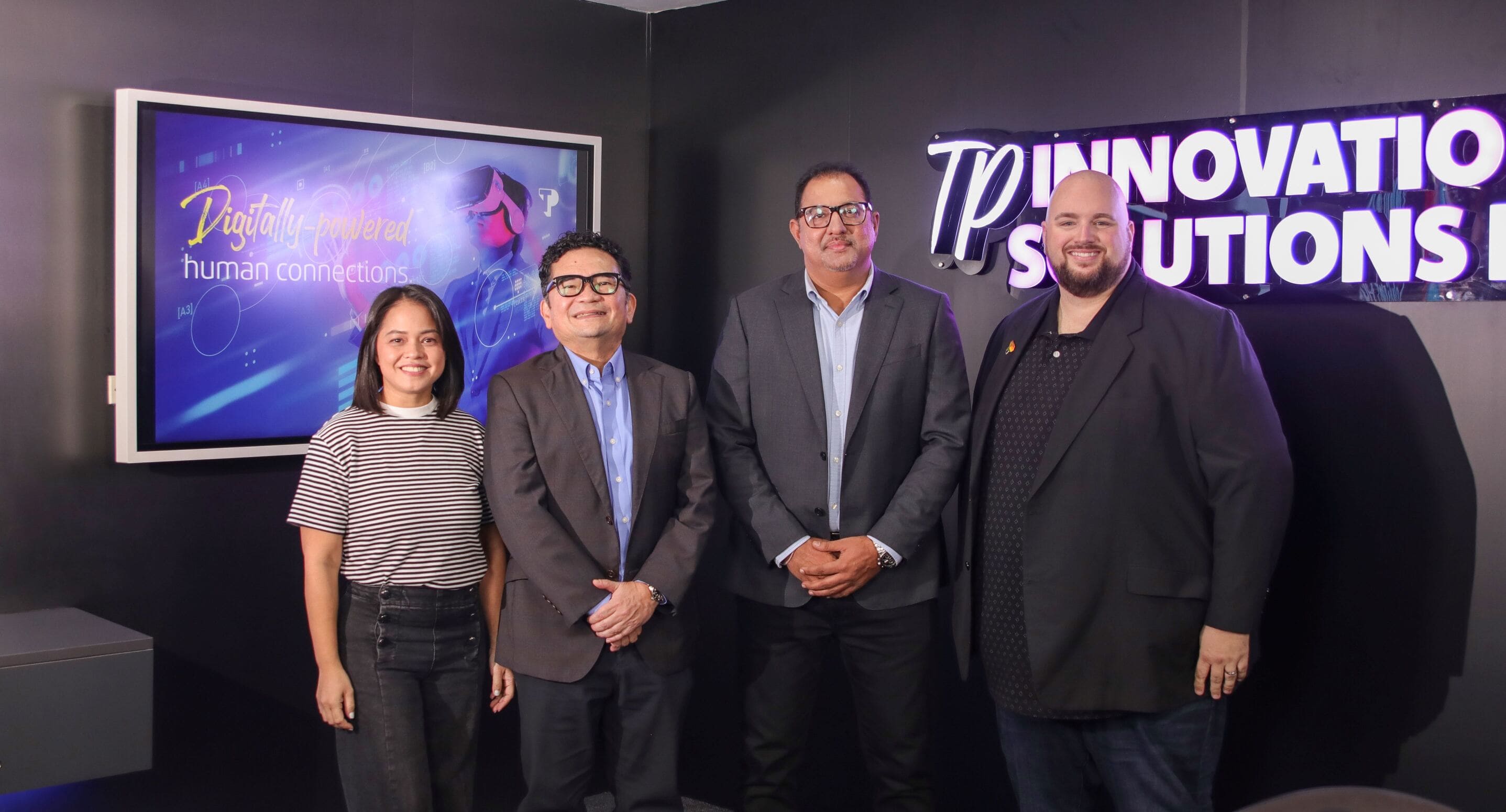
“Empathy, from my perspective, drives innovation.”
Rahul Jolly · TP Philippines CEO
TP interview article, September 2025
A workforce is also a responsibility
TP emphasizes emotional intelligence and development. Its 2025 integrated report says 68% of management positions were filled through internal promotion. That matters in an operation where people need to learn client systems, coach colleagues and manage service quality. Institutional knowledge accumulates in the workforce.
Its labor history also complicates the polished picture. In 2022, TIME reported allegations about traumatic working conditions, low pay and anti-union practices among Colombian TikTok moderators employed by Teleperformance. Colombia’s labor ministry opened an investigation. These were reported allegations, not a finding that every claim had been established.
TP’s subsequent reporting described psychological support and training, and said it had decided, after consulting stakeholders, to withdraw from the most offensive moderation segment. A global agreement with UNI Global Union followed in December 2022; a Colombian implementation agreement was announced in April 2023.
The episode exposes a cost that an efficiency chart can conceal. Some outsourced work means repeatedly confronting distressing material. For a buyer, staff support, worker representation and escalation procedures belong in the operating specification. Moving the work to a supplier still leaves a relationship to supervise.
The numbers have not caught up with the pitch
The latest results keep the reinvention grounded. In the first half of 2026, TP reported €4.883 billion in revenue, down 1.7% on a like-for-like basis. Recurring EBITA margin held at 13.6%. The company described continuing weakness in Trust & Safety, alongside support from back-office and AI-powered services.
Like-for-like revenue change
Recurring EBITA margin, unchanged
TP also expected €120 million to €140 million in restructuring costs for 2026. That is a reminder that redesigning operations consumes money before savings become routine. Earlier, its 2025 results showed Specialized Services revenue affected by the non-renewal of a significant visa application contract. Even a global supplier can feel the loss of one important assignment.
Jorge Amar became group CEO in March 2026, succeeding Julien. TP presented his experience in AI-based customer operations as central to the appointment. The management change puts responsibility for the next phase in new hands; the results will show whether that phase produces more than efficiencies.
Buy the resolution, inspect the handoff
TP faces established alternatives including Concentrix, Foundever, TTEC and Alorica. Clients can also retain work internally or automate selected tasks themselves. Its distinction is the breadth of its operating network and service portfolio. AI plus human support is a proposition competitors can make too.
Our reading of TP’s cases suggests a practical approach for buyers: start with one troublesome workflow, establish a baseline, then measure whether the problem actually gets resolved. Count repeat contacts and errors alongside handling time. Specify when a person takes over and who maintains the knowledge the system uses.
A small, straightforward support operation may have little use for a multinational delivery network. A process with unreliable records or unclear decision rights needs repair before automation can deliver much. TP’s most credible opportunity is the difficult middle: organizations with enough complexity to need an operator, and enough repeatable work to benefit from better tools.
The company has spent decades making other brands sound organized. Its next assignment is to make its own combination of people and machines work well enough that clients keep handing it the phone.