The drones were coming home when the trouble began. After months of useful service in Ukraine, aircraft supplied by Quantum Systems started crashing in late 2022. The wings had not suddenly forgotten how to produce lift. Russian electronic warfare was disrupting the satellite signals the machines used to navigate. A successful flight out no longer guaranteed a successful flight back.
- Vertical takeoff, fixed-wing flight and onboard intelligence in one aircraft.
- Military reconnaissance and commercial mapping share the engineering.
- The next bet: common software connecting air, ground and maritime systems.
That episode, described in reporting the following year, is a useful place to meet this German company. Quantum Systems makes drones, but its experience exposes a larger problem in autonomous machines: the world keeps changing the conditions of the test. A specification describes what an aircraft can do. An operator discovers what it can survive.
01 / The signal disappears
“It was this mystery.”
Sven Kruck, on the navigation failures
The response combined AI-assisted flight software, an option for manual recovery using an Xbox controller, and a service center that could follow the electronic interference. Engineers gathered information from operators, tested changes and repeated the process. The repair was technical. The method depended on people talking to one another.
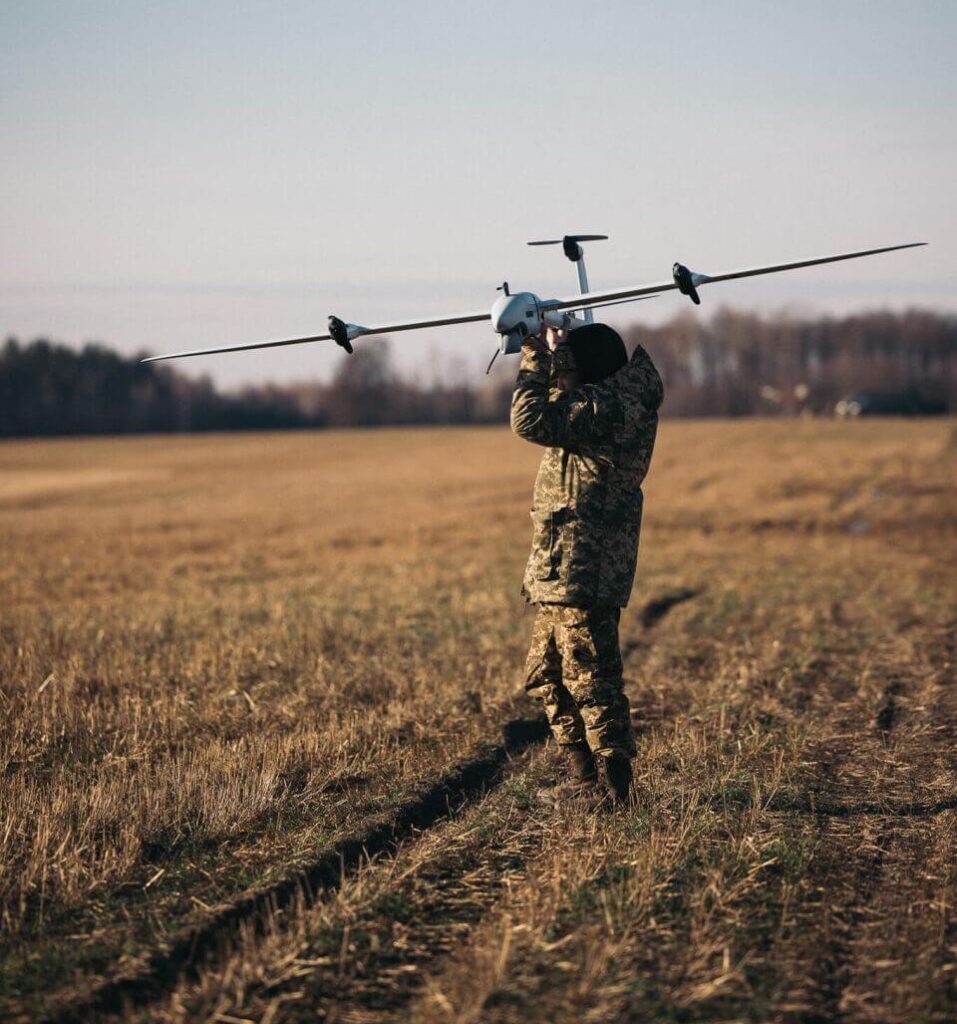
This helps explain the company’s emphasis on onboard computing. Vector AI, its current mid-range reconnaissance aircraft, uses NVIDIA Jetson Orin modules to process camera information on the aircraft. Its navigation technology combines visual information and other sensors to reduce dependence on satellite positioning. Processing locally also reduces how much work must wait for an external connection.
Those are responses to an adversary who can change tactics. They establish no permanent immunity to interference. The interesting achievement is the ability to revise a machine after the environment exposes a weakness. Buyers need evidence from their own operating conditions; a reassuring adjective on a datasheet cannot substitute for that.
02 / A runway is a luxury
The original design problem was wonderfully physical. Fixed-wing aircraft travel efficiently. Multicopters can rise from a small patch of ground. Put those abilities together and an operator can cover territory without bringing a runway, catapult or elaborate recovery equipment. The engineering team took shape in 2011; Florian Seibel, Michael Kriegel, Tobias Kloss and Armin Busse founded Quantum Systems in 2015.
Seibel had been a military helicopter pilot and an aerospace researcher. He abandoned an unfinished doctorate to build the company. That background makes the attention to launch and recovery understandable: getting an aircraft airborne is part of the mission, with its own demands on space, equipment and personnel.
Vector AI carries that practical thinking into its modular design. The same central fuselage, avionics, controller and sensors can support a fixed-wing or multicopter configuration. The operator keeps a familiar interface. Meanwhile, Trinity Pro serves mapping professionals, pairing flight hardware with QBase 3D mission planning and interchangeable sensors. A surveyor’s map and a soldier’s reconnaissance feed require different workflows, but both begin with collecting usable observations.
Conceptual flight sequence; operating limits vary by platform and mission.
03 / The repair shop belongs in the product
Customers include armed forces in Germany, Ukraine, Australia, New Zealand and Spain. Commercial examples named by Quantum Systems include RocketDNA and India’s Department for Science and Technology. These buyers need the observations for different decisions: reconnaissance, terrain analysis, surveying, infrastructure work. The common problem is obtaining information without putting a person at every point being observed.
Australia provides a revealing business example. The company announced two contracts totaling A$90 million in 2024. One covered acquisition of Vector/Scorpion systems. The other covered training, maintenance, engineering, supply, logistics and support, continuing into 2031. That total is a program commitment, rather than a reliable price tag for one aircraft.
In April 2024, Quantum Systems also announced a Ukrainian factory and investment of up to €6 million over two years. Local capacity puts production and expertise closer to the people discovering problems. The lesson other businesses can copy is straightforward: give customer experience a short route back to engineering, and budget for what happens after delivery.

04 / A billion dollars meets the factory floor
In July 2026, Quantum Systems announced the signing of a $1.2 billion Series D, at roughly $8 billion post-money. Blackstone, Noteus, Airbus and Advent co-led it. The stated uses included production capacity, stronger supply chains, delivery across allied markets, software and AI. The company also reported more than 19,000 missions by its systems in Ukraine during 2025.
Company-reported operational activity
Capital is only useful here if it becomes delivered capability. An April 2026 U.S. Army award for Vector AI was valued at $15.3 million. Such procurement puts Quantum Systems in a market where alternatives range from AeroVironment’s tactical reconnaissance aircraft to TEKEVER’s fixed-wing systems. The relevant comparison depends on the mission: launch footprint, sensors, endurance, integration and support all matter.
05 / One software layer, three domains
The next expansion reaches beyond aircraft. MOSAIC UXS is Quantum Systems’ mission software for coordinating unmanned platforms and sensor information. In September 2026, the company introduced Seavex and Subvex, surface and underwater systems entering sea-trial validation. It also announced a partnership to integrate XTEND’s autonomous mission capabilities into its software ecosystem.
That broadens the challenge considerably. A fleet needs compatible interfaces, dependable communications and people trained to manage it. Maritime trials should be judged as trials. Shared software must prove useful across different machines. For an organization needing only a simple, short-range inspection, this much integration may bring unnecessary cost and complexity.
There is a second route to expansion: manufacture someone else’s field-tested design. In October 2026, Quantum Frontline Industries, its joint venture with Frontline Robotics, announced a further National Guard of Ukraine order for Linza and Zoom drones for 2027. The venture said it planned to increase production capacity fivefold. That remains a production plan, with the harder test of delivery still ahead.
For buyers, the useful starting point is the decision they need to make. A mapping team needs appropriate sensors and a dependable route from collected data to a usable map. A reconnaissance unit needs timely observations, communications and recovery options. Both need trained operators and maintenance. Comparing only the aircraft risks leaving the most expensive operational problems outside the purchasing decision.
Quantum Systems’ most portable idea remains the one forced upon it when aircraft stopped coming home: stay close enough to the user to learn what the specification missed. Every new domain will supply fresh omissions.