In 2002, the people at Primavera were working nights and weekends to finish a software release. They sold tools that helped other people plan projects. Their own release arrived three weeks late, with management judging it incomplete and developers exhausted. For a scheduling company, this was an awkward demonstration of the difference between owning a plan and being able to deliver it.
- Primavera made complex project schedules a software business.
- Its own delivery problems prompted a change in development practices.
- Oracle acquired the company in 2008; P6, Primavera Cloud, and Unifier serve different needs today.
The contradiction is useful. A project can have dates, dependencies, and a handsome chart while the organization around it makes promises the team cannot keep. Primavera’s story belongs to anyone who has watched a green status report turn into a very red meeting.
Before the cloud, there was a railway
Joel Koppelman brought an engineer’s experience to the business he co-founded in 1983. Before Primavera, he worked at Day & Zimmermann, where his assignments included management controls for the initial 18-mile Los Angeles Metro Rail project. These were physical systems: routes, construction work, capital commitments. An optimistic assumption could travel a considerable distance before anyone caught it.
Alongside Dick Faris and Les Seskin, Koppelman helped establish a company that put project planning into software. Primavera grew around a demanding question: when work depends on other work, what happens to the finish date when something changes?
Consider a simplified construction sequence. An inspection must precede the next trade’s work. That crew also has commitments elsewhere. Move the inspection and you may change both the sequence and the availability of people. The planner needs to understand the consequences, rather than simply drag a colored bar to Friday.
That is the territory of critical-path scheduling, resource planning, and project controls. Primavera’s customers include the organizations that build infrastructure, operate utilities, and coordinate engineering programs. Their problem is less about remembering a task than understanding how thousands of commitments fit together.
There is an economic reason to care about that distinction. A team can finish its own assignment efficiently while leaving another team unable to start. Looking at the whole sequence changes the conversation from individual busyness to the work that governs completion. That is the useful promise behind a project schedule.
The meeting was part of the machinery
Inside Primavera, the development problem involved how decisions were made. In a 2005 account, company development leaders Bob Schatz and Ibrahim Abdelshafi described a command-and-control approach that kept decisions distant from the developers doing the work.
“The truth is, we struggle just like everyone else.”
Bob Schatz and Ibrahim Abdelshafi
Primavera Gets Agile, 2005
In 2003, Primavera tried Scrum, followed by Extreme Programming practices. A contemporary case study reported a better-received release and more participation in trade-off decisions. The interesting change was organizational: people across functions became involved in deciding what the team could accomplish.
The interpretation worth borrowing is modest. Give people who understand the work a voice before a commitment hardens into a deadline. Review what actually works. Let new information change priorities. A planning system helps when the organization can respond to what it discovers.
One name. Several buying decisions.
By December 2006, Primavera was broadening its scope through acquisitions. ProSight added portfolio analysis; Pertmaster added risk analysis and mitigation. Choosing the right projects and anticipating uncertainty became part of a business already concerned with executing the work.
Oracle announced its agreement to acquire Primavera in October 2008, without disclosing financial terms. Its announcement described a business aimed at project-intensive industries including construction, aerospace, utilities, and energy. The company’s name survived inside a larger software portfolio.
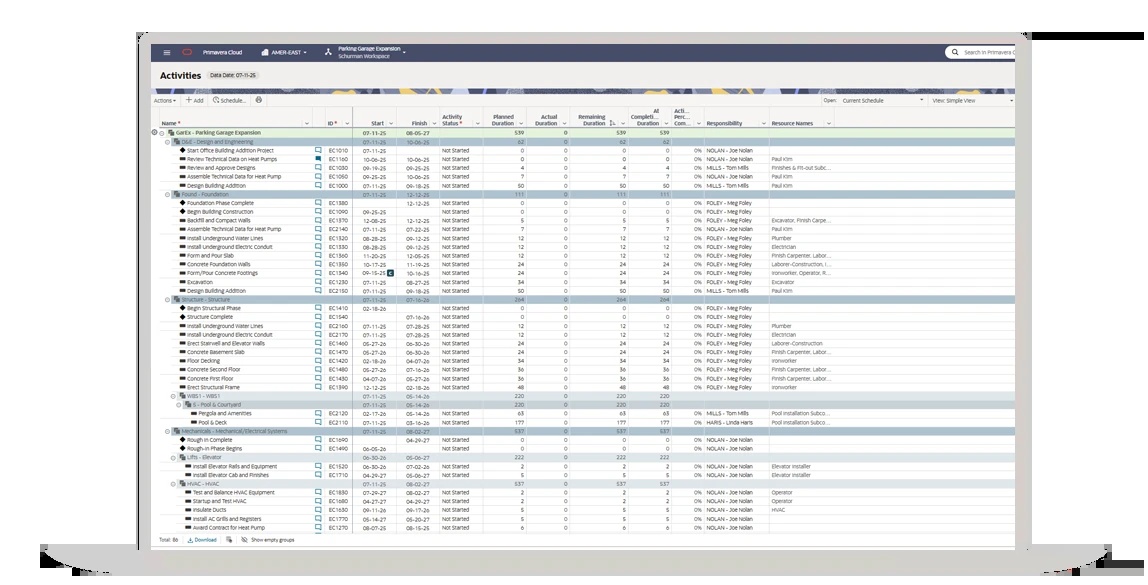
Today, buyers need to look past that shared name. P6 Enterprise Project Portfolio Management handles enterprise scheduling, resources, programs, and portfolios. Oracle documents both cloud and on-premises deployments. Primavera Cloud is a separate service connecting contract schedules with field planning, resources, and risk. Unifier focuses on project controls, costs, workflows, and assets.
Primavera’s position is therefore more specific than general team productivity. It addresses the coordination and controls around project delivery. Microsoft Project and premium Planner plans also offer scheduling and dependencies; Safran supplies scheduling and risk tools. The meaningful comparison starts with required workflows, deployment, and the schedules that owners and contractors need to exchange.
The price of a useful plan
One public benchmark comes from Laminar Projects’ UK Digital Marketplace listing: P6 EPPM Cloud at £176 to £220 per licence per month. That is a particular supplier’s offer, rather than a universal Primavera tariff. Ten licences at those listed rates imply £21,120 to £26,400 annually, before any separately charged work.
per licence / month
Supplier: Laminar Projects · UK Digital Marketplace
The deployment budget also needs a scope. Oracle’s onboarding guidance calls out administrators, workspaces, dictionaries, and integration choices. Someone must decide how calendars, codes, and incoming project data will be organized. Those decisions demand time even when the software is already available.
Customer stories show different reasons to make that effort. Oracle reports that Miller Valentine selected Primavera Cloud after increasing project complexity outgrew its previous scheduling tools. MWH Treatment moved P6 EPPM from its on-premises environment to Oracle’s cloud, reporting lower costs and easier subscription administration. These are vendor-published accounts, with benefits tied to each organization’s circumstances.
A sensible first exercise is to take one real project and ask who will maintain the schedule, who will report progress, and who will resolve conflicts over shared resources. Oracle offers free video-based learning through MyLearn, alongside paid training formats. Learning the interface helps; agreeing on those responsibilities makes the exercise meaningful.
Keep the plan open to correction
The products continue to change. Primavera Cloud’s October 2026 release documents fiscal-year funding support and a process for proposing project risks for a shared library. The latter makes an appealing connection: a discovery on one project can inform another.
The practical limit remains human. If progress updates are unreliable, detailed schedules can produce precise-looking answers from weak assumptions. A small team with straightforward work may find the setup harder to justify. The habit anyone can copy is simpler: name the dependencies, invite corrections, and make trade-offs visible while there is still time to act.