At S2E, a French employee-savings services company, a portfolio report could take about twenty days to assemble. Project information lived in three different tools. People reconciled it by hand. By the time the summary reached its audience, the work it described had moved on. Imagine navigating with a map that takes three weeks to unfold.
- Sciforma connects project selection with the people, money, and time available to deliver.
- Planview acquired it in February 2025. Its Vantage platform is now ProjectAdvantage.
- The practical lesson: pilot with real users, share the underlying data, and resist unnecessary customization.
01 / The report was the symptom
S2E’s difficulty was more revealing than a slow spreadsheet. Time, budgets, and project operations had separate homes. A common management process was hard to establish because the information needed to support it was scattered. The company wanted a shared repository and a clearer relationship between project work and financial control.
That is Sciforma’s territory. A project manager wants to know whether one assignment will finish on schedule. A portfolio manager needs to know whether all the assignments can coexist. Put five plausible plans beside one another and a shared engineer, laboratory, or budget can become the constraint. Software that sees only one plan misses the argument happening between them.
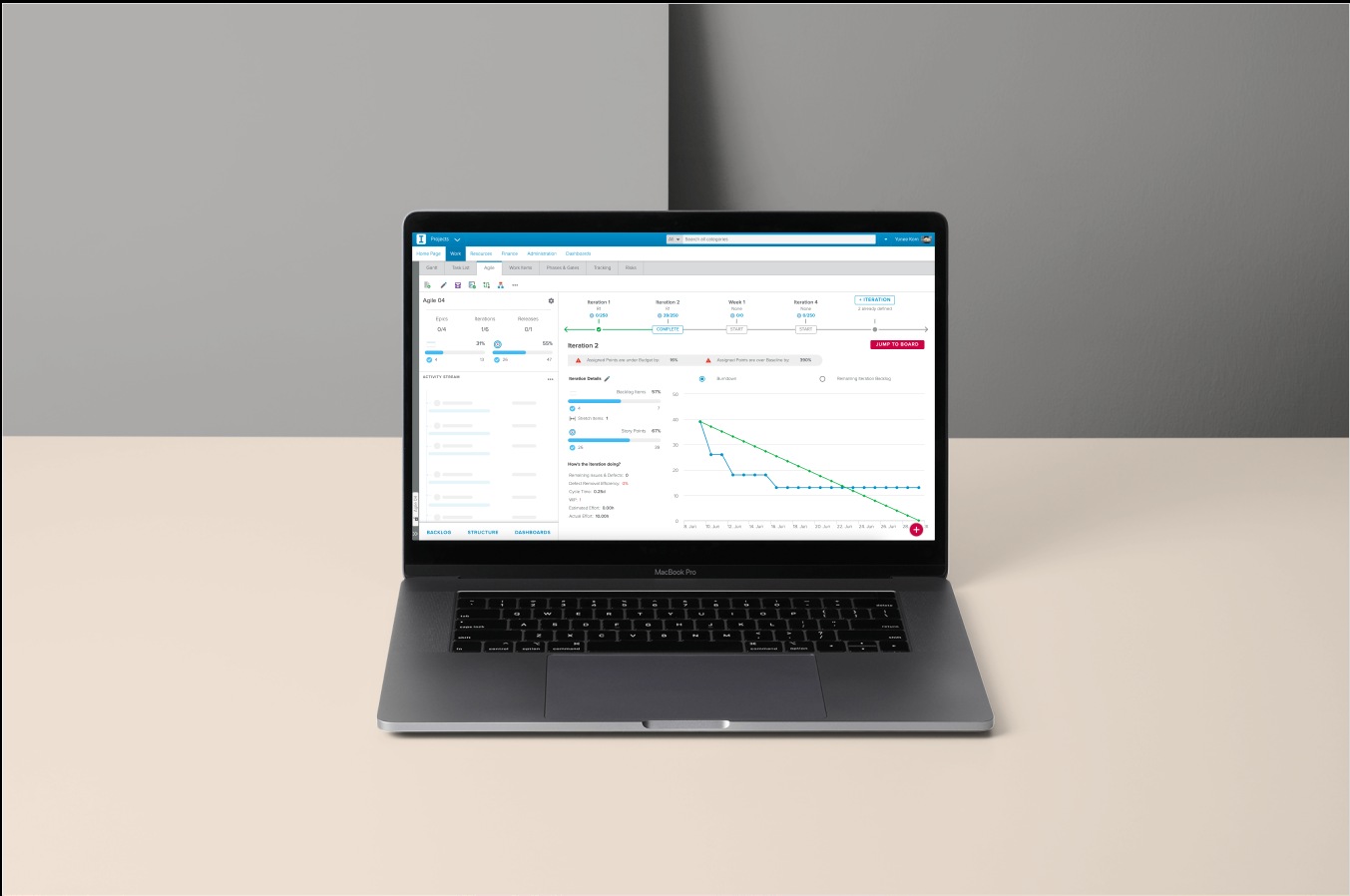
Sciforma sells the machinery for having that argument earlier: demand intake, portfolio evaluation, project planning, resource management, time recording, and reporting. Its expertise sits where organizational priorities meet delivery details. The customers are typically project management offices in midsize and large organizations, including IT departments, manufacturers, researchers, and public agencies.
02 / The meeting before the meeting
Consider Gravotech, which makes marking and engraving equipment. Its R&D organization adopted phase-gate management: projects would pass through explicit reviews of schedules, technical performance, and budgets. The discipline made sense. Preparing for it with Excel had become cumbersome.
Sciforma went into the R&D department in July 2021. Standard templates brought resource plans, costs, and deliverables together. Gravotech subsequently reported cutting gate-review preparation time by two-thirds. That is a customer account published by the vendor, so treat it as one organization’s result. Still, it identifies a useful mechanism: fewer separate records to reconcile before a decision.
“We reduced the time spent preparing reviews by two-thirds.”Gabriel Kretzschmar / Project Manager, Gravotech
The more interesting gain was the conversation afterward. A shared picture of team availability helped leaders assess proposed product launches against capacity. The review could spend less attention establishing which numbers were current and more attention deciding what those numbers allowed.
03 / A small pilot, a deliberate restraint
S2E provides a second lesson. Its IT deployment began on January 1, 2021, after a pilot lasting roughly six weeks with about twenty users. An expert supported the rollout through use cases, configuration, training, and user assistance. This was an implementation process with people doing the work around the software.
The team also stayed close to the standard product. Experience had made it wary of maintaining an excessively customized system. The portable idea is straightforward: use a small group to test the actual work, identify the few adjustments that matter, and keep the rest ordinary. A system can be configurable without becoming a monument to every historical exception.
Bioaster, the French microbiology research institute, adds an adoption test. Its projects share scientific resources and bring together partners with different constraints. After implementation, project managers began using Sciforma’s consolidated data in their own presentations. That behavior matters. Information becomes useful when the people producing it also find reasons to use it.
There is a management choice buried in these examples. Reporting can be treated as a tax paid to headquarters, with each team surrendering a different version of events. Or the same records can help teams make their own choices. The second arrangement gives people a reason to care about accuracy before someone asks for a monthly slide deck. It also gives managers a practical adoption question: which decisions became easier this week?
04 / The name on the door changed
Sciforma’s software history reaches back to 1982. A 2015 release announcement traced a journey through DOS, Windows, Java, and finally HTML5. That lineage helps explain the company’s place in the market: an established portfolio-management specialist with accumulated scheduling and governance machinery.
Ownership changed too. STG acquired Sciforma in March 2021. One2Team joined that October; KeyedIn followed in 2023. Planview announced its completed acquisition on February 18, 2025, emphasizing a stronger European presence and continuity for existing customers. The former Sciforma Vantage is now marketed as Planview ProjectAdvantage.
Its position is easiest to understand through buying requirements. A department seeking shared checklists has a different problem from an R&D office balancing gates, scarce specialists, and competing investments. Sciforma belongs in the latter evaluation. Planisware is an enterprise portfolio alternative; a sensible comparison starts with the organization’s actual decisions and workflow.
05 / Put a price on the promise
The commercial model is enterprise software subscriptions, accompanied by deployment and support services. One concrete price appears in Xioma Information Solutions’ AWS Marketplace listing: $19,230 for a twelve-month, 25-user package, described as ten editors, fifteen viewers, and an administrator. It is a reseller offer with particular terms, rather than a universal price for every Sciforma customer.
A buyer should scope configuration, training, integrations, and ongoing administration alongside the subscription. The stronger evaluation asks the vendor to reproduce a real staffing conflict and a real approval meeting. Can the team see the trade-off? Can it keep the information current? Those questions reveal more than an immaculate demonstration dataset.
There are conditions attached. Stale timesheets produce stale forecasts. Unresolved priorities remain unresolved when moved into a dashboard. For a small team with little shared-resource contention, the machinery may exceed the problem. For an organization willing to maintain common data and act on capacity limits, it offers a useful discipline: a credible reason to say later before everybody has already said yes.