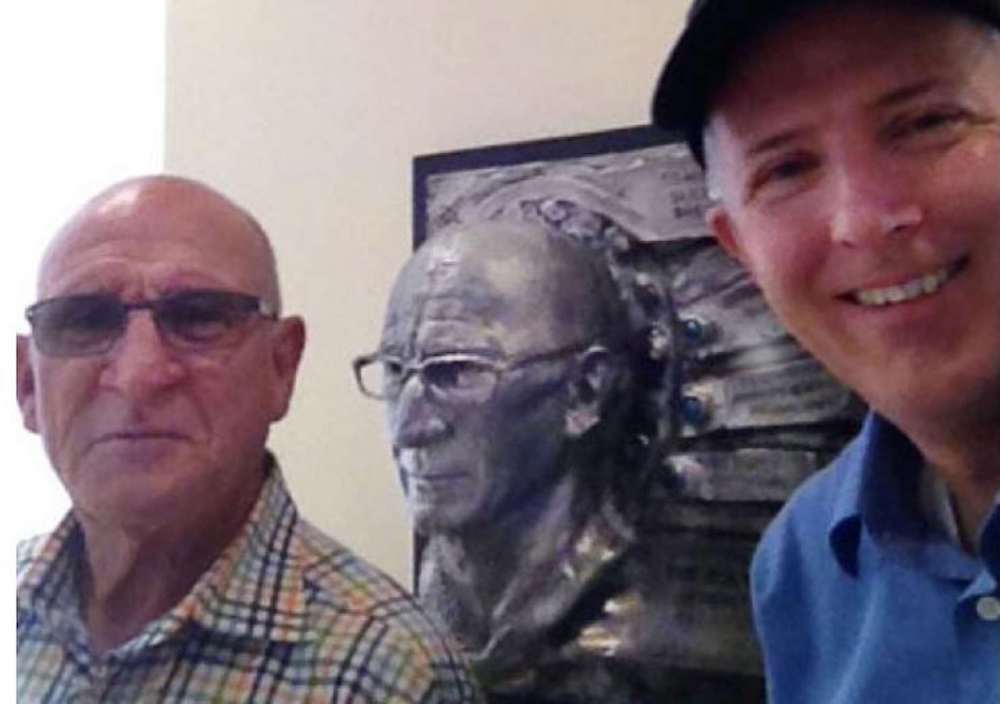
Peter Farrell has a face you can find in stainless steel. At ResMed, sculptor Richard Becker made a portrait of the founder, complete with glasses and the sort of permanence that comes with being cast in metal. There is a photograph of the two men beside the work. The living Farrell stands on the left; his metal likeness occupies the middle. For once, a founder has competition for the centre of the picture.
That is a useful place to begin with someone whose career keeps resisting the past tense. Farrell founded ResMed in 1989. He became its chair emeritus in January 2023. In 2026, he appears in the company’s proxy statement as a director, while a student entrepreneurship competition bearing his name continues at the University of New South Wales. The sculpture stays put. The interests travel.
His story passes through Australian universities, American graduate schools, corporate laboratories and boardrooms. Along the way, a scholarship student became a founder, then a donor interested in what other people might build. The recurring question is practical: what happens to an idea once someone has agreed it is interesting?
A scholarship and a longer route home
Farrell grew up in Sydney in a household of modest means. His father worked as an accountant and supplemented the family income as a bookmaker’s assistant on weekends. His mother encouraged further education. There is something pleasingly Australian about that combination: the household accounts, the racecourse and the conviction that a university place might alter the odds.
A scholarship helped take him to the University of Sydney, where he graduated with an honours degree in chemical engineering. Further study took him to MIT for a master’s degree and the University of Washington in Seattle for a doctorate. He later received a Doctor of Science from UNSW. The academic initials accumulate quickly; the geographical distance matters just as much. His working life would repeatedly cross the Pacific.
Before the founder’s title came a job with Union Carbide, first in Sydney and then in Montreal. Working around colleagues with advanced degrees encouraged him to seek more education. He became the first person in his family to attend college. That experience gives his later support for education a personal point of reference: someone had helped finance his own entrance.
- SydneyEngineering honours
- MITMaster’s degree
- WashingtonDoctorate
- UNSWDoctor of Science
The professor with a commercial second act
In 1978, Farrell became foundation director of a graduate engineering school at UNSW. He held that position through 1989. During the same decade, his responsibilities expanded into industry: from 1984 to 1989 he was a vice president of research and development at Baxter subsidiaries, and from 1985 he also ran Baxter’s research centre in Sydney.
The overlap is revealing. The familiar founder biography often moves briskly from education to a sudden moment of entrepreneurial courage. Farrell spent years inside institutions first. He had experience of research programmes, corporate responsibilities and the work of directing people before he established his own company. The leap came with a substantial amount of preparation already packed.
It also left him with a lasting interest in the awkward passage between a university idea and a business. A laboratory can establish that something works. A company must arrange for people to make it, finance it, distribute it and keep improving it. Farrell’s career sits in that passage, where a promising result acquires a payroll.
There is an unromantic virtue to this sort of engineering biography. The interesting object is only part of the story. The organisation around it must work too. A founder has to become interested in matters that rarely make it into the photograph: hiring, manufacturing, contracts and the money required to try again.
Nine people, then a public company
ResMed began in Australia in 1989 under the name ResCare, through a management buyout from Baxter. Its early scale is worth holding in mind. The business had nine employees in its first fiscal year, with revenue below US$1 million. A future public company was, at that point, a small collection of people doing a great many jobs.
In 1995, ResCare became ResMed. That June, the company listed on Nasdaq, raising US$24 million. Six years separate the founding from the flotation. On a timeline, that interval fits between two neat marks. Inside a business, six years is a considerable quantity of decisions, expenses and work that has to be done before anyone can admire the result.
Founded in Australia
Employees in the first fiscal year
Nasdaq listing
Farrell’s first period as chief executive ran from July 1990 to December 2007. He returned to the role in February 2011 and served until March 2013. These dates complicate the tidy image of a founder who starts a business and then retreats. His relationship with the executive chair moved through several arrangements as the company developed.
Recognition arrived on both sides of the Pacific. He was named Australian Entrepreneur of the Year in 2001. His professional affiliations also extend into engineering institutions, including the US National Academy of Engineering. The combination suits a career in which technical training and commercial responsibility have remained closely entangled.
A chair changes hands
In March 2013, Michael “Mick” Farrell became ResMed’s chief executive. Mick had joined the company in 2000 and held roles in business development, marketing and regional leadership before taking the top job. The family connection is plain; so is the extended period he spent working inside the business.
A decade later, the board appointed Mick chair as well. Peter became chair emeritus on January 25, 2023, while remaining a board member. The change separated two stages of the succession: responsibility for running the company had passed in 2013; the board chair followed in 2023.
Peter described wanting more time for other boards and philanthropic interests. He also said he would remain involved in the company’s strategy, innovation and culture. Emeritus can sound like a comfortable chair placed at a respectful distance from proceedings. Here, the announcement specified continuing work. His October 2026 proxy biography still records a directorship dating to the company’s beginning.
That leaves a more interesting portrait than either perpetual command or a ceremonial farewell. Farrell has changed his commitments while keeping a connection to the organisation he founded. It is a familiar challenge for founders with long tenures: how to make room for the next leadership while deciding which parts of one’s experience remain useful.
Giving, with an engineer’s questions attached
The Farrell Family Foundation was established in 2001. Its explanation of its origins makes clear that involving his children was part of the purpose. Peter, Catherine Sertori, Paul Farrell and Michael Farrell appear in its account of the family’s participation, alongside executive director Kristi Burlingame. Giving became a shared activity with responsibilities attached.
“We see our gift giving as an investment upon which we look for a return.”Peter Farrell
The return he describes is an improvement in society. That wording brings the vocabulary of business into philanthropy without much ceremony. It asks a donor to consider the consequence of a grant, and a family to discuss what it expects to change. A generous impulse still has to answer a practical question.
Education, technology and the arts feature in the foundation’s interests. Farrell’s university connections have also involved time as well as money. He served as a UC San Diego Foundation trustee from 2001 to 2007, and his university biographies record advisory work with the Rady School of Management and Jacobs School of Engineering. The businessman has continued returning to campus.
At UNSW, he pledged seed funding of $500,000 over five years for a centre concerned with innovation, commercialisation and entrepreneurship. Its ambition brought together students across disciplines and included the business of intellectual property and new ventures. The proposal addressed a problem he knew from both sides: how research might become an organisation able to stand on its own.
A cup for the unfinished idea
The Peter Farrell Cup makes that interest visible at student level. The UNSW competition gives early ideas a place to be tested through workshops, mentoring and pitches. Its 2020 edition selected 46 teams from 79 applications. Ten finalists competed for a share of $20,000. A student did not have to arrive with an established company to take part.
The programme’s range is part of its appeal. In 2020, recognised teams included Negotium, concerned with buying and selling businesses, and Freighto, which proposed a network of independent trucks. There was room for a business transaction and a freight problem in the same competition. Engineering habits could find work far beyond their original classroom.
By the 2026 finals, held on September 18, the programme reported 230 applications and 97 teams pitching in the semi-finals, with ten reaching the final. Those are counts of participation, rather than a prediction of future fortunes. They describe something more immediate: people have brought ideas far enough to put them in front of an audience.
Among the teams recognised in 2026 was Forte, an app for musicians to share their practice with others. Its pitch concerned the solitary hours involved in learning an instrument. That is a modest, recognisable frustration to bring to an entrepreneurship programme. It also gives the proceedings a human scale: a student can begin with something encountered in daily life, then ask whether other people might find a solution useful.
For Farrell, whose own route depended on education and crossed repeatedly between universities and business, that is a fitting continuing interest. A portrait can preserve the face of a founder. A student competition offers an untidier kind of continuation: someone else gets a chance to begin, without knowing yet how the story will turn out.
Continue the conversation
Explore Farrell’s current board biography, his LinkedIn profile and the Farrell Family Foundation.
Watch his Blenheim Partners conversation on YouTube or his Horatio Alger video profile. Visit the 2026 Peter Farrell Cup and Richard Becker’s portrait project.