In 2016, Jeffrey L. Cleland had a new company and an old address. Graybug Vision, the business he was running, had moved into the former Redwood City offices of Versartis, the company he had previously led. Silicon Valley likes a fresh beginning. This one came with a floor plan he might reasonably have recognized.
It is a pleasing detail because it brings an expansive career down to the size of a room. Cleland had already been a scientist, an executive, a co-founder and the chief executive of a publicly traded company. Here he was, back in familiar premises, with another enterprise to organize. The company name had changed. The work of making a company function had returned.
Today, Ashvattha Therapeutics lists him as its chief executive officer and founder. His professional history stretches across established organizations, young businesses, university connections and investor syndicates. The interesting question is how those different worlds fit into one working life. A doctorate supplies one kind of preparation. Running a company requires several more.
The office anecdote offers a useful place to begin. It suggests a career measured in repeated acts of assembly: people, capital, expertise and responsibility, brought together for a particular undertaking. For Cleland, a new venture has often meant another chance to put that assembly to work.
An engineer before the executive
Cleland studied chemical engineering at the University of California, Davis, then earned his doctorate in the same discipline at MIT. MIT identifies him with the PhD class of 1991. That educational route gives his later business career a technical foundation: he came to company leadership through engineering and research.
His professional biographies also credit him with more than 100 articles, four books and issued patents. Those are different forms of participation in a field. An article puts work into circulation. A book asks for a longer stretch of a reader’s attention. A patent records an invention within a formal system of ownership. Alongside the executive titles sits a substantial record of technical authorship.
He spent more than a decade at Genentech, working in product development and manufacturing. Those two words, development and manufacturing, are worth pausing over. They concern how an idea becomes something an organization can actually produce. The engineering question extends beyond whether something can be conceived to whether the necessary work can be organized and repeated.
That distinction gives the later résumé some texture. Cleland’s route to the chief executive’s chair included work on the machinery of execution. Reading his career backwards from the founder title would miss the long period in which technical and organizational responsibilities occupied the same working day.
The alphabet before the stock symbol
Before Versartis, there were executive roles at Targesome, Novacea and BaroFold. He also founded a consulting group. The sequence places him in several different organizational settings before the public-market chapter for which he is often introduced. His experience accumulated across companies rather than inside a single corporate ladder.
Versartis was established in 2008; Cleland served as its president, chief executive and a director from May 2009. He also co-founded Diartis and led it from December 2010 to March 2013. The overlapping dates are a reminder that an entrepreneurial career can be less tidy than the single vertical line of a conventional résumé.
By February 2014, Versartis had reached Series E. A $55 million financing brought its total capital raised to $132 million. Existing investors included Sofinnova Ventures, Aisling Capital, New Leaf Venture Partners and Advent Life Sciences. Five new investors joined the round. The alphabet had become a record of repeated decisions to keep funding the enterprise.
“We are pleased to welcome our new investors to our investor syndicate,” Cleland said at the time. It is an ordinary sentence from a financing announcement, and its ordinariness is instructive. A company expands through agreements among people with different responsibilities and different expectations. Even a round with eight figures attached begins with the business of getting people to join.
Six million nine hundred thousand shares
Versartis began trading on Nasdaq on March 21, 2014, under the symbol VSAR. Its offering closed with 6.9 million shares sold at $21 each, including the underwriters’ full additional-share option. Multiplication produces $144.9 million in gross proceeds. The company estimated approximately $132.4 million in net proceeds after the relevant deductions.
There is a small education in those two totals. The gross figure describes the transaction’s scale. The net figure describes what remains after underwriting discounts, commissions and estimated expenses. Both belong in the story. A financing is a practical arrangement with a cost, even when the headline is large.
The move from private rounds to a quoted stock also changed the setting in which Cleland worked. The founder was now leading a company with public shareholders and the accompanying reporting obligations. The ticker symbol compressed the business into four letters; the responsibilities behind it became more extensive.
His time at the helm ended in May 2015. He resigned as president, chief executive and a director, with an agreement to serve for up to a year as senior scientific adviser to the succeeding chief executive. A careful account keeps that transition in view. Founding a company and leading it indefinitely are separate propositions, and this career continued into another company.
Back to the table
At Graybug Vision, Cleland again worked at the junction of academic origins, company building and outside capital. The business grew out of Johns Hopkins University work. In May 2016, it announced a $44.5 million Series B financing led by Deerfield Management, with new investors OrbiMed Advisors and Clarus Ventures joining existing investor Hatteras Venture Partners.
The financing also changed the board. Cameron Wheeler of Deerfield, Chau Khuong of OrbiMed and Emmett Cunningham of Clarus were named as incoming directors. The money arrived with additional people who would help govern the company. A round of investment redraws the table around which decisions are made.
“We are pleased to have Deerfield as a supporter of our technology and company,” Cleland said in the investor’s announcement. His language emphasized the organization joining the venture. It is consistent with the practical relationship at the center of these transactions: a company receives capital, while investors assume a place in its future.
This was the Graybug chapter that brought him back into Versartis’ old offices. The detail has the mild comedy of an industry that travels internationally while occasionally finding its next act down a familiar corridor. It also makes the succession tangible. Cleland had moved on from the previous business and returned to the work of putting another one together.
“Having a supportive regional partner is key to our future success!”
Jeffrey L. Cleland · LinkedIn
The fine print gets a microphone
Cleland has also appeared on the other side of the fundraising conversation, sharing a platform with people who advise founders. A RESI conference workshop placed him alongside lawyers Roger Kuan, Mark Mihanovic and John Demeter, and technology-development executive Ha Nguyen. The subject was negotiating term sheets, with particular attention to the interests of companies and their founders.
The agenda included valuation, dilution, liquidation preferences, board composition and protective provisions. These are the parts of company building that tend to disappear from the celebratory photograph. They determine ownership, influence and the distribution of returns. A large financing number can conceal a surprisingly complicated set of arrangements underneath.
Cleland’s presence on the panel connected that fine print to experience on the company side of the table. He had worked through successive private rounds and a public offering. In the workshop setting, those transactions became material for a conversation with other entrepreneurs. The accompanying recording preserves the discussion in its suitably practical setting: a panel, a table, microphones and plenty of books.
A more recent public comment keeps the emphasis on relationships. “Having a supportive regional partner is key to our future success!” he wrote on LinkedIn after a discussion about licensing and alliances in Tokyo. The statement is an aspiration expressed in his own words: future progress depends, at least in part, on who agrees to work alongside the company.
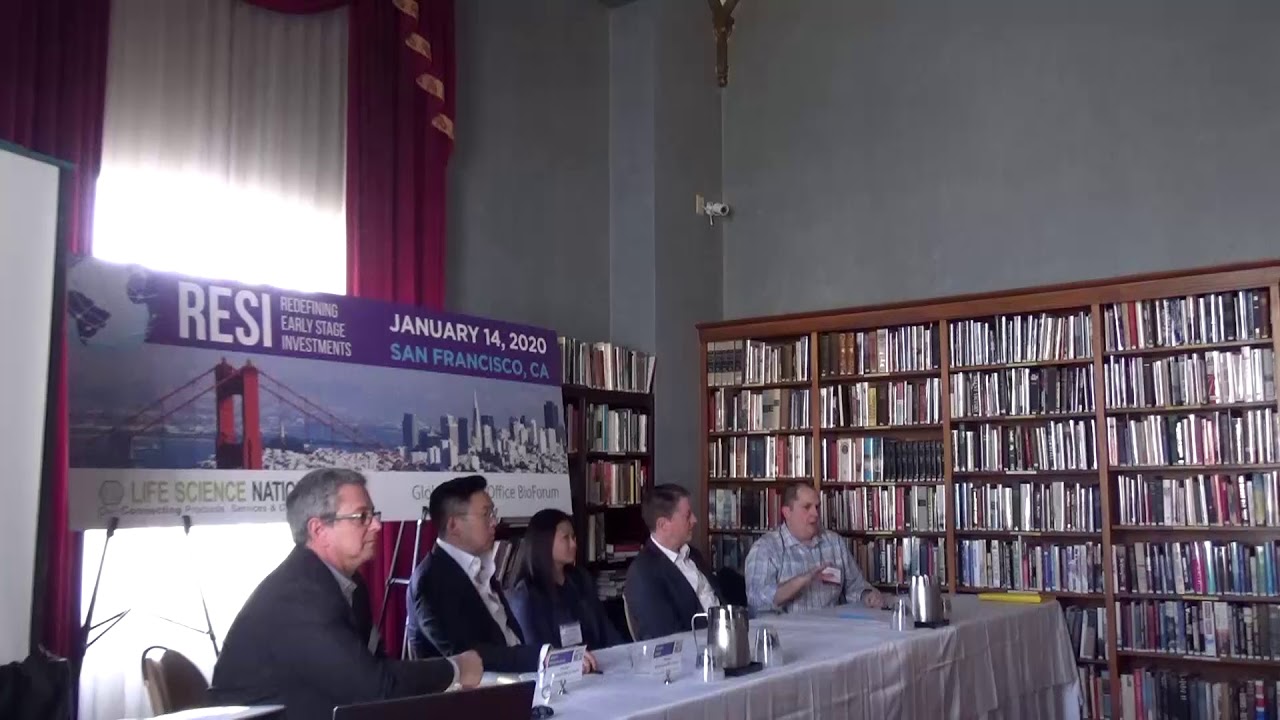
Image: RESI / Life Science Nation, workshop video still.
Another company, another set of decisions
Ashvattha’s current leadership page gives Cleland the titles chief executive officer and founder. It lists him on the board alongside people including Kannan Rangaramanujam and Jay Zaveri. The combination brings technical and investment experience into the same governing group. It is a recognizable setting for someone whose career has repeatedly crossed those boundaries.
His responsibilities extend beyond Ashvattha. Programmable Medicine identifies him as chairman, president and chief executive. APstem lists him as its board chairman, while Syncromune lists him as a director. Each title describes a particular relationship to an organization; together, they show a working life spread across executive leadership and governance.
There is also an educational connection. The University of the Pacific lists him on the advisory board of its Jie Du Center, where advisers contribute expertise and serve as mentors. It adds another direction to the flow of experience. Knowledge acquired inside companies can return to a university setting, where others are preparing for their own professional lives.
What holds these chapters together is a recurring practical task: take a body of expertise, assemble an organization around it and secure the resources for the next stage. Cleland has done that from several seats at the table. The next company requires its own decisions, whatever the previous one accomplished. Sometimes it even occupies the previous company’s office. There is something rather useful about a fresh start that already knows where the meeting room is.