A truck full of carpets is a demanding business professor. John Oyler discovered this while he was a student at MIT, running a dorm-supply venture with his roommate. They sold the things students needed when they arrived: rugs, refrigerators, bookshelves. Then an inadequately planned unloading job produced eight hours of reloading. The carpets had already been moved once. They now required a second performance.
It is a useful place to begin his story because it keeps the achievement in proportion. Before the executive titles and the international organization came a young person learning that selling something creates a whole chain of obligations. The order matters. So does the truck. An attractive business idea can still leave its owner shifting the same merchandise twice.
Oyler now leads BeOne Medicines, the company he co-founded with Xiaodong Wang in 2010 under the name BeiGene. His career has crossed consulting, wireless information and company building on different continents. Yet the student venture offers a particularly good introduction to his recurring interest: how work actually gets done.
Eight hours with the same carpets
At MIT, Oyler worked to help pay his tuition. His early jobs included selling doughnuts, followed by the dorm essentials business with his roommate. The customer was close at hand. So were the consequences of getting the practical details wrong. A refrigerator has an admirable way of resisting abstraction.
He later remembered the venture as his first experience of owning and running a business. The lesson about carpets survived the passage from undergraduate work to executive interviews. “I learned a lot the hard way,” he recalled. That is a modest description of an education conducted partly through repeated lifting.
The appeal of the episode lies in its specificity. Entrepreneurship can sound rather weightless when reduced to ambition, confidence and an ability to spot opportunities. Here, the opportunity had dimensions and required transport. Thinking through the sequence would have saved hours. The person making the plan was also close enough to the work to discover its shortcomings.
“I learned a lot the hard way.”
John Oyler, on his student business
What Pittsburgh left him
Oyler grew up around Pittsburgh. His father was a civil engineer and professor; his mother stressed doing work well and choosing work he could feel proud of. He has credited both parents as role models, with his father’s example giving particular weight to mentorship. Those influences provide a domestic scale for a career often described through institutions.
There was another education outside the house. Families were leaving the region as jobs disappeared, and friends moved away. Oyler has connected that experience to his belief that a well-run company can provide stability for families and communities. In that account, an employer matters because other lives are organized around its continued existence.
The Pittsburgh Steelers supplied a more cheerful influence. Asked which brand he would be, he chose his hometown team. He admired its association with hard work, persistence, teamwork and care for the community. The answer adds something a list of qualifications cannot: a picture of the qualities he wants his work to express.
There is pleasure in a business biography that leaves room for football. Oyler’s allegiance also makes his management language easier to understand. He talks about building teams and valuing different strengths. The connection is his own, rather than a sporting analogy pasted onto the career afterward.
The wireless years
He completed his MIT degree in mechanical engineering in June 1990 and began his professional career at McKinsey & Company. Consulting took him to mainland China early in the decade. He later earned an MBA at Stanford, completing it in January 1996. Engineering, business training and experience abroad were becoming parts of the same working life.
In 1997 and 1998, he served as co-CEO of Genta. From 1998 to 2002, he was a founder and president of Telephia, a company built to supply information about the wireless market. The sequence is a reminder that his route to BeOne included a substantial detour through telecommunications.
Telephia brought together information on such matters as market share, network quality, brands and promotions. Oyler founded it with Tom Frangione in February 1998. A contemporary account described its ambition to become the wireless industry’s equivalent of Nielsen. Nielsen eventually acquired the company in 2007, years after Oyler’s tenure as president.
That distinction matters. Careers are often compressed until founding, running and selling a company sound like a single afternoon’s activity. Here, the dates leave room for the other people and intervening years. Oyler’s part in the story was substantial without requiring him to occupy every scene.
A career in four dates
Mechanical engineering
Founder & president
Co-founded with Wang
A new company name
A partnership before a company
After Telephia came leadership roles at Galenea, where he was CEO from 2002 to 2004, and BioDuro, where he served as president and CEO from 2005 to 2009. At BioDuro, an introduction arrived in a wonderfully ordinary fashion: Xiaodong Wang walked into the lobby.
Oyler had previously tried to meet Wang while recruiting people in China. When they began chatting that day, he did not initially realize who his visitor was. The acquaintance developed over several years. Their organizations even competed in intramural sports. A future founding partnership had time to acquire a life before it acquired incorporation papers.
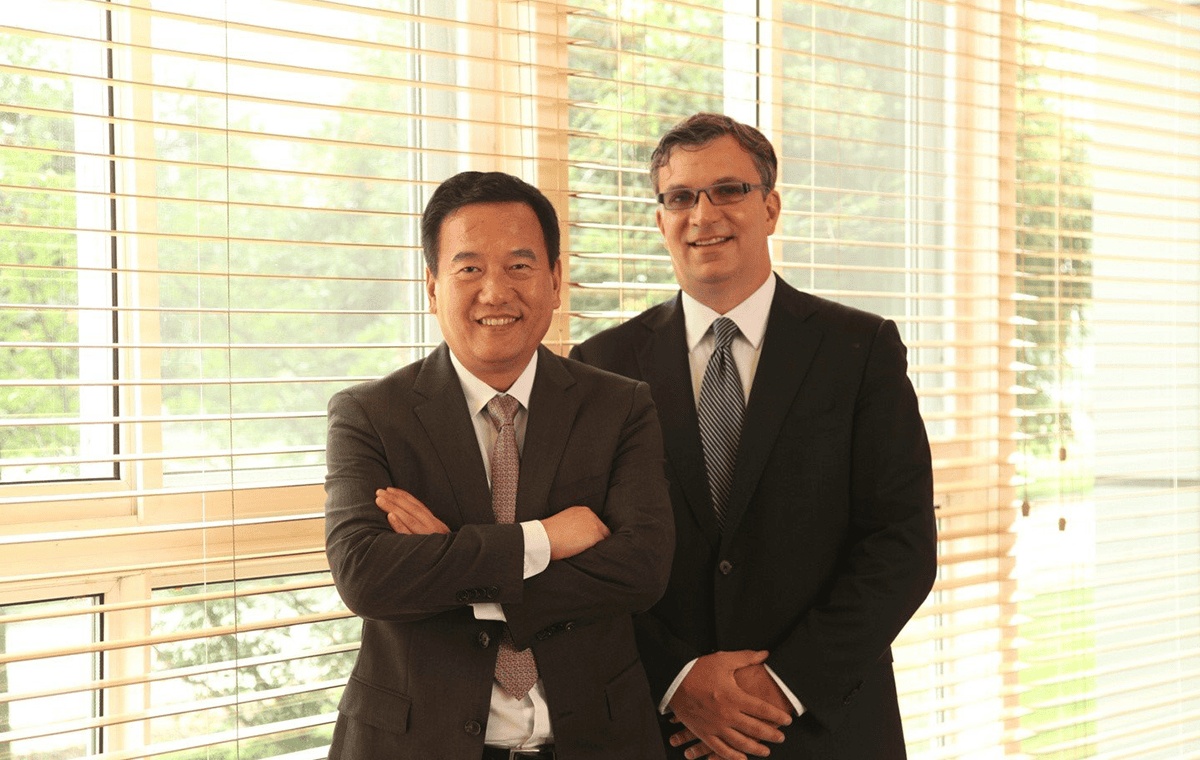
PPD’s acquisition of BioDuro gave Oyler another reason to consider what he wanted from his next venture. He wanted to build something enduring. In conversations with Wang, the possibility of a company designed for an eventual sale gave way to an ambition for a business they could keep developing.
They founded BeiGene in 2010. The longevity of their association is easy to miss when the story is told only through corporate milestones. Companies have legal starting dates. Partnerships often have longer beginnings, made from conversations, familiarity and a growing understanding of what each person hopes to build.
Where the decisions happen
A company working across countries must answer a deceptively simple question: where is the center? Oyler once fielded a version of it in a conversation with Singapore’s finance minister. His reply was memorable: “Our company headquarters is on Zoom.”
The joke contained an organizational preference. Senior colleagues worked in different places. Oyler resisted the idea that one office should automatically carry greater authority because it housed the boss. In his telling, distributing work also required distributing the right to influence decisions.
His stated leadership approach welcomes disagreement and asks people to use evidence, hypotheses and reason. That ambition gives a reader something more useful than a flattering personality label. It describes how he says a company ought to function, and therefore a standard against which its everyday conduct can be considered.
The tension is familiar far beyond his own business. Hiring internationally is relatively easy to announce. Making a colleague in another time zone feel that their judgment counts requires repeated choices. Who joins the discussion? Who gets the final word? Which inconvenient opinion survives the meeting? An office map cannot answer those questions.
“Our company headquarters is on Zoom.”
John Oyler, recalling a question about the company’s center
A campus makes the idea physical
There is a satisfying counterpoint to the Zoom answer in Hopewell, New Jersey. On July 23, 2024, Oyler joined Governor Phil Murphy and local officials to open the company’s new campus. The project represented an $800 million investment, with 400,000 square feet on a 42-acre site.
Three years of construction preceded the ribbon cutting. Local officials, business leaders and company colleagues attended. The ceremony marked a tangible commitment to a place: buildings, infrastructure and the coordination required to turn a site into an operating campus. A geographically distributed company still has to build real things somewhere.
The idea, in bricks and acres · 2024
$800mCampus investment
42Acres in Hopewell
400,000 square feet · New Jersey
The carpet episode and the campus belong at very different scales. The connection between them is an editorial one: both direct attention toward operations. Buildings require schedules. Deliveries require sequencing. Someone has to arrange the work that sits between announcing an intention and having something ready to use.
The business he is still building
In May 2025, BeiGene became BeOne Medicines, alongside a redomiciliation to Switzerland. The company’s history for that year recorded approximately 12,000 employees across six continents. Oyler remained co-founder, chairman and CEO. A new name arrived over a partnership and an organization already fifteen years in the making.
The financial scale had changed as well. In August 2026, BeOne reported second-quarter total global revenue of $1.7 billion, an increase of 30% over the same quarter a year earlier. Those figures describe the company at a particular moment. They also show how far the responsibilities of its early founders had expanded.
His work had also received recognition outside the company. In 2025, he was among EY’s Entrepreneur Of The Year New England winners and went on to become a national category winner. The recognition places him among other business founders, a useful context for someone whose earliest customers were fellow students trying to furnish a room.
He also serves on the Stanford Graduate School of Business Advisory Council. The institution that awarded his MBA remains part of his professional life. Alongside the executive role, that connection creates another setting for the questions that run through his career: what a company should attempt, how it should organize itself, and what its leaders owe the people doing the work.
Oyler’s public account of mentorship brings the story back to individuals. He has singled out lawyer Jeff Weisen for years of advice, alongside his parents’ influence. He wants to help others learn and grow. The aspiration is personal, and it gives the company-building story another measure besides size.
A résumé can accommodate MIT, Stanford, McKinsey and a succession of executive jobs in a few lines. It takes a little longer to make room for the roommate, the parents, the lobby visitor and the adviser. They belong in the story. So do the carpets, which required eight hours of attention and offered their instruction without issuing a diploma.
Follow the conversation
Profiles, interviews & company updates
- BeOne Medicines Company website
- John Oyler on LinkedIn Personal profile
- John Oyler on X Personal account
- Watch: John Oyler’s founding story, Part II YouTube conversation
- How and why he built BeiGene 2019 interview
- Inside Telephia’s early ambition From the wireless years
- BeOne’s second-quarter 2026 business update August 5, 2026