The aisle can look like a riot of tubes, wands and improbable promises. Behind Performance Beauty Group, the arrangement is much more orderly. The Frisco, Texas company has collected founder-built brands that answer neighboring beauty problems: a serum for fuller-looking lashes, a dramatic strip lash, an under-lash extension for the bathroom mirror, a brow treatment, a hair-and-scalp routine. Each keeps its own name and audience. Out of sight, the brands can draw on the same capital, factories, distribution network, ecommerce knowledge and retail relationships. PBG is less a single beauty label than the plumbing connecting several of them.
That makes it an intriguing creature in modern beauty: part holding company, part operating platform, part private-equity experiment in keeping a founder's spark alive after the spreadsheets arrive. Gauge Capital established the platform in 2019, with Lilly Lashes described as the initial investment. PBG subsequently assembled Grande Cosmetics, Babe Original, Velour Beauty, FlutterHabit and haircare brand BondiBoost. A 2024 company announcement also named Nutraluxe. The center of gravity remains obvious. If a product sits near an eyelid, PBG probably has a point of view about it.
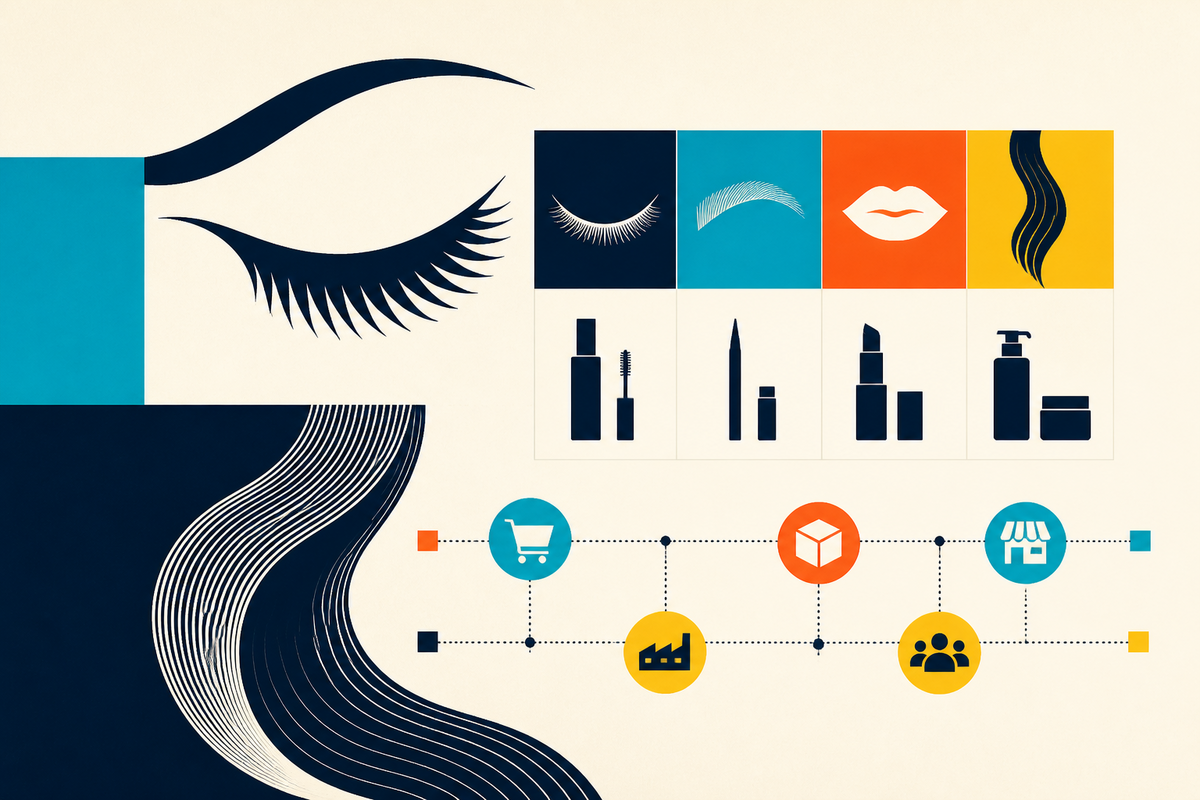
A portfolio shaped like an eye
Portfolio companies often speak in the language of breadth. PBG's sharper idea is adjacency. Grande Cosmetics has built authority in lash and brow serums. Babe Original offers accessible enhancement products with a younger, social-first sensibility. Lilly Lashes and Velour approach false lashes through style, fit and occasion. FlutterHabit sells DIY extensions applied beneath the natural lash. Together, they cover different prices, techniques and levels of confidence without requiring one brand to stretch until it means nothing. BondiBoost is the outlier, but even that move follows the same performance-led logic: give a customer a visible routine for a specific hair concern.
This is the practical difference between PBG and a conventional incubator. It is not mainly inventing brands on a whiteboard. It acquires or backs businesses that already have products, founders and communities, then tries to remove the obstacles that appear when a cult item must become a dependable global business. Those obstacles are rarely photogenic: forecasting inventory, negotiating shelf space, manufacturing consistently, shipping internationally, translating a viral tutorial into retail education and finding the few products that deserve more investment.
“I talk a lot about brand relevance and less about brand awareness.”JuE Wong, chief executive officer
The $12,000 proof point
FlutterHabit offers the neatest demonstration of the machine. Kasey and Tim Jackson started the brand in 2019 after seeking a cheaper, less time-consuming alternative to professional lash extensions. Trade reporting says they put roughly $12,000 into opening inventory and passed $1 million in sales within a year. The product found its audience through direct sales, salons, Amazon, TikTok Shop and a Facebook group that now counts more than 30,000 members. PBG bought the company in 2023. By July 2026, FlutterHabit had sold more than 18 million pairs of extensions and was preparing to enter more than 500 Sephora stores.
The move solves two problems at once. Customers who like the result but dislike a salon appointment get a replenishable at-home system. Sephora gets a differentiated lash product and a brand with a built-in teaching challenge, which suits a retailer organized around discovery and trial. FlutterHabit gets physical demonstration, national reach and new customers without discarding the community that helped refine its products. Brand president Sabeen Mian has described the Facebook group as something close to a focus group. Members react to styles, suggest improvements and sometimes help a limited edition earn a permanent place in the line.
The unglamorous moat
PBG calls itself vertically integrated, and its address book explains why. The company lists a distribution center in Fort Worth and manufacturing locations in Fort Myers, Salt Lake City and Queensland, Australia. It also lists offices in California, New York, Toronto, Sydney and Berkshire in the United Kingdom. That footprint gives its brands more than a check. It gives them a route from formulation and packaging to a warehouse and, ultimately, a retailer or front porch. For a growing beauty company, dependable supply can matter as much as a clever campaign.
Distribution is deliberately mixed. PBG's brands sell on their own sites, through marketplaces and subscriptions, in spas and salons, and through retailers including Sephora, Ulta Beauty, Macy's, QVC, Dermstore, Lookfantastic and Amazon. The model earns money from the product sales of the underlying brands, while shared teams and facilities are meant to spread expensive capabilities across the group. DTC provides rapid signals about conversion, repeat purchase and customer questions. Wholesale supplies reach and credibility. Professional channels supply technique and trust. No single channel has to carry the whole story.
The scale is meaningful, though private-company arithmetic requires care. In an October 2024 interview, Wong said PBG's brands had generated roughly $500 million to $700 million in global retail sales. That figure describes sales at retail across the brands, not PBG's net revenue. Separately, supplied business data estimates annual company revenue at $25.7 million and headcount at 110, while LinkedIn places the organization in its broader 201-to-500-employee band. The useful conclusion is not a precise multiple. It is that the consumer footprint is substantially larger than the parent company's public profile.
Discipline in a launch-happy business
When Wong became CEO in October 2024, she arrived with a resume that included Moroccanoil, Elizabeth Arden, StriVectin and Olaplex, which she led through its 2021 public offering. Her stated priority at PBG was not another acquisition spree. It was relevance: make the existing brands top of mind, deepen technology and retail partnerships, and use DTC data to serve shoppers online and off. In beauty, where a crowded product calendar can look like momentum, she has argued for an 80/20 discipline. A small group of products usually does most of the commercial work. Find them, learn from them and support them.
That restraint is also PBG's answer to a harsher funding market. Fast top-line growth once encouraged beauty founders to expect generous revenue multiples. Buyers now care more about profit, acquisition costs, repeat behavior and sustainable growth. A platform with operating depth can make a credible promise to a founder: the brand does not have to build every department alone. The trade is equally clear. Shared leadership and capital come with targets, portfolio priorities and the possibility that a beloved founder story becomes one line in a larger financial plan.
Its alternatives are varied. A founder might remain independent and hire distributors, sell to a larger strategic beauty company, or join another private-equity-backed platform. On the shelf, PBG brands compete with specialists such as House of Lashes, The Ordinary and Olaplex, as well as the portfolios of e.l.f. Beauty, Kendo and other multi-brand operators. PBG's difference is not that it invented the roll-up. It is the unusually coherent cluster of lash, brow and eye brands, paired with manufacturing and a feedback-rich DTC heritage. The portfolio can share knowledge without asking every label to tell the same story.
What the platform is really selling
To consumers, PBG sells time, confidence and a more manageable ritual. Grande promises enhancement without a salon barrier. FlutterHabit turns a professional-looking extension into a home technique. Velour lowers the intimidation of false lashes. BondiBoost organizes hair concerns into routines. To founders, the group sells a different kind of relief: access to capital, manufacturing, logistics, retail doors and experienced operators. To retailers, it sells category knowledge and products with communities already attached.
The next test is whether the Sephora expansion can preserve FlutterHabit's intimacy while teaching a technique to a much larger audience. Another is whether PBG can make BondiBoost as strategically legible in hair as Grande is in lash serum. Neither depends on louder branding from the parent. Most shoppers will never know the name Performance Beauty Group, and that may be the design. The holding company is backstage, arranging light, timing entrances and making sure the right box is waiting in the wings.
The brand owns the applause. The platform makes sure the curtain rises on time.
Keep exploring
Meet the group and the brands operating inside its focused corner of beauty.