At Wood Stone, a manufacturer of commercial cooking equipment, the trouble was a few missing spreadsheet cells. Their accidental deletion meant hundreds of hours of cleanup. Elsewhere in the same business, timecards went unapproved, employees requested leave through a public calendar, and physical paychecks still arrived on Fridays. The company could build ovens for professional kitchens. Its own administrative machinery was running rather hot.
- Start with payroll, where accuracy has a deadline.
- Connect the employee record to schedules, benefits, and communication.
- Follow the approvals into finance, spending, and recruiting.
The spreadsheet had other plans
Wood Stone switched to Paylocity in November 2019. It introduced remote clocking, centralized communication, and better use of workforce data. In Paylocity’s published case study, the manufacturer reports saving more than 1,000 hours a year through time and attendance improvements. That is a customer-reported result, specific to its starting point. But the starting point is familiar: a business grows while its office routines accumulate small, expensive exceptions.
This is a useful way into Paylocity. The software handles payroll, tax filing, benefits, recruiting, scheduling, learning, and performance management. Employees can check pay, request leave, and complete tasks on mobile. The proposition is that those activities should share information. An approved hour should not need another person to type it into the next system.
The interesting unit here is the exception: the forgotten approval, the changed shift, the deduction someone must reconcile. Each looks trivial on its own. Repeated across employees and pay periods, exceptions become a job. Software earns its place when it makes that job smaller without hiding who remains responsible.
A basement, then a browser
Steve Sarowitz founded the business in 1997, working from a basement. He already knew payroll providers from the inside. Earlier, while selling payroll services, he had also operated a Chinese-food delivery restaurant called Ying Yang’s Orient Express. Few software founders have had such literal experience with the dinner rush.

“We have very high standards.”Steve Sarowitz · 2003
His ambition combined software customers could control with the service of an outsourced payroll provider. Paylocity released its first SaaS platform in 2002. Scaling brought ordinary trouble: in a 2003 account, Sarowitz described hiring mistakes and the resulting staff problems. The story contains an early warning for anyone selling workplace efficiency. Growing the company creates people problems of its own.
In 2008, Adams Street Partners committed nearly $10 million in Series A capital to support product investment and geographic expansion. In March 2014, Paylocity priced its IPO at $17 a share and began trading on Nasdaq. Browser software, service, and sales coverage had become the ingredients of a public company.
The employee record gets a second job
The pivotal expansion came in 2024. Paylocity announced an approximately $325 million acquisition of Airbase, funded through its revolving credit facility. Airbase brought corporate cards, expense management, procurement, and accounts payable automation. The deal closed that October. Paylocity was buying its way into the finance department.
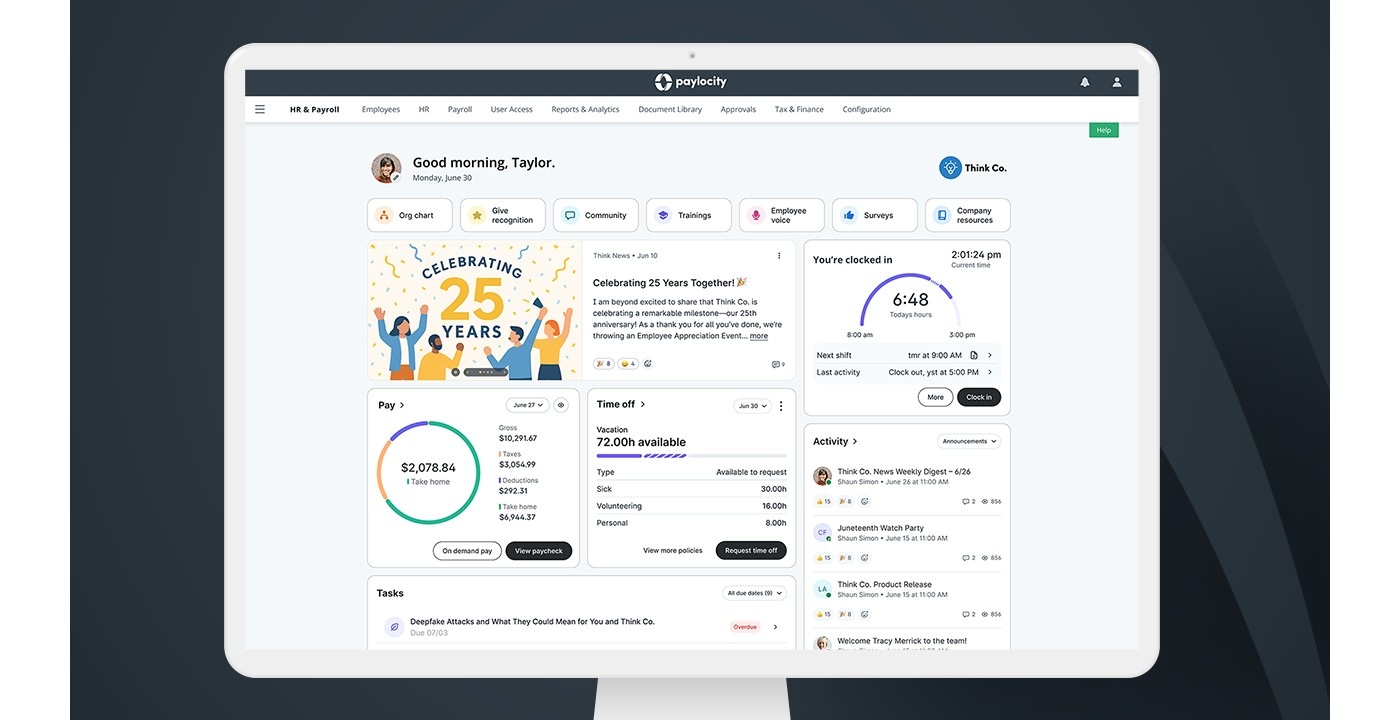
In July 2025, those capabilities became Paylocity for Finance. The connecting idea was the employee record. Finance needs to know who bought something, which department pays, and who approves it. HR already maintains much of that organizational information. A manager’s task list can therefore bring together purchases, expenses, and time-off approvals. The appeal lies in fewer handoffs between departments.
A social feed with a payroll habit
Community, Paylocity’s communication tool, seems an unusual neighbor for payroll. Consider its distribution, though. People have a reason to open an app containing their wages and schedules. Company announcements can travel through that existing habit, including to workers who spend little time at a desk.
At San Luis Valley Behavioral Health Group, a published customer account describes using Community to publicize benefits enrollment and celebrate birthdays and anniversaries. The mobile app also gave clinic staff access to clocking, paychecks, and announcements. These are modest features. Their usefulness depends on whether the message reaches someone before a deadline does.

La Porte County Public Library provides another example. Its eight locations, mobile services, and varied public programs create a scheduling puzzle. Paylocity’s case study describes using scheduling tools and benefits-provider integrations to reduce administrative effort. The setting changes from a factory to a library; the need to coordinate people remains.
The company has described customers as participants in product design and uses its own products internally. Employees interviewed in 2019 also emphasized open discussion with leaders. Those accounts help explain the culture Paylocity presents: product feedback and employee voice belong close to everyday work.
Who pays, and what the bill buys
Employers buy the software. Recurring fees generally depend on employee counts per month, with implementation and other services alongside them. Quotes depend on the modules and services selected. The financial model also includes interest earned on funds held for clients, a separate stream from software and service revenue.
Paylocity competes with ADP, Paychex, Paycom, UKG, Dayforce, and Rippling. Its argument centers on connected workflows, employee engagement, and service. Buyers still need to establish fit. Existing integrations, local payroll requirements, data cleanup, and manager participation determine whether consolidation removes work or merely relocates it. A small employer needing only basic payroll may find a broad suite unnecessary.
A sensible demonstration should include a changed manager, an absent approver, and an employee working away from a desk. These are ordinary operating conditions. A polished dashboard is easy to admire; a corrected record arriving in the right place is easier to value.
The New York Jets offer a different use case. In September 2026, the organization named Paylocity its official HCM platform, describing easier employee updates, seasonal staffing preparation, and workforce reporting. Football supplies the recognizable name; variable staffing supplies the operational reason.
The next handoff is a candidate
Paylocity acquired recruiting-automation company Grayscale in April 2026 for $50 million in cash consideration, subject to adjustments. In July it introduced Ignite AI. On October 22, it launched Recruiting Optimizer, with agents for candidate engagement and rediscovering previous applicants. Recruiters configure criteria and retain hiring judgment. The promise concerns faster movement through a process with many opportunities to stall.
The transferable lesson is practical. Trace one employee from application to first paycheck to first expense claim. Count the repeated entries and approvals. Ask a vendor to demonstrate that exact journey, including an exception. Paylocity’s expansion makes a coherent bet on those connections. Its value to a particular employer will show up in the hours people stop spending between systems.