The psychiatrist had an electronic health record, a billing company, a clearinghouse, and a shared folder. Each did its job. Together, they required somebody to carry information from one place to another. At PathWave Psychiatry in California’s East Bay, Sahab Yaqubi could treat a patient, but seeing the financial aftermath depended on somebody else entering the reimbursement. The clinic’s nervous system had a missing connection.
- The work: software and services for psychiatry practices, especially those offering TMS, Spravato, and ketamine.
- The bet: connect treatment records, patient outcomes, and billing so routine care can also inform research.
- The lesson: a useful new tool can struggle when it gives busy people another system to manage.
Osmind makes that connection its business. Yaqubi already used its software; he later moved billing onto Osmind 360. In a September 2026 customer account, Osmind reported that his practice collected from payers in about 26 days. It is one company-measured customer result, rather than a forecast for every clinic. Still, it explains why a company interested in psychiatric discovery spends so much time thinking about claims.
“The problem was that there were several systems. Here it’s all one.”
Sahab Yaqubi / PathWave Psychiatry
01 / The app that needed to get bigger
Lucia Huang and Jimmy Qian met in a Stanford health information technology class in 2019. She was studying for an MBA; he was pursuing medicine. Huang had worked in neuroscience biotechnology. Qian would leave Stanford’s MD program to build Osmind. Their common interest was mental health, but their early research kept returning them to the less glamorous business of recording it.
In Stanford’s account of their work, psychiatrists described paper treatment plans, paper outcome surveys, and trouble following patients between appointments. The founders launched Osmind in 2020. Its initial product concentrated on tracking outcomes. That sounds admirably focused. Unfortunately, a focused product can be one more tab in a clinician’s already crowded day.
Huang later told Terra’s podcast that providers were reluctant to adopt something disconnected from their existing records. They also disliked those records and asked Osmind to offer more. Meanwhile, life sciences companies wanted outcomes linked to prescriptions, histories, and diagnoses. Those requests changed the product’s direction. Over roughly six months of market feedback, the argument for building a full EHR became harder to ignore.
02 / Psychiatry has particular paperwork
Osmind’s territory is interventional psychiatry: practices delivering treatments such as transcranial magnetic stimulation, ketamine, and Spravato. Its customers need more than a place to type a conversation. Treatment sessions have documentation requirements; patients have symptoms to track between visits; insurance authorizations have dates that expire.
Osmind One supplies the clinical software. Its tools include customizable notes, telehealth, electronic prescribing, and a patient portal and mobile app. More than 50 rating scales can feed scored results into the chart. A clinician can look at a patient’s progress over time rather than hunt for a questionnaire that has achieved independence from its filing cabinet.
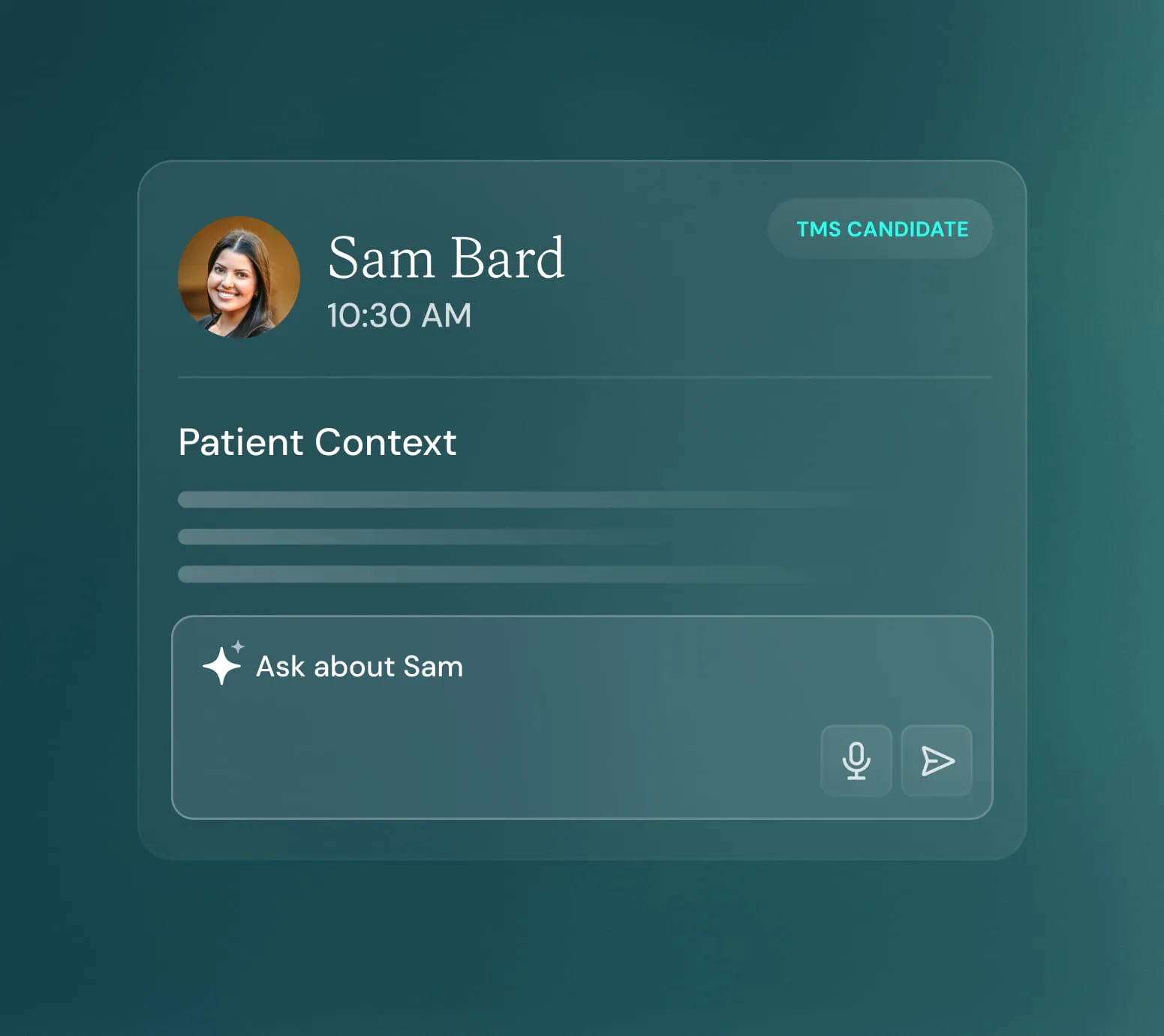
The detail that tells the story is REMS, the safety-monitoring framework used for certain medications. Through its UBC collaboration, Osmind connects EHR information to a REMS database, reducing duplicate entry. For Spravato, the company describes charting that populates and submits the required monitoring form. Administrative repetition becomes a software problem with a specific solution.
Its competitive position follows from that specificity. An alternative might be a general practice platform such as SimplePractice, a specialty EHR, or several separate vendors. Osmind’s appeal grows when treatment documentation, authorizations, and outcomes need to travel together. A practice with simpler requirements should judge whether those specialized workflows justify the expense and the effort of switching.
03 / The price of keeping things together
The published software-only EHR price is $249 per clinician per month. Selected extras add to the bill: controlled-substance prescribing is listed at $49 monthly per clinician, while automated Spravato REMS submissions cost $4 each. These are advertised rates, not a complete budget for changing systems.
Selected features carry additional charges.
Practices can buy more of the operation. Care Network adds services and Osmind-negotiated payer contracts. Osmind 360 bundles revenue-cycle support for established practices bringing their own contracts. Both include the EHR within a percentage-based fee. The distinction matters: software, outsourced billing, and access to payer contracts solve different problems, even when they arrive in the same sales conversation.
There is also the expense of financing care. PathWave purchases Spravato before reimbursement arrives. Faster collections therefore matter beyond tidier bookkeeping. Osmind’s April 2026 CareNet GPO partnership addresses another part of that equation: pooled purchasing. Participation in the GPO is free, and practices do not have to buy Osmind software to join.
04 / A chart with a second life
For researchers, the same infrastructure offers something a symptom score alone cannot: context. Osmind’s life sciences services combine clinical records, outcomes, clinician access, and prospective data collection. Sponsors can use them for research design, recruitment, evidence generation, and regulatory support. This is a second customer group with a different reason to value the software.
- 01 Clinical encounter
- 02 Structured record
- 03 Outcomes over time
- 04 Research questions
The work has produced published ketamine analyses, including a 2023 retrospective study of depression, anxiety, and suicidal ideation. Such research follows treatment in ordinary care settings. Its observational design also limits causal conclusions. A useful dataset needs careful interpretation as much as it needs collection.
Osmind’s 2024 American Psychiatric Association collaboration brought additional measures into the EHR and explored participation in the PsychPRO registry. In April 2026, Compass Pathways partnered with Osmind to understand independent clinics’ readiness for potential psychedelic treatments, if FDA approved. The conditional language matters. Preparing delivery infrastructure does not approve a medicine.
05 / Copy the listening, not the scale
A $40 million Series B in May 2022 brought Osmind’s reported funding to about $57 million. Its current website reports more than 1,000 practices nationwide. The company is a public benefit corporation: a for-profit business with a public-benefit commitment. Its mission joins treatment access with research, while subscriptions and services pay for the machinery.
The transferable idea is narrower than building another healthcare platform. Watch where people carry information by hand. Ask why a useful tool goes unused. Make measurement part of work already happening. Osmind’s first customers wanted fewer disconnected systems; its later billing customers wanted the same thing. The promising idea was there early. Listening revealed where it had to live.