Giorgos Tsetis noticed hair landing on his engineering textbook. He was young, studying, and working as a model. His father and grandfather had lost their hair early. The little accumulation on the page looked less like a nuisance than a forecast. He sought treatment. In his account, finasteride reduced the shedding, but sexual side effects eventually made the arrangement intolerable. Keeping his hair had become a negotiation with the rest of his life.
- Nutrafol sells supplements and topical care for thinning hair.
- Its formulas distinguish age, life stage and lifestyle.
- Professional recommendations sit alongside direct subscriptions and beauty retail.
- The customer buys a routine measured in months, with costs to match.
The treatment worked. The bargain didn’t.
That distinction explains the company better than a bottle label. What failed first, for Tsetis, was the compromise he had accepted. He wanted an alternative he could live with. His friend Roland Peralta had been investigating botanical ingredients during his own health difficulties. Physician Sophia Kogan brought another experience: shedding during the punishing schedules of medical training. The three approached the same visible problem through different doors.
Their proposition was that hair health belonged in a larger conversation about the body. Stress, nutrition, hormones and aging became part of the explanation. Kogan’s professional biography dates the founding partnership to 2015; the company’s financing announcement dates its commercial launch to 2016. Nutrafol’s origin was personal, but its commercial ambition required evidence other people could inspect.

“The idea started as a hypothesis.”
Giorgos Tsetis · 2017 interview with Out
He also had to change how he explained it. In a later public reflection, Tsetis recalled a PR agency being more interested in his personal story than his science pitch. Describing the treatment side effects felt exposing, but he says people connected with it. The practical lesson is modest: technical detail helps establish credibility; a recognizable predicament explains why anyone should care.
One symptom, several customers
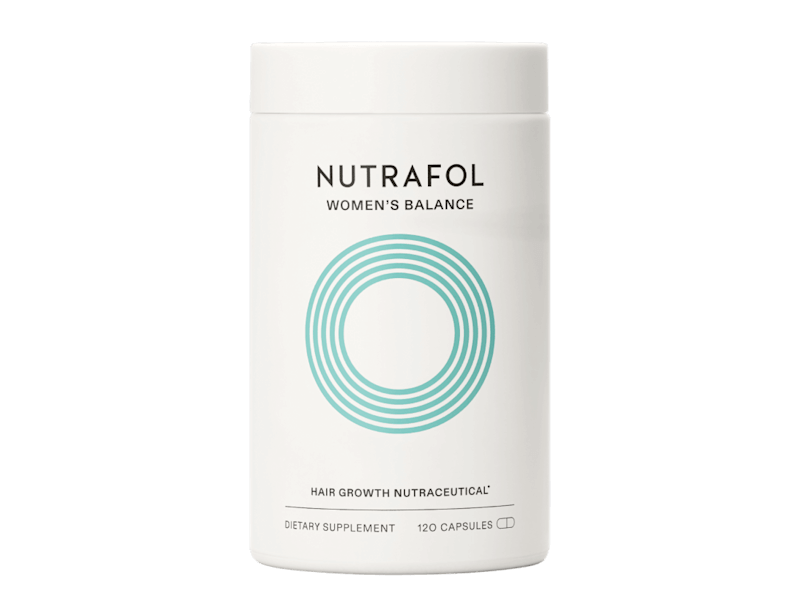
A person noticing a wider part after childbirth and a man noticing a receding hairline may both say “thinning.” Nutrafol makes that shared word the beginning of product selection. Its range includes Women for ages 18-44, Women’s Balance for women 45 and older, Postpartum, Men, and the Men 50+ formula introduced in February 2026.
The distinctions are the merchandising. Instead of asking everyone to recognize themselves in one bottle, the company gives them a life stage. Its advanced Women formula is vegan. Its July 2026 Booster range adds seven optional products, with intended roles spanning stress, the microbiome, menopause, antioxidants, cellular metabolism, collagen and DHT support. These are the company’s formulation targets, rather than a diagnosis delivered by an online quiz.
The surrounding range now reaches beyond ingestibles. Shampoos and conditioners address scalp and hair care. Strand Serum, announced September 30, 2026, addresses breakage, with broader availability scheduled for October 6 at $54 for 30 millilitres. The expansion follows a sensible customer question: why celebrate growth if the resulting strands keep snapping?
Forty women, six months
Hair is an awkward witness. A good photograph, a flattering haircut and a hopeful observer can all complicate the verdict. Nutrafol’s early randomized, double-blind, placebo-controlled study tried to make the question countable. Published in 2018, it enrolled 40 women with self-perceived thinning: 26 received the supplement and 14 received placebo.
Investigators used photographs to measure hairs in a target area. The study reported statistically significant increases in terminal and vellus hair counts at 90 and 180 days compared with placebo. That is specific evidence for a specific tested formulation and population. Forty participants are still forty participants. The result cannot establish that every later product works equally well, or that every cause of hair loss responds.
40 women · six months · randomized and blinded
The distinction matters because Nutrafol occupies the border between beauty and health. Supplement competitors include Viviscal and ordinary hair vitamins. Minoxidil and prescription treatments offer different approaches. Nutrafol’s position combines botanical formulations, research and professional recommendations; “drug-free” does not establish universal safety or suitability. Someone whose thinning reflects an untreated condition needs the condition understood, not simply a more persuasive checkout.
The price of waiting
Consider the calendar. Nutrafol advertises supplement results in three to six months. Women’s Balance currently lists monthly subscription delivery at $79, three-month delivery at $224 and six-month delivery at $422. Six separate monthly deliveries cost $474. An experiment in the bathroom cabinet therefore becomes a household budget decision well before its outcome is clear.
Nutrafol surrounds that interval with support: its app, wellness consultations, Headspace access and a six-month results guarantee subject to terms. My reading of the business is straightforward. A slow product needs a durable relationship. The repeat-order figures support that interpretation: Unilever reported in 2025 that repeat purchasers generated 80% of Nutrafol’s direct-to-consumer revenue.
A reader building another business can copy the alignment: explain the time required, help customers sustain the routine, and make the purchase schedule intelligible. The approach depends on a product worth repeating and customers able to afford the interval. Reminders cannot rescue weak performance. Nor does a subscription prove efficacy; it records continued purchasing.
The same philosophy appears in its recruiting materials, which advertise wellness breaks, No-Meeting Wednesdays and a US remote team. These are the company’s stated practices. Its listed departments supply the more revealing detail: clinical affairs, quality assurance and scientific research sit beside customer retention and digital product. Nutrafol needs people who can formulate the capsule and people who can help the customer remember tomorrow’s.
A bigger owner, a longer season
The infrastructure took capital. Nutrafol raised a $35 million Series B in April 2019, led by L Catterton with Unilever Ventures participating. In July 2022, Unilever increased its ownership to 80%; it bought the remaining 20% in April 2025. Cindy Gustafson succeeded Tsetis as CEO that January, with the co-founder moving to chairman.
Distribution now includes professional providers, Amazon, Sephora and Ulta. Unilever’s 2025 annual report says turnover had tripled since acquisition. Nutrafol also signed a multi-year MLB partnership after its core supplements earned NSF Certified for Sport status. The certification concerns independent supplement testing; it is distinct from proof that hair grows. Baseball supplies the more amusing connection: a long season rewards showing up. Nutrafol has made a business of asking customers to do precisely that.
Keep following the story
Explore Nutrafol · Company journal · Recent announcements
LinkedIn · X · Instagram · Facebook · TikTok
Watch: Tsetis and hair expert Shab Caspara
Listen: Tsetis on Finding Mastery