The first thing WONDERSKIN asks you to do is make your lips blue. Metallic blue, the sort of colour that suggests a costume party rather than a coffee meeting. Then you remove it. Underneath is the shade you actually ordered. For a cosmetics company, this is an unusually helpful sequence: the product supplies its own suspense, demonstration and ending.
- A $22 lip stain turns an unfamiliar application into a visible reveal.
- Creators helped sell it; testing helped make the business viable.
- A $50 million investment and Sephora distribution widened the ambition.
Most makeup advertisements must invent a reason to keep watching. Here, the reason is sitting on somebody’s mouth. But the interesting question begins when the video finishes. Would someone buy the product again if nobody was watching? WONDERSKIN’s answer rests on a rather ordinary desire: to eat lunch, drink coffee and get through the day without repeatedly inspecting one’s lipstick.
The inconvenience that buys convenience
The Wonder Blading system deposits colour into the upper layer of the lips, according to the brand, instead of leaving only a conventional layer of lipstick on top. Its patented technology is called Liquid Blading. The theatrical masque comes off; the stain remains. Waterproof and transfer-proof are product claims, rather than a promise that every person will achieve identical wear.
There are two routes through the ritual. Peel & Reveal uses an activator spray to turn the masque into a removable film. Stain & Go lets customers wipe it away with a damp cloth. The company says it discovered that the masque could deliver colour without the spray, then offered that simpler option. A little less theatre, a little less time at the sink.
For the customer, this is a trade: extra attention during application for less maintenance afterwards. The useful audience is defined by that preference, rather than by an age bracket. Someone who enjoys a glossy lipstick and frequent shade changes may see little advantage. Someone who wants colour while forgetting about colour has a more obvious reason to try it.
The blue was only the beginning
WONDERSKIN launched in 2020, founded by Michael Malinsky, Marina Kalenchyts and Doug Cooper. Kalenchyts has described the lockdown demand for salon-like results at home. The lip stain offered an effect resembling temporary lip blushing, without the salon appointment. Its unusual appearance also suited a moment when beauty discovery increasingly happened through a phone.
Family history supplied another influence. Kalenchyts remembers a grandmother who wore hot-pink lipstick even on a trip to the bakery; Malinsky’s grandmother made beauty treatments from what she could find. There is something charming about that inheritance. The modern laboratory changes the ingredients, while the old wish survives: looking put together should fit into a life.
The founders’ later account complicates the overnight-success story. At a 2026 beauty summit, Malinsky said it took roughly a year and a half to crack profitability. They shifted spending toward natural application videos and human reactions as those performed better. The early problem was making attention economical enough to scale. A popular clip still leaves inventory, shipping and customer service to be paid for.
“We are confident and comfortable enough to move away from things that don’t work.”Michael Malinsky, CEO
407 people, one useful experiment
TikTok’s published case study offers a more concrete view of the machinery. Through TikTok Creative Challenge, WONDERSKIN worked with 407 creators across eight campaigns. It could brief different products, choose creators familiar with the intended market and put the resulting videos into advertising. The platform says production fees were fully subsidised, a detail that belongs beside the results.
The reported outcomes included higher click-through rates and lower cost per click. These are campaign comparisons, not audited measures of the entire company. Still, the method is instructive: give people a product worth demonstrating, collect different demonstrations and spend behind the ones that sell. The transferable habit is testing. Blue pigment alone is an awfully narrow business education.
A burrito becomes a product test
In July 2024, Chipotle and WONDERSKIN introduced Lipotle, a $29 limited-edition kit in the United States. Its masque was green, inspired by guacamole, and revealed a nude-pink stain. The marketing called it burrito-proof. A restaurant collaboration might sound like a joke looking for a purchase order, but eating is precisely where a no-smudge claim becomes useful.
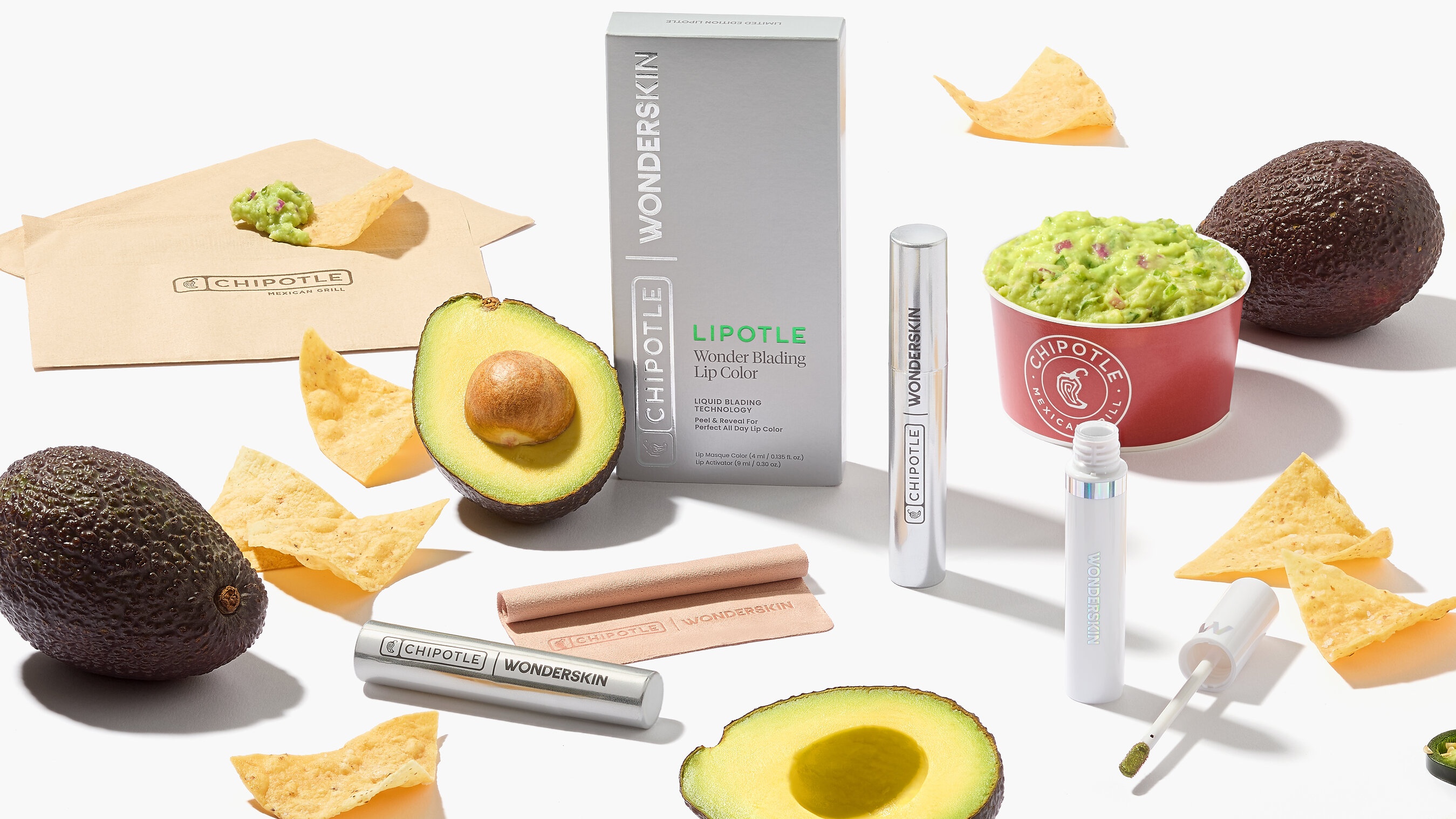
The partnership made the benefit specific. It gave the product an occasion, a visual joke and a practical challenge in the same package. There is a lesson here for less photogenic businesses: choose a collaboration that puts the promised benefit under pressure. Borrowing another brand’s audience is more persuasive when the customer understands why the two belong together.
What happens after the lip stain?
In May 2025, WONDERSKIN announced a $50 million minority investment led by Insight Partners, intended for retail expansion and product innovation. That September, its lip stains debuted at Sephora in the US, including the retailer’s Hot on Social displays. The company sells through its own websites, marketplaces and social commerce as well as retailers. Each channel shortens a different part of the journey from curiosity to purchase.
The range now extends to an $18 eyeliner named 1440, the number of minutes in a day; a $26 pHLUSH colour stick for cheeks and lips; and a $42 Hyper Bond serum foundation. These products carry related promises of convenient wear. They also create fresh tests of the brand: knowing a lip stain does not tell a customer whether a foundation suits their skin.
Competition includes Sacheu’s peel-off stains and familiar long-wear makeup brands. WONDERSKIN’s distinction is the combination of a conspicuous delivery process, proprietary formulation and a commerce system built around demonstrations. For users, technique matters: the brand recommends bare, dry lips and complete coverage. A reviewer who struggled to peel the film found wiping worked instead. The practical triumph is modest and appealing: good colour, followed by getting on with something else.