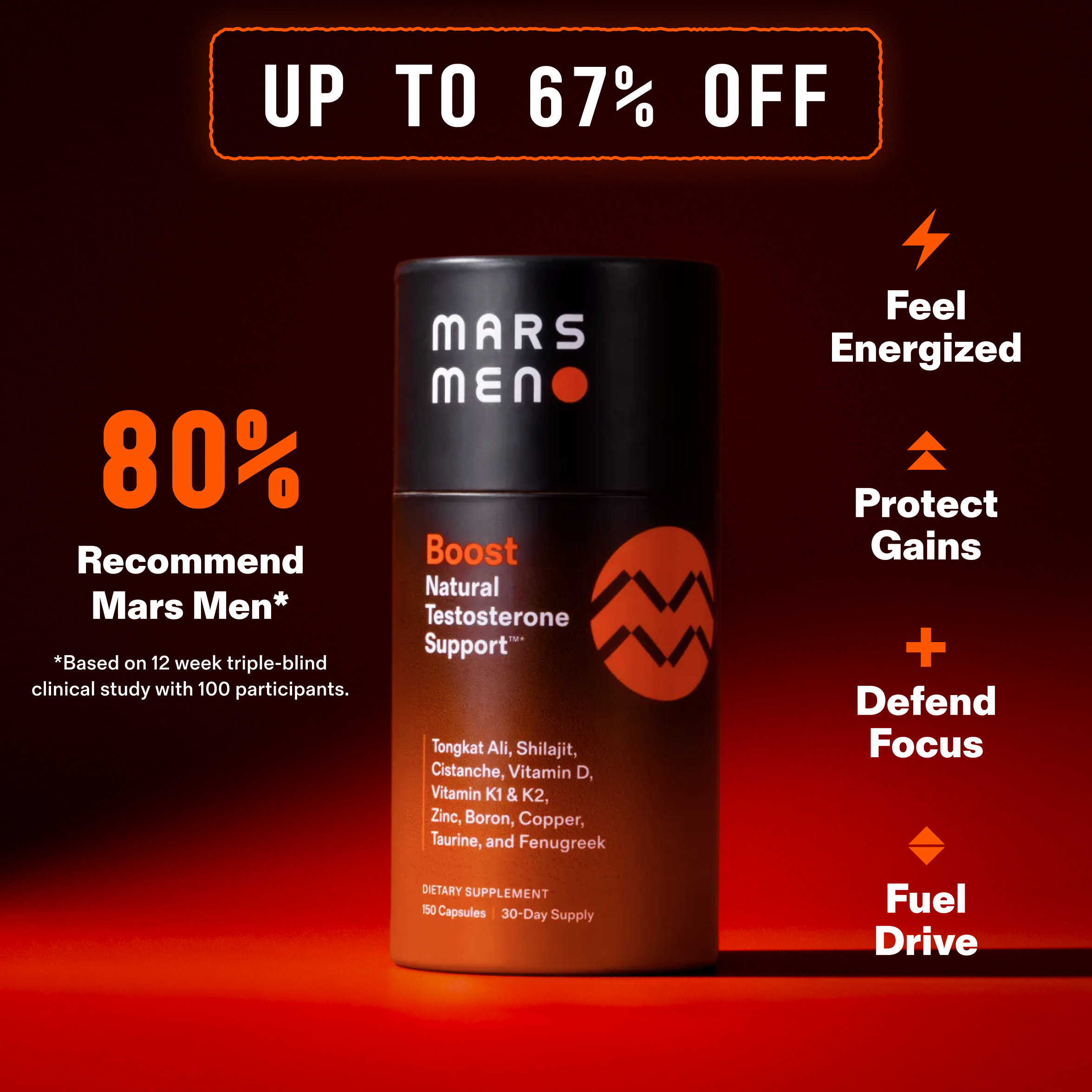
A bottle of Mars Men Boost contains 150 capsules. The directions call for five a day. Thirty days later, the bottle is empty. It is a small piece of arithmetic, but it explains more about this company than the rocket language on its website. The product runs out on a schedule. The business is arranged to meet it there.
- Boost bundles herbs, vitamins and minerals into a daily testosterone-support supplement.
- Mars Men reported a $100 million revenue run rate before its first outside funding.
- GNC distribution and the new Ignite drink extend the business beyond its original bottle.
The customer being addressed is recognisable: a man who wants more energy, better recovery, or the feeling that he has not misplaced his former self. Mars Men sells him a routine with a name that sounds like an expedition. Buying vitamins seldom offers much theatre. Here, even the refill gets a mission.
The second purchase was already in the room
The standard Boost subscription offer displayed on the company’s site is $59 for a 30-day supply. That works out to about $1.97 a day. Subscribers can skip, pause or cancel. There are larger supply options, promotional prices and a one-time purchase route, but recurring delivery occupies a conspicuous place in the pitch.
This arrangement solves a mundane problem before it attempts a biological one. A customer can replace a collection of separate supplement purchases with a single bottle and a replenishment schedule. The commercial proposition is convenience, selection and continuity. The ingredients matter; so does the number of decisions removed from breakfast.
Standard direct subscription offer per bottle → approximate daily cost. Promotions and retail prices vary.
There is an equally useful detail in the guarantee. Under the refund policy updated October 1, 2026, the 90-day offer covers a customer’s first Mars Men order, once. Renewals are excluded. Non-defective returns incur a $7 processing fee, and gifts must be returned for the full eligible refund. The reassurance has a boundary. A recurring purchase deserves recurring attention.
A familiar cabinet, packed into one bottle
Boost lists 11 ingredients, including tongkat ali, shilajit, fenugreek, cistanche, taurine, zinc, copper, boron and vitamins D, K1 and K2. The company publishes quantities rather than hiding the formula inside a proprietary blend. Its positioning rests on disclosed dosing and natural testosterone support, with manufacturing and testing claims supplying another layer of reassurance.
Those details give shoppers something concrete to compare with competing supplements or a stack assembled from individual ingredients. They do not make the bottle a prescription. Mars Men operates in consumer wellness: it sells dietary supplements, rather than diagnosis, hormone testing or testosterone replacement therapy. A medical treatment and a supplement may appear in the same shopping conversation while answering different questions.
The distinction matters because low energy is an experience, not a laboratory result. The Endocrine Society’s guidance requires compatible symptoms and consistently low testosterone measurements to establish hypogonadism, with repeat morning testing. Research on an ingredient also answers a narrower question than a controlled trial of a finished mixture. Transparent labels help people inspect a product; they cannot, by themselves, predict an individual outcome.
The money arrived after the customers
On March 30, 2026, Mars Men announced a $27.5 million Series A led by L Catterton. In that announcement, it reported reaching a $100 million revenue run rate, profitably, within less than 18 months of launch, without earlier outside capital. It also said it had served more than 400,000 customers. These are company-reported business figures.
- 01Launch and build recurring demand
- 02Report a $100M annualized run rate
- 03Raise $27.5M for expansion
A run rate annualises a current pace of sales. It should not be read as an audited year’s revenue, and customers served should not be silently converted into active subscribers. Even with those distinctions, the sequence is revealing: customer demand preceded the institutional cheque. The announcement positioned the money for more products, staffing, partnerships and distribution.
The founders are Benjamin Smith, CEO, and Zach Stuck, CMO. Stuck’s background includes founding the ecommerce growth agency Homestead Studio. On LinkedIn, he described building Mars Men with Smith for two years before announcing the investor partnership. That history gives the company a particular commercial competence: selling consumer products online was familiar territory.
Public hiring offers a less glamorous, more useful clue. Mars Men has advertised roles in retention copywriting, design and implementation, alongside performance-ad video editing. These are jobs concerned with winning attention and keeping customers. For a subscription business, the communication after checkout belongs in the machinery as surely as the advertisement before it.
The same man, a different afternoon
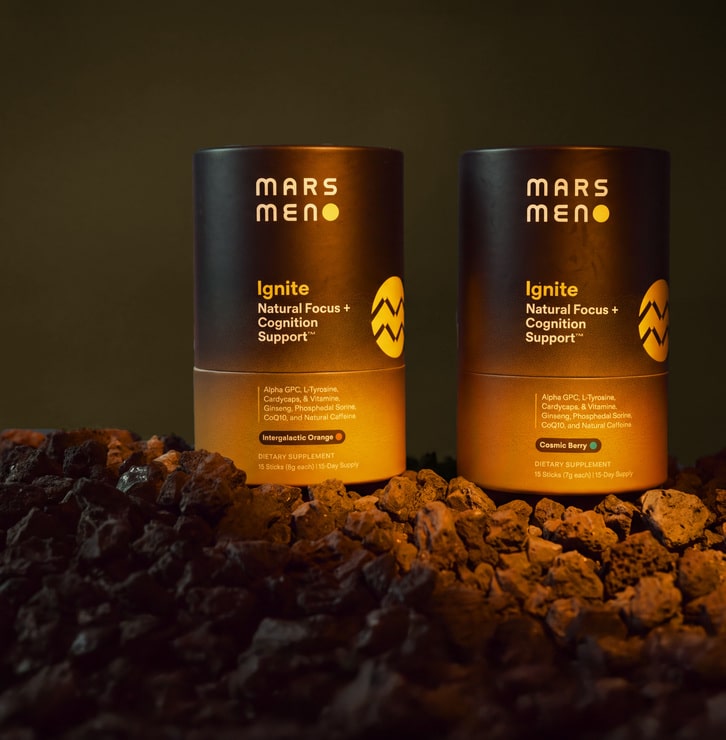
By September, expansion had acquired a tangible form. Mars Men launched Ignite on September 17, 2026: a sugar-free drink mix marketed for focus, clarity and memory. It contains 80 milligrams of natural caffeine alongside ingredients including Alpha-GPC, phosphatidylserine, lion’s mane and L-theanine. The flavours are Intergalactic Orange and Cosmic Berry. Outer space apparently has a fruit aisle.
“Our customers have a lot on their plate, and physical performance is only part of the equation.”Benjamin, Mars Men co-founder / Ignite launch announcement
Ignite can be mixed with cold water and is offered in 15- and 30-pack formats. For Mars Men, it introduces another buying occasion for the audience already reached by Boost. The competing purchase might now be coffee, an energy drink or a nootropic supplement. The brand has widened the day it wants to occupy.
The calendar is the useful part
Boost is also listed at GNC, where the observed price was $99.99 for 30 servings. Retail changes the encounter. A shopper can find the product alongside alternatives without first travelling through the brand’s online sales pitch. Distribution adds access, but it also invites immediate comparison on price, ingredients and shelf presentation.
For another founder, the transferable idea is straightforward: align the product’s use, its supply and the next purchase. Make the label inspectable. Give customers control over delivery. Budget for retention work. This approach depends on a product people willingly keep using; it becomes expensive when repeat orders lag, acquisition costs outrun margin, or the customer expects a medical answer from a retail purchase.
Mars Men’s most instructive achievement is organising a repeatable transaction around a daily concern. Whether the next chapter happens at breakfast, on a GNC shelf or beside an afternoon glass of orange-flavoured water, the question remains wonderfully ordinary: will the customer want another?