Most electrical equipment is designed to disappear into the background. A breaker sits in a cabinet. A panelboard waits behind a door. The best outcome is usually uneventful: current moves, a facility runs, nobody calls. Norm Sowards has spent much of his career working on the business problem hidden inside that engineering success. If the value of infrastructure is easiest to see when it fails, how do you make customers care before that moment arrives?
Sowards's answer, across roles at GE and ABB, has been to stay close to the operating consequence. He has sold, improved, managed and marketed products that distribute electricity. His public record stretches from market-segment management and district sales in the 1990s to Six Sigma, commercial marketing, P&L leadership and his current role as CMO and senior vice president of marketing and strategy at ABB Electrification. The vocabulary changed along the way. The central task did not: translate technical capability into a reason to act.
That is a more demanding job than polishing a product sheet. Electrical equipment travels through a network of engineers, distributors, contractors, plant managers and end users. Each person sees a different risk. One worries about specification. Another worries about installation time. Someone else worries about the shift that stops at 2 a.m. The useful story has to survive every handoff.
Learning the system from the inside
The early sequence matters. Sowards worked as a market segment manager, then a district sales manager, then a Six Sigma Master Black Belt. Sales exposes the gap between what a factory makes and what a customer believes it is buying. Process improvement exposes the gap between a promise and the system required to keep it. Those experiences later sat underneath general-management titles that carried responsibility for profitability, investment decisions and product vitality.
By 2010, he was publicly identified as general manager of commercial and industrial marketing at GE Appliances & Lighting. He spoke about continuing education for engineers, designers and consultants, and about energy-efficient LED systems. The communication was practical: useful information, lower maintenance, consistent light, less energy. It met the audience at the workbench rather than asking them to admire a slogan.
In 2012, Sowards moved into leadership of GE Energy Management's Power Components business. The role pulled him closer to the unglamorous hardware that keeps complicated places operating. It also brought a sharper version of the visibility problem. A lighting system can be seen. A circuit breaker is noticed mostly when it trips, wears out or fails to protect what is downstream.
The product that succeeds by being forgotten
The GuardEon circuit-breaker platform made that paradox concrete. Its pitch included predictive-maintenance features that could help operators understand wear and operating time before a problem became an incident. Sowards framed the value around advance warning, not the drama of the trip itself. In a ship, data center or process plant, the useful event is the one an operator can address on a schedule rather than discover during an outage.
What you care about with something like GuardEon is that you never notice that it is there.Norm Sowards on dependable electrical protection
There is a compact marketing lesson in that sentence. Features matter because they change the operator's day. Contact-wear data becomes an earlier decision. An internal event log becomes a maintenance plan. Reliability becomes time returned to the people running the facility. The technology stays complex. The reason to care gets simpler.
The product was also tied to a different way of building. GE invested in advanced manufacturing capability, bringing design teams together with manufacturing engineers, 3-D printers and a collaborative robot. Sowards called the resulting lab a “toy room for engineers.” The line carries a flash of personality, but the room had an operating purpose. It allowed teams to prototype, test and respond to customer feedback without treating design and production as distant stages.
The industrial marketing stack
A new name over an old installed base
In June 2018, ABB completed its $2.6 billion acquisition of GE Industrial Solutions. Acquisition announcements speak in market positions, installed bases and expected synergies. The people inside the deal face a more tactile assignment. Product names shift. Systems combine. Customers want to know what will be supported, what will change and whether the people who understand their equipment are still listening.
Sowards continued into ABB, carrying experience from the acquired portfolio into the company's electrification business. By 2023, ABB identified him as senior vice president of marketing and strategy. His product language still began with a job to be done. In announcing ReliaGear panelboards, he focused on helping electrical contractors complete projects on time, on budget and on specification. Versatility and availability were not abstract virtues. They were answers to a schedule.
The scope widened. At a 2024 OEM summit, Sowards presented a special report on market trends. That year he also represented ABB when a redesigned Spec Setter Safety Switch received a silver Product of the Year recognition. The switch included changes intended to ease installation, improve accuracy, reduce packaging footprint and add safety features. These are modest-sounding improvements with direct consequences for the person moving, mounting or opening the equipment.
The workforce is part of the product
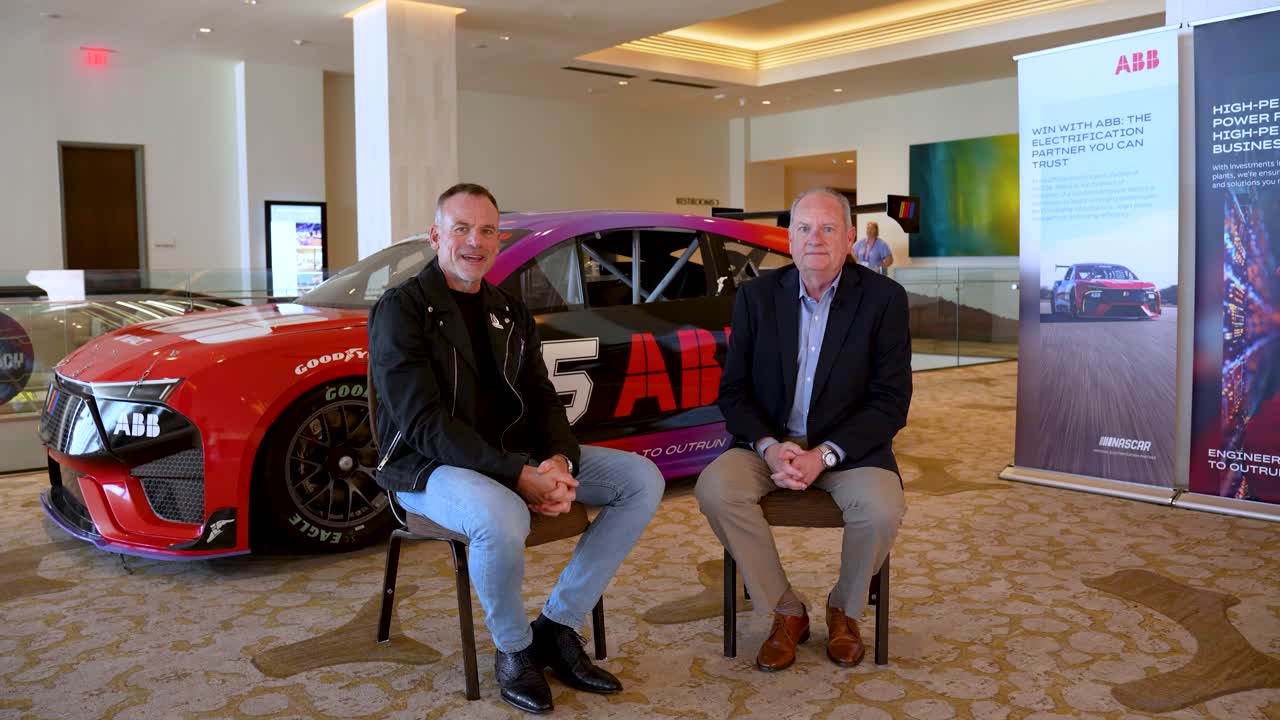
By 2025, a conversation with Trade Hounds placed Sowards beside an ABB-branded NASCAR electric prototype. The setting turned electrification into something visible, fast and culturally familiar. Yet the discussion returned to a quieter constraint: the people who make adoption possible. Product innovation and AI-enabled tools are arriving while the electrical trade manages a generational handoff. Knowledge has to move as surely as current does.
That changes the marketing brief. Reaching the next generation of electricians means more than placing an advertisement near them. It means understanding how they learn, how they evaluate products and where they ask peers for help. Digital training becomes market infrastructure. A contractor who can confidently select and install a system is part of the value chain, not an audience waiting at the end of it.
Sowards has continued to amplify that connection. In 2026 he shared ABB's support for a workforce coalition aimed at expanding pathways into electrical careers, beginning in North Carolina. He also promoted a data-center startup challenge and a live motorsport demonstration combining electrification, automation and real-time energy management. The subjects look different on the surface. Underneath, they all ask how an industrial company makes a large transition understandable, credible and staffed.
Our monthly 1:1s pushed me to think six to twelve months ahead and cut through the noise.A former ABB colleague on Sowards's strategic mentoring
Colleagues add another dimension to the public record. One credited Sowards with teaching strategic marketing through monthly conversations that forced a longer view. An ABB intern remembered cupcakes at her first meeting with him on a birthday away from home. Neither moment is a corporate transformation. Both show what strategy looks like at human scale: make room for someone, then help that person see further.
The discipline of useful attention
Sowards's career is not a founder mythology or a reinvention tale. It is a long apprenticeship inside industrial systems. He learned the channel in sales, the process in Six Sigma, the tradeoffs in general management and the narrative in marketing. He stayed with a portfolio through an acquisition and into an era when electrification moved from a specialist concern toward the center of debates about data centers, transport, buildings and the grid.
The transferable idea is not to make every circuit breaker exciting. It is to identify the consequence that deserves attention. Sometimes that is a fault detected early. Sometimes it is an enclosure designed to install with less friction. Sometimes it is a young electrician who needs a better way to learn. The executive's work is to connect those points without flattening the engineering or losing the person who has to use it.
Invisible infrastructure will keep its strange bargain with the public. When it works, it recedes. When it fails, it becomes the only story in the room. Sowards has built a career in the space before failure, where customer insight, product investment and workforce readiness can still change the ending.