Rich Stinson liked to give an old abbreviation a second job. Every chief executive knows the first P&L, the cool and unforgiving arithmetic of profit and loss. Stinson kept another beside it: People and Lives. He did not pretend the second erased the first. He said they were equally important. In the world of copper rod, industrial cable, plants and distribution hubs, it was a neat piece of verbal engineering - two measures sharing the same terminals.
The phrase outlasts his tenure because it explains the particular assignment he accepted in Carrollton, Georgia. Southwire was a large manufacturer with a family name over the door and a stated ambition to last for generations. Stinson arrived from Eaton in October 2015, became chief executive on the first day of 2016 and retired on the first day of 2026. His task was to make a mature industrial company grow without misplacing the culture that made its owners want it to endure.
He brought a résumé built in the less glamorous rooms of American industry. After earning an engineering degree at the University of Pittsburgh, he entered Westinghouse's manufacturing development program. Assignments took him to Puerto Rico, the Dominican Republic, Japan, Mexico and plants around the United States. When Eaton acquired part of Westinghouse's electrical business in the 1990s, Stinson stayed with the work. Engineering led to manufacturing, supply, plant management and operations. By the turn of the century he was a vice president and general manager; later, he ran one of Eaton's multibillion-dollar power businesses.
Engineer in Westinghouse's manufacturing development program
Operations and executive roles across Westinghouse and Eaton
President and CEO of Southwire
Retirement, adviser handoff and NAED service award
The engineer learns a wider equation
Moving from a public corporation to a privately held, family-owned company broadened his field of view. Stinson said Southwire could weigh the interests of the community, environment, customers, employees and shareholders, rather than allow every decision to end at a quarterly financial metric. The difference was not an escape from performance. It was a larger definition of it.
Profit &
Loss
Growth, investment, acquisitions, operating rhythm and the financial strength required to keep going.
People &
Lives
Opportunity, trust, inclusion and the quality of the place where the work gets done.
At Southwire, the first ledger involved organic growth, acquisitions and process improvement. The second ran through a culture Stinson described with four sturdy nouns: empowerment, trust, consistency and inclusion. He spoke about employee resource groups and an “extraordinary place to work” in the same direct register he used for operating performance. In November 2025, accepting Southwire's Pioneer Award for inclusion, he returned to the two ledgers. Profit sustained success, he said; People and Lives made the workplace worth sustaining.
The formulation risks sounding like something embossed on a lobby wall. Its force comes from the stubborn “and.” Stinson never offered people as an alibi for weak results, or profit as permission to neglect people. The books had to close together.
That balance also suited the peculiar time horizon of a multigenerational company. Public markets can make three months feel like an era; a family enterprise that talks about the next hundred years has a different clock on the wall. Machinery, talent and trust all mature at different speeds. Stinson's engineer's instinct was to make them part of one operating system, where culture was not the soft subject postponed until the production meeting ended.
“The most important thing that a leader can do is lead.”Rich Stinson, describing his management philosophy
Three instructions from the sideline
For all the language of stakeholder value and generational sustainability, Stinson's personal operating system came from somewhere less polished: his high school football coach. He remembered three instructions. Be ready to hit first or be hit. Complacency stifles progress. And do not spend your time reading Saturday's newspaper, admiring the last result; worry about the next game.
They help decode the style he called direct but approachable. The first maxim supplied competitiveness. The second made improvement perpetual. The third discouraged executive victory laps. Approachability kept the bluntness from hardening into distance. Stinson took pride in colleagues coming to him with business problems, opportunities and the untidy matter of their personal lives.
That combination - candor with an open door - is harder than its plain language suggests. Direct leaders can become merely loud. Approachable leaders can become merely agreeable. Stinson's ideal required both: say what the work demands and remain available to the people doing it. A colleague presenting his 2025 Pioneer Award described him in equally athletic terms: candor, commitment, drive, a will to win and a sense of fair play.
A shortage of hands, not ambition
Stinson's concern for the second ledger extended beyond current employees. In 2017 he wrote publicly about a skilled-trades shortage that threatened manufacturing's ability to grow. The diagnosis mixed demographics, perception and training: experienced workers were retiring, young people and their parents ranked manufacturing poorly, and apprenticeships lacked enough support.
His proposed remedy was less glamorous than a product launch and more durable than a recruitment slogan. Manufacturers had to work with schools, invest in apprenticeships and widen who could see a future in the industry. He pointed to 12 for Life, Southwire's partnership with the local school system, where students at risk of leaving school could earn wages in a manufacturing setting while finishing their diplomas. By his 2017 account, more than 2,000 students had graduated through the program.
This was practical self-interest with a civic radius. A manufacturer needs skilled people; a town needs young people with a credible route into skilled work. The company and community meet in the same classroom and, eventually, on the same plant floor. Stinson's second P&L gave that overlap a name.
He also argued that inclusion belonged in the same conversation. If manufacturers hoped to recruit from a changing America, they had to let more people contribute at their highest level. Years later, Women in Manufacturing gave him its William E. Gaskin Ally Award for supporting women's advancement. The honor did not prove the work complete. It did show that his public language about inclusion had acquired institutional weight inside and beyond Southwire.
From one company to the whole circuit
Late in his career, Stinson widened the diagram again. Electrification was accelerating while the grid, equipment supply chain and workforce all faced constraints. He warned that electricity demand could outrun supply if the country did nothing extraordinary. The problem crossed the boundaries between manufacturers, contractors, distributors and manufacturers' representatives, so the response had to cross them too.
Stinson helped form the Alliance to Electrify America, convening four associations whose initials can resemble a bowl of alphabet cereal: NEMA, NECA, NAED and NEMRA. Behind the acronyms was a simple idea. The electrical industry needed a stronger common voice in Washington and closer coordination on grid reliability, supply chains and workforce development.
It was a natural final act for an operator whose career had moved across the seams. He had designed, made, supplied and managed electrical products. As chair of NEMA's Board of Governors in 2023, he also knew what a trade association could and could not do alone. The alliance turned accumulated knowledge into connective tissue.
There is an appealing modesty to this kind of legacy. A coalition is not a cable, a factory or a quarterly result. It is an agreement to keep talking across commercial boundaries, then make that conversation useful. For someone trained to solve physical problems, Stinson's late work treated coordination itself as a piece of infrastructure.
“It's a great time to be in the electrical industry.”A Stinson refrain, repeated as electrification moved to the center of the economy
The orderly handoff
Stinson announced his retirement in October 2025. Ganesh Ramaswamy, then an executive vice president at Baker Hughes, would take the job. Stinson would stay briefly as executive adviser and help with the transfer. On January 1, 2026, after more than 44 years in the industry and exactly a decade as Southwire's CEO, the handoff became official.
There is symmetry here. Stinson had entered Southwire through an orderly transition of his own, serving first as president under retiring CEO Stu Thorn. Ten years later, he left through another. For a leader fond of the next game, succession was not an epilogue. It was the last operating assignment.
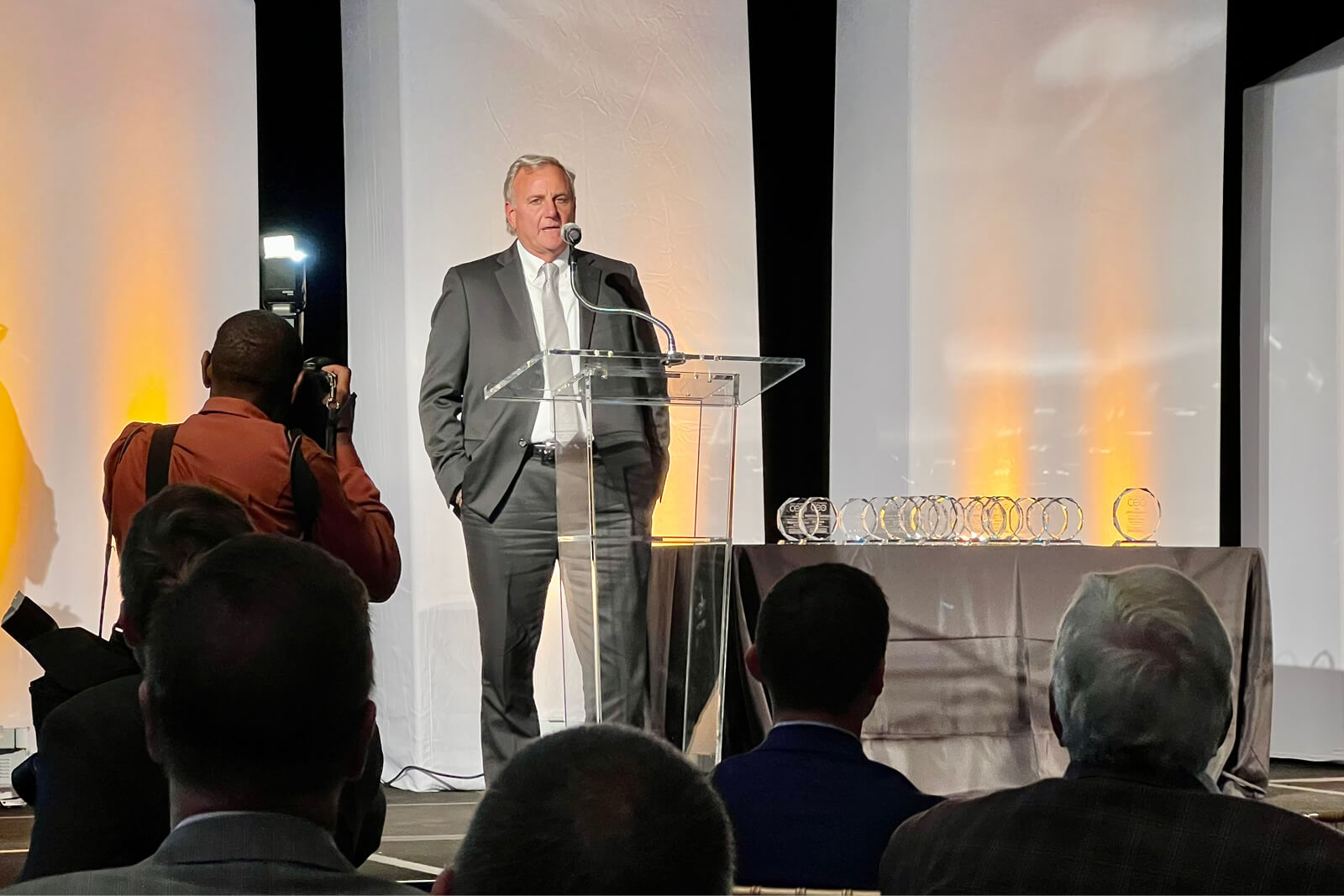
Recognition clustered around the exit: the William E. Gaskin Ally Award from Women in Manufacturing, Southwire's Pioneer Award, and in June 2026, the National Association of Electrical Distributors' Associate Distinguished Service Award. Earlier honors included Georgia Trend's 2023 Most Respected Business Leader and a 2022 Most Admired CEO award from the Atlanta Business Chronicle. The plaques tell one version of the career. The coalition, workforce programs and vocabulary tell the more useful one.
Stinson left the corner office with no grand mystery about what mattered. A company must remain financially sound. It must prepare for the next market, the next constraint and the next leader. It must also notice what its decisions do to the people inside and around it. His accounting trick was to put both obligations in management's daily language.
Profit and Loss. People and Lives. The first tells you whether the enterprise can continue. The second helps explain why anyone should want it to.