The future of electricity has a peculiar habit of disappearing behind the wall. We admire the electric car, the cloud, the bright new factory and the solar array. Then we forget the miles of copper and aluminum that make any of them useful. Ganesh Ramaswamy has spent a career moving closer to those concealed systems. In December 2025, the route brought him to Southwire, the family-owned Georgia manufacturer whose products do the uncelebrated work of carrying power from where it is made to where somebody needs it.
His arrival contained a tidy industrial irony. Ramaswamy had already run businesses concerned with medical equipment, product identification, smart buildings and energy technology. Each sector sells a visible outcome, yet each depends on quiet infrastructure. At Southwire, he took charge of a company devoted to infrastructure itself. Wire lacks the theatrical instincts of a wind turbine. It is content to be indispensable.
Southwire announced him as successor to Rich Stinson, who retired after a decade as chief executive and more than 40 years in the electrical industry. Ramaswamy joined as president and CEO while Norman Adkins, the company's president and chief operating officer, prepared for an April 2026 retirement. The handover placed an outsider with a global résumé inside a 75-year-old business that still speaks in the language of generations.
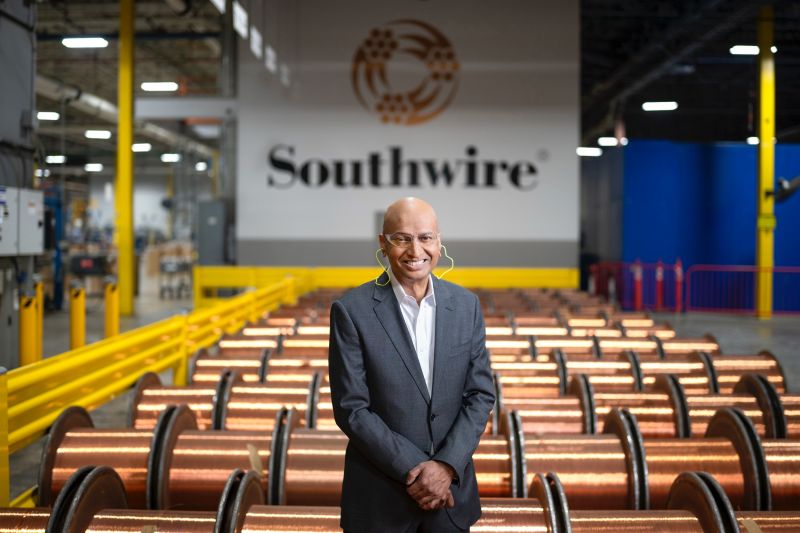
First, find the factory floor
By February, Ramaswamy offered his first useful clue about how he intended to learn the place. Much of his time, he said, had gone into visiting facilities and connecting with team members and customers. It is the sort of sentence that can dissolve into executive wallpaper. In his case, the pattern predates Southwire. While at Baker Hughes, he wrote about visiting a valve service center in Deer Park, Texas, and a sensor campus in Minden, Nevada. What he noticed was not the lobby. He praised the focus on lean practice across the factory floors and the care teams put into quality and service.
This is a revealing preference. Industrial companies are often described from high altitude: revenue, markets, portfolio, strategy. A plant insists on nouns you can drop on your foot. Valves. Sensors. Cable. The factory floor exposes the distance between a slide and a shipped product, and it gives a new chief executive a swift education in who really understands the business.
“Since joining the company in December, much of my time has been spent visiting our facilities and connecting with our team members and customers.”Ganesh Ramaswamy, February 2026
The listening tour preceded a reworking of Southwire's senior ranks. The chief financial officer and chief people and culture officer announced retirements. Supply-chain responsibilities shifted. By July, three new executives had joined and two existing leaders had larger portfolios. Ramaswamy's explanation was characteristically plain: “The strength of any organization starts with its people.” Corporate reorganizations are rarely charming, but clarity has its own manners.
An engineer accumulates worlds
Ramaswamy was born and raised in India. His education began with a mechanical-engineering degree from the University of Kerala, continued with a master's at Auburn University, and reached a doctorate in mechanical engineering and applied mechanics at the University of Pennsylvania. He later added an MBA from the University of Wisconsin-Milwaukee. Four degrees can suggest a fondness for classrooms. His career suggests impatience with leaving ideas there.
He began in product development and general management at GE Global Research and GE Healthcare. From there came a sequence of increasingly broad operating assignments. At Hoya's Pentax Medical, he worked in quality, global product development and ultimately served as president. In 2015 he moved to Danaher, first leading high-growth markets at Beckman Coulter Diagnostics, then serving as president of Videojet Technologies and group executive for marking and coding.
The products changed, but the grammar remained industrial: precision, repeatability, quality, service and the stubborn details between an invention and a reliable business. Videojet equipment puts codes and markings on products. Pentax Medical makes sophisticated imaging systems. Their customers buy different machines, yet both expect performance that survives contact with reality.
The operating circuit
Research & Healthcare
Medical
businesses
Controls
Hughes
CEO
In late 2019, Johnson Controls asked him to lead Global Services and Transformation. The mandate combined a traditional service business with digital capabilities and sustainability solutions. Buildings had become machines with long memories: sensors, software and service histories alongside chillers and controls. Ramaswamy led the effort to make those parts behave like one business. The company credited him with digital-services transformation and year-over-year growth in services and sustainability offerings.
Baker Hughes recruited him in January 2023 to run Industrial & Energy Technology. The segment placed him inside one of the century's hardest practical arguments: how to supply secure, affordable energy while lowering emissions. Its portfolio ranged across turbomachinery, valves, sensors and emerging energy-transition technologies. The job added scale and political complexity to a career already accustomed to products that must work.
From transactions to ecosystems
At an energy-transition summit, Ramaswamy described a market changing from a transactional model into partnerships between customers and “an ecosystem of multiple collaborators.” The phrase is managerial, but the point is concrete. The energy transition cannot be ordered from a catalogue by one buyer from one seller. It requires utilities, manufacturers, technology providers, regulators, investors and customers to move with some degree of coordination. His conclusion was that collaboration was necessary to develop and deploy technology at the required pace.
“This collaboration model is needed to spur the development and deployment of technologies for the energy transition.”Ganesh Ramaswamy at the Financial Times Energy Transition Summit
Southwire gives that conviction a new setting. Its wire and cable run through utility networks, buildings, factories and other critical infrastructure. Demand is being tugged from several directions at once: grid modernization, renewable generation, electric transport, new manufacturing and the extraordinary appetite of data centers. The company also sells tools and assembled products used by the people who install and maintain those systems. It occupies the space between a grand electrification plan and the electrician who must make it conduct.
That breadth helps explain why Ramaswamy's varied résumé feels less like wandering than preparation. Medical equipment taught the discipline of quality. Danaher made operating systems part of the daily vocabulary. Johnson Controls joined physical assets to digital services. Baker Hughes placed technology inside the energy trilemma of security, affordability and sustainability. Southwire connects all of those lessons with actual conductors.
The burden of the hundredth year
A family-owned company measures time differently. Southwire was founded in 1950 and remains anchored in Carrollton, Georgia. When its leaders talk about being “generationally sustainable,” the expression includes balance-sheet endurance, environmental responsibility, community standing and the ability to hand a viable enterprise to people who have not yet joined it. A public company can announce a five-year plan. A family business approaching its centenary is having a longer conversation.
Ramaswamy inherited that conversation at an unusually busy moment. In his first year, Southwire announced senior appointments, partnerships around digital electricity, manufacturing investments and sustainability work. He also appeared before electrical contractors at NECA's Emerge 2026 gathering to discuss planning, production and performance. Those three words are modest beside the slogans of technological revolution. They are also how revolutions acquire delivery dates.
When he announced his move in December, Ramaswamy described Southwire through the places its products reach: homes, industries, communities and critical infrastructure. That list is almost a sketch of his own career. He has worked on technology for hospitals and laboratories, equipment for production lines, services for buildings, and machinery for energy producers. Now the customer is anyone trying to move an electron safely. The remit is broad enough to sound philosophical until a storm, a construction deadline or a crowded grid makes it urgently local.
His outside view is balanced by boardroom experience at PACCAR, the truck manufacturer whose Kenworth, Peterbilt and DAF brands inhabit another essential corner of the physical economy. He has served as an independent director since 2021. That vantage point adds freight, manufacturing and long-lived capital equipment to his working map. It is hard to romanticize transformation after watching what it takes to build a truck.
The scale of his earlier assignments matters here. At Baker Hughes he held responsibility for a diverse industrial and energy portfolio. At Johnson Controls he was asked to join equipment, service and digital capability into a more coherent offer. Southwire's challenge has a family resemblance: protect the reliability of a mature manufacturing base while finding growth in markets being remade by electrification. Innovation, in this setting, must coexist with delivery trucks leaving on time.
The temptation for a new CEO is to arrive as an author, eager to replace the existing plot. Ramaswamy's opening months looked more like field research. Walk the plants. Meet the customers. Respect the departing leaders. Then adjust the organization. His language about Southwire's next 100 years carries ambition, but the method so far has been observational and incremental.
Perhaps that is appropriate for wire. Its genius lies in continuity. A conductor works because the path remains unbroken, because material, insulation, connection and installation all do their jobs. Ramaswamy now leads a company built around that simple and unforgiving fact. The modern world may prefer its miracles wireless. Somewhere behind the wall, copper is enjoying the joke.