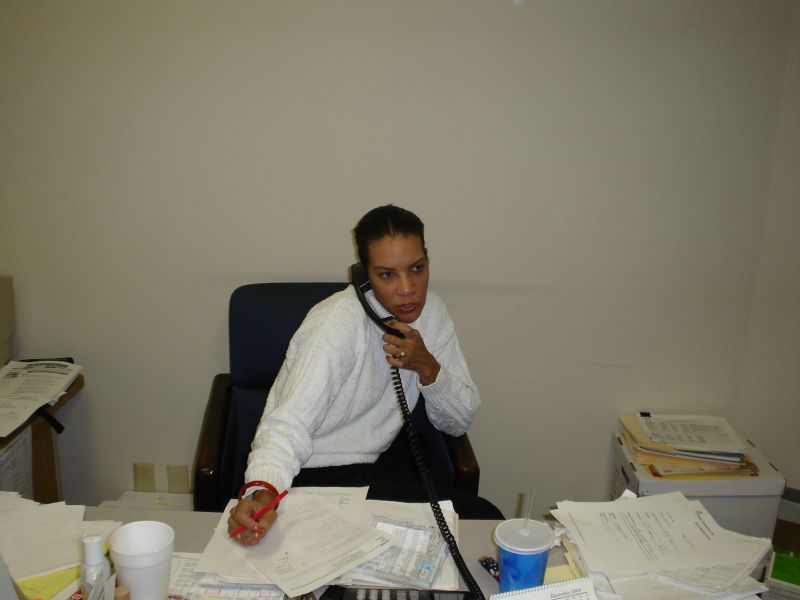
The photograph is almost aggressively ordinary. A bare wall. A black office chair. A telephone cord looped across a desk where papers have colonized every available inch. Cynthia Stewart holds the receiver to her ear with one hand and keeps a red pen moving with the other. There is no branding exercise in sight, no founder posing beside a slogan. There is simply work, arriving faster than the furniture.
The picture was taken during the first year of Power Personnel, the San Jose staffing company Stewart founded in 1994. She has said that the piles represented the many jobs she performed as the company's sole employee: marketing, sales, recruiting, sourcing, interviewing, payroll, invoicing and answering the telephone around the clock. Entrepreneurship, in this version, looks less like freedom than an inability to delegate.
Yet the clutter also contains the whole plot. Stewart began with no office, no clients and no existing book of business. More than 30 years later, Power Personnel says it has made over 40,000 placements and developed enduring relationships with healthcare institutions across Northern California. The distance between those two scenes is not a cinematic leap. It is a long accumulation of answered calls.
She studied the leap before she took it
Three years before she opened the company, Stewart completed an MBA thesis titled Profiles of African-American Businesses. This is the unusual pleasure of her origin story: the founder first appeared as a researcher. She studied how Black-owned companies formed, survived and grew. Then life placed an exam in front of her. She could accept a financial analyst position with Xerox, or she could test her findings with her own money, reputation and sleep.
She chose the business. Her husband, Rickey Green, an attorney, helped incorporate it and supported the venture from the beginning. He would later become Power Personnel's chief executive. Stewart's degree in marketing from San Jose State University gave her one lens; her MBA in finance from California State University, East Bay supplied another. Neither could place the first candidate or win the first client. Credentials can sharpen judgment. They cannot dial the telephone.
“A few years later, I had a decision to make, accept a financial analyst position with Xerox, or bet on myself. I chose entrepreneurship.”Cynthia Stewart, reflecting on Power Personnel's beginning
The bet had older roots. Stewart has lived in San Jose since the 1970s, and at 11 she was already spending hours in her father Robert Stewart's store. He had retired from a 20-year Army career before becoming a retailer in Silicon Valley. At the counter, his daughter watched negotiation, customer service and the unromantic mechanics of running a business. Robert also mentored aspiring entrepreneurs and urged people to be ready when opportunity arrived. Cynthia absorbed both halves of that instruction: preparation matters, and the door should remain open behind you.
A placement is a small event with a long shadow
Power Personnel became known for healthcare staffing, supplying clinical and non-clinical workers to hospitals, outpatient clinics and other facilities. Staffing is often described as a matching exercise. The employer has a vacancy; the recruiter finds a person. Stewart's account is more expansive. Work changes the options available to an individual and a family. A filled role changes what a department can deliver. In healthcare, an administrative hire or a patient-care worker can affect an entire chain of people who never learn the recruiter's name.
The company's history offers evidence of that compounding effect. Its relationships with Stanford Health Care and Stanford Medicine Children's Health date to 1995. A former Stanford quality leader credited Stewart's organization with finding candidates for performance improvement, quality management and program roles, some of whom later converted to permanent employees. A good placement, in other words, does not merely end a search. It can begin a career inside the client institution.
That kind of relationship also changes the recruiter's job. After years inside a client's routines, a staffing partner learns which qualifications merely decorate a résumé and which ones survive the working day. It learns the pace of onboarding, the expectations of managers and the soft skills that keep a technically able person from becoming a costly mismatch. Stewart's advantage was therefore not a secret database. It was memory, earned over repeated assignments and difficult-to-fake attention. Silicon Valley adores disruption; a hospital with an uncovered shift has more use for continuity.
Stewart also built preparation into the service. She has described pre-placement programs that combine clinical and client-specific training before healthcare professionals begin work. The distinction is important. Access without readiness can be a revolving door; readiness without access is a locked one. Her model attempts both at once.
“Opportunity does not happen on its own. It takes people willing to do the work and leaders willing to create jobs, build strong teams, invest in people, and open doors for others.”Cynthia Stewart, Labor Day 2026
Growth, inspected
Staffing firms sell confidence in conditions that invite doubt. A hospital must trust that licenses were checked, experience was tested and a worker is ready for a demanding environment. Power Personnel first earned Joint Commission certification for healthcare staffing in 2007. By 2025, it had earned a ninth consecutive certification. The repeated audits are less glamorous than an awards stage and more revealing. They turn quality from an adjective into paperwork, verification and recurring scrutiny.
Growth arrived alongside that discipline. Power Personnel appeared on Staffing Industry Analysts' fastest-growing firms list in 2013, 2014, 2015 and 2016, then returned in 2022 at number 104. Stewart was named to the industry's Global Power 150 Women in Staffing in 2023 and again in 2024. She framed the latter recognition as a signal for women of color as much as a personal distinction. Her own route had begun in a field where authority, ownership and access did not distribute themselves evenly.
The patient build · selected milestones
- MBA thesis examines African American businesses
- Power Personnel begins with no clients or inherited book
- Long-running Stanford healthcare partnerships begin
- First Joint Commission staffing certification
- El Camino Hospital Finance Committee appointment
- Back-to-back Global Power 150 recognition
- More than 40,000 placements reported
Her professional orbit widened beyond the company. In 2021, El Camino Hospital selected Stewart as a community member of its Finance Committee after a process that reviewed seven applicants and interviewed four. She brought an uncommon combination to the table: formal finance training, decades of healthcare workforce operations and the perspective of a supplier familiar with how institutions behave at ground level. She also serves with Women Health Care Executives NorCal, supporting networks intended to widen leadership pipelines.
The business after the business
The persuasive part of Stewart's public character is its consistency. The daughter who learned in a neighborhood shop became an owner who talks about opening doors. The graduate student who studied Black enterprise became a founder who marks Black Business Month by explaining the mechanics of her choice. The recruiter who treats work as access volunteers in ways that make the idea literal.
She has written that, every Saturday, rain or shine, she spent two and a half hours delivering baked goods for the Cathedral of Faith's Reaching Out Center, which assists lower-income families, seniors and students in Santa Clara County. Power Personnel has partnered with community organizations for more than two decades. The gesture and the enterprise operate at different scales, but their grammar is similar: somebody needs something, somebody knows how to move it, and reliability is a form of respect.
There is also a family continuity here without any need for mythology. Robert Stewart built a business, mentored others and taught his daughter at the counter. Cynthia Stewart built another business with her husband and made preparation part of its service. In 2025, when her father received a posthumous Silicon Valley Black Legends honor, the company described his influence as a practice of turning barriers into bridges. The phrase risks sounding ornamental until one returns to the placement ledger. Forty thousand crossings make a sturdy bridge.
Longevity can make an entrepreneur's original uncertainty difficult to see. The awards, committee seats and certifications line up afterward and pretend the road was obvious. The old office photograph corrects the record. Stewart is not smiling for a launch announcement. She is looking slightly away, listening to somebody on the other end, red pen ready. The room contains no proof that this will work.
What it contains is a method: study the field, learn the numbers, answer the call, prepare the person, keep the promise. Then do it again long enough that a small company becomes part of how a region finds its people. Cynthia Stewart made a bet on herself in 1994. Its meaningful returns have gone to everyone who found an open door on the other side.