Noam Solomon found an unusual way to avoid school: he went to university. At 14, the Israeli teenager was already studying mathematics at Tel Aviv University. Most escape plans involve less homework. His involved choosing the questions himself, and accepting that the answers might take considerably longer than an afternoon.
That distinction still helps explain the co-founder and CEO of Immunai. Solomon has collected two doctorates, held research posts at Harvard and MIT, and built a career that moves between abstraction and practical responsibility. The interesting part is how often he has reconsidered the destination. A childhood ambition can become a very comfortable room. It can also become a room you need to leave.
His route into entrepreneurship contains an awkward lesson for anyone who likes a tidy career plan. Getting good at something does not settle whether you want to spend your life doing it. Solomon had to ask that question after investing years in becoming a mathematician. Then he had to learn how to work among people whose expertise he did not possess.
The qualifications were real. So was the restlessness.
Two separate universities awarded the doctorates: Ben-Gurion University for number theory, and Tel Aviv University for computer science. His research interests stretched across combinatorial and computational geometry, combinatorics, algebraic complexity and number theory. These are subjects in which an innocent-looking question can keep an entire room of qualified adults occupied for years.
There is a useful corrective here to the familiar portrait of the founder who merely borrowed a few equations before going into business. Solomon did the work. His academic record includes research with named collaborators, formal publications and problems whose significance takes patience to explain. Mathematics was a profession and an intellectual commitment before it became part of his entrepreneurial background.
Consider Closure Results for Polynomial Factorization, published in 2019 with Chi-Ning Chou and Mrinal Kumar. The paper investigates how the computational complexity of a polynomial relates to that of its factors. Among its results, it establishes closure under factoring for the complexity class VNP, confirming a conjecture in Peter Bürgisser’s 2000 monograph. It is an achievement with a wonderfully unaccommodating title.
The paper gives substance to a phrase that becomes blurry in business biographies: theoretical computer science. This work concerns what kinds of calculations can be represented efficiently and how their difficulty changes under mathematical operations. The distance from a theorem to a commercial product can be considerable. Solomon had spent years learning to think carefully within that distance.
Another part of his academic record supplies a quieter detail. In 2006, Ben-Gurion University recognized his master’s thesis, supervised by Amnon Besser, on elliptic p-adic polylogarithms and arithmetic applications with a Friedman Prize. Long before the CEO title, there was already a sustained apprenticeship in difficult mathematics. The early university start was followed by years of research, rather than serving as a precocious anecdote on its own.
Yet the work and the life around the work are different questions. His later account of leaving pure mathematics describes a growing need for conversation, collaboration and a wider audience for his efforts. The intellectual attraction survived. The solitary working arrangement became harder to accept. That is a less cinematic reason to change careers than a sudden revelation, and a more recognizable one.
The address almost said Vancouver
Harvard lists Solomon as a CMSA postdoctoral fellow for 2017-18. MIT records subsequently place him in its mathematics department. The institutional sequence looks inevitable when compressed into a biography. His own recollection makes it much less so: he had seriously considered Vancouver. His fiancée, now his wife, favored the United States, and the decision helped determine the people he would meet.
He is candid about the social advantage that followed. Harvard and MIT made his business card easier for other people to interpret. He also disliked how readily the world evaluated people through a handful of institutional names. It is possible to benefit from a shortcut and still wish people would do the longer reading.
That ambivalence is useful in understanding him. He can appreciate an institution’s opportunities while questioning the habits it encourages in everyone outside it. Credentials open a conversation. They cannot supply everything that ought to happen once the conversation begins.
Alongside academia, Solomon worked in Israeli technology companies as an algorithms developer, data scientist, consultant and head of data science. The work brought him into contact with another rhythm of achievement: colleagues combining their skills to make something function. His professional life had already acquired more than one language before he became a founder.
A CEO with permission to ask
Immunai was founded in December 2018. Luis Voloch became Solomon’s co-founder, and a founding scientific group included Ansuman Satpathy, Danny Wells and Dan Littman. Their different backgrounds mattered to the company’s structure. Expertise had to be assembled across disciplines; it could not simply be declared into existence by the people signing the incorporation papers.
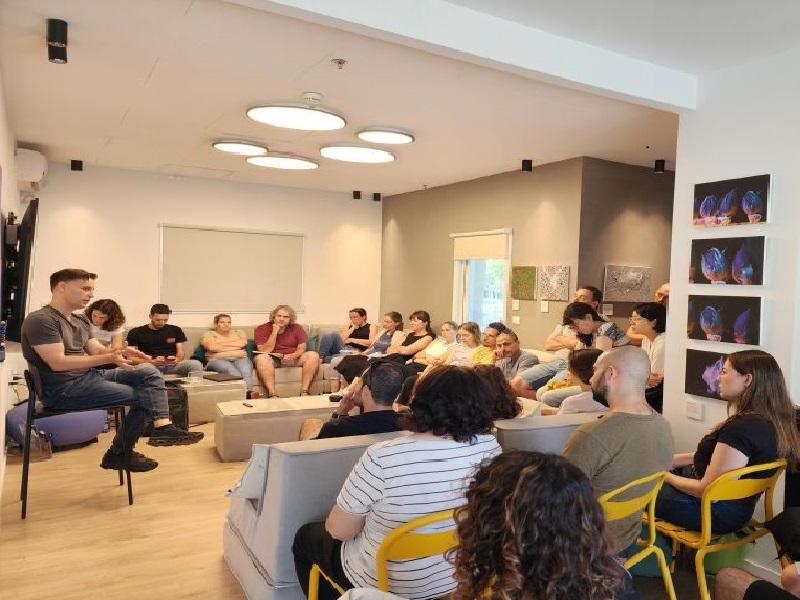
Solomon’s description of his early leadership is unusually revealing. He treated his own gaps in knowledge as questions to put in front of the team. If the CEO could ask something elementary, a newer colleague might feel freer to do the same. There is a practical benefit to removing the little performance in which everyone nods and hopes somebody else understands.
The authority in this arrangement comes from making a useful discussion possible. A leader can define the question, choose capable people and give them room to investigate. Pretending to possess everyone else’s knowledge would consume time without adding any. In a group of specialists, curiosity has the advantage of being much easier to sustain than omniscience.
“You first need to fall in love with the problems.”
Noam Solomon
His advice about technology follows the same pattern. A model can be absorbing to build, particularly for someone trained to enjoy puzzles. The question it is supposed to answer deserves attention before the machinery does. In his public discussions of AI, Solomon repeatedly returns to the relationship between the underlying data, the interpretation and the work required to check a result.
That emphasis helps explain his impatience with treating a fashionable tool as a complete business proposition. A company needs a reason for the tool to exist in its particular setting. The people who understand that setting must be part of the process. It is a demanding arrangement, because everyone arrives with something to teach and something to learn.
- 01Choose the questionKeep the problem in view.
- 02Bring different mindsBuild across disciplines.
- 03Keep studyingMake learning part of the job.
Friendship, failure and the length of a promise
Solomon talks about investors in terms of relationships built before a financing conversation becomes urgent. Trust creates room for uncertainty. His advice to founders includes allowing enough resources for parallel experiments, so that an unsuccessful attempt can teach the team something while other work continues. Failure needs a budget as well as a forgiving slogan.
He places similar weight on recruiting and retaining people who can work with uncertainty. A founder may introduce the idea, but colleagues carry it through the ordinary complications of operating a company. His emphasis shifts attention toward the conditions in which the team can keep making decisions. The personality of the person at the top cannot substitute for those conditions.
He is selective about partnerships, too. Before accepting a project, he describes assessing the likelihood that the company can deliver. A promising name on a presentation is of limited use if the actual work will disappoint the people who trusted you. The ability to decline an engagement belongs alongside the ability to win one.
At BINA in 2024, the leadership priorities he discussed were consistent with this outlook: focus on the problem, create teams with different perspectives, and continue learning. There is no elaborate managerial costume required. The difficulty lies in doing those things when deadlines, confidence and competing demands make a simpler performance attractive.
Still willing to change the question
His interests extend beyond the immediate responsibilities of his company. In a September 2023 opinion essay, he proposed a “psychological Turing Test” to examine whether machines might exhibit autonomous desires. He argued for monitoring and evaluating AI behavior. These were his proposals about future risks, rather than established findings about machine consciousness.
The subject fits a long-standing interest in the foundations of computation, though the audience has changed. A question that once belonged in a specialist discussion can now arrive in a newspaper. Solomon’s writing asks readers to think about what a system is optimizing and how anyone would recognize a change in its behavior. It is another instance of his habit of interrogating the premise.
An older academic biography lists sports, music, books, movies and socializing among his interests. The last item sits comfortably beside his later explanation of wanting a more collaborative working life. Even a person willing to spend years on mathematical abstraction may eventually want more people in the room.
His career offers a useful way to think about ambition: an aim can be sincere, pursued seriously, and later revised. The university teenager became a researcher. The researcher became a founder. Each step required accumulated knowledge, and each left something unsettled. For Solomon, being educated has included learning when to reconsider what the education was for.
Continue the conversation
Explore Solomon’s work, writing and conversations.