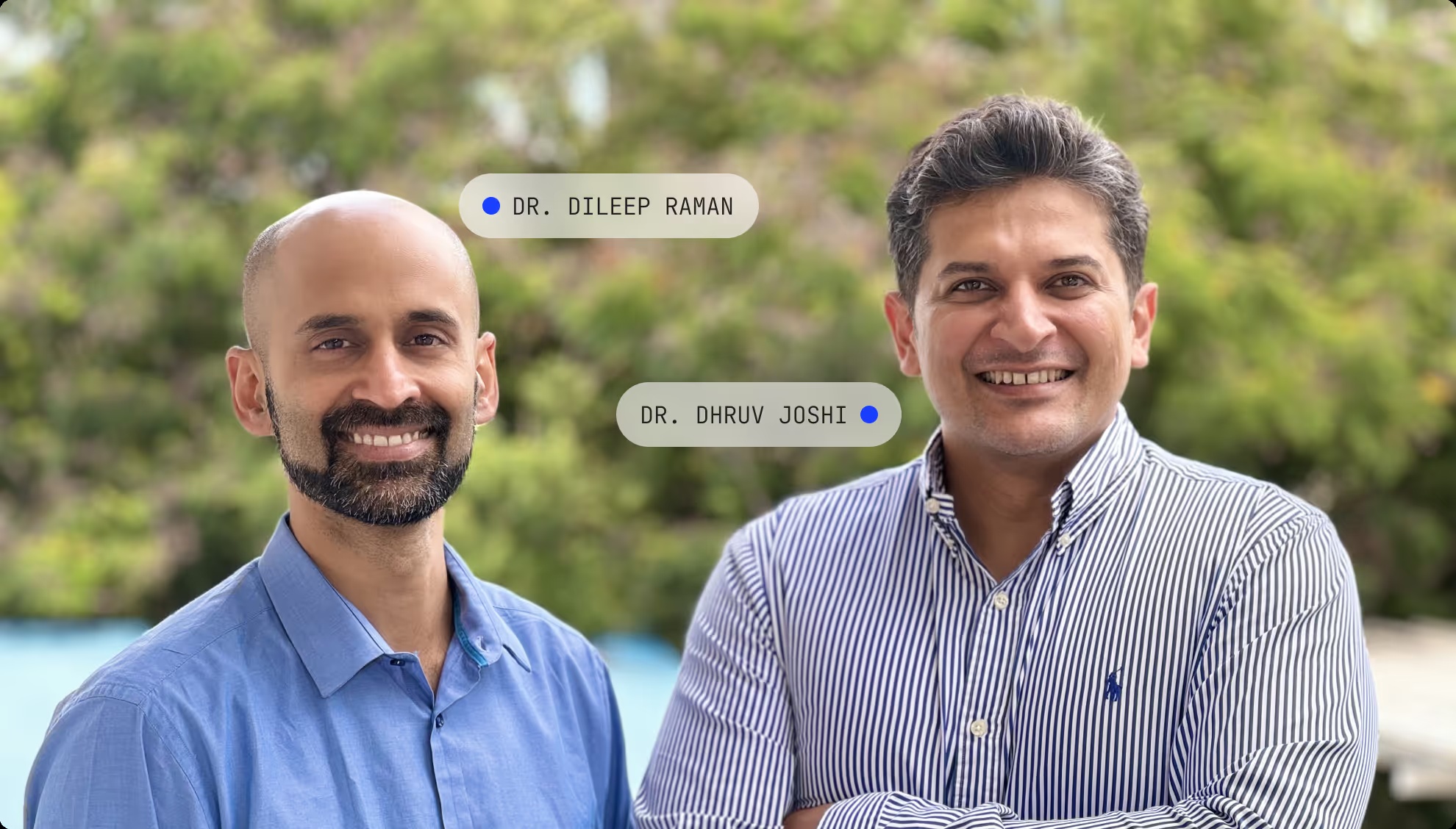
A magazine cover is a tempting place to develop a sudden fondness for the first person singular. There you are, professionally lit, looking as though all the difficult decisions have already been made. Dr. Dhruv Joshi had a different response to his appearance on a Forbes India cover in 2025. He thanked the publication, then pointed out the person who ought to have been standing beside him: his co-founder, Dileep Raman.
Raman had missed the shoot because he was travelling for work. Joshi supplied the explanation with a smile in the punctuation. A cover could accommodate his photograph; his account of the company required another person. It was a small correction to a flattering moment, and a useful entrance into the story of Cloudphysician's co-founder and CEO.
Entrepreneurship has a weakness for the individual portrait. A company, meanwhile, insists on being a group project. Joshi's public story contains both: the CEO raising capital and speaking at events, and the colleague who keeps directing attention towards the partnership. The more interesting picture emerges when those two versions are placed together.
Before the company, a colleague
Joshi studied at St. John's Medical College in Bengaluru. His LinkedIn education record lists 2001 to 2007. He subsequently trained at Good Samaritan Hospital in the United States and at the Cleveland Clinic Foundation. Those institutional names trace a journey across countries, but Cleveland supplied something that would outlast a line on a biography. It was where he met Raman.
A future co-founder rarely arrives wearing a useful label. At the time, they were colleagues in training. Their later partnership grew out of a shared professional background and an interest in what they could build in India. Cloudphysician was founded in 2017. The encounter in Ohio became part of the prehistory of an Indian company.
The distance between meeting a colleague and founding a company is measured in decisions. These two had to agree on a direction, then commit themselves to an enterprise. The significant part was the continuation: an acquaintance became somebody with whom Joshi would share the responsibility of building, hiring and planning over years.
Their account of returning to India includes extensive travel and visits to smaller cities. The important business detail is the willingness to examine conditions in person. An idea formed abroad still had to meet the circumstances in which it would be used. Travel became a form of checking the premise before asking others to buy into it.
The awkward business of being useful
By 2021, Joshi was describing adoption as a deliberate design choice. He explained that the company had intentionally worked to make its solution easier to adopt. It is a modest-sounding ambition with considerable operational consequences. A product can be admired from a distance. Adoption requires somebody to bring it into an ordinary working day.
That distinction helps explain why Joshi's founder story is worth reading beyond the usual sequence of company launch and investment announcement. Choosing to lower a barrier means paying attention to the person who has to cross it. The purchaser, the user and the engineer may each encounter a different obstacle. A CEO has to make room for all three views.
There is little glamour in removing friction. Nobody frames a photograph of a shorter setup process. Yet this is where an enterprise earns the right to stay: in the accumulated details that make people willing to keep using it. Joshi's own formulation gives those details a place near the centre of the business.
It also places a constraint on ambition. Expansion creates more settings, more expectations and more opportunities for a supposedly simple process to become complicated. The phrase “barrier for adoption” is therefore a useful question to carry through the rest of his career: as the company grows, what becomes easier for the people expected to work with it?
“We have intentionally created a solution that drops the barrier for adoption.”
Dr. Dhruv Joshi · 2021
Capital, with a destination attached
In October 2021, Cloudphysician announced $4 million in funding from Elevar Equity. The announced uses included international expansion and hiring across commercial, technology and data science roles. These are less photogenic milestones than a launch, but they describe the construction of an organisation: adding people with different skills, then making their work fit together.
June 2024 brought another announcement: a $10.5 million financing round led by Peak XV Partners, with participation from Elevar Equity and venture debt firm Panthera Peak. Joshi set out plans to expand in India, enter overseas markets and continue developing the company's AI platform. The money had destinations attached to it.
The two amounts belong to separate rounds, three years apart. They are financing milestones, rather than a measure of Joshi's personal fortune. Their value to this story is what they reveal about the changing job of a founder. Starting a company and allocating a larger pool of capital are related occupations, but the decisions arrive at a different scale.
A funding announcement briefly makes a complicated enterprise look like a number. Afterwards come the less tidy questions: who to recruit, which market to enter, what to build next, and how much attention each deserves. Joshi's stated plans span all of those questions. The cheque opens another stage of work; it does not write the operating manual.
An ambition that travels
Joshi discussed the 2024 round with Avanne Dubash on ET Now's Startup Central in July. By then, international expansion was part of the public conversation around Cloudphysician. A business founded in India was making plans that extended beyond it. The interview put the CEO in the familiar founder's position of explaining where the next stage might lead.
An international plan changes the meaning of familiarity. A process that seems obvious to its maker may need a better explanation somewhere else. Commercial relationships, expectations and working habits do not travel as effortlessly as a presentation file. For Joshi, the adoption question can follow the company across a border without losing any of its force.
His public appearances also place him among other founders. At TechSparks in November 2025, he joined Ankur Jain of Jivi AI and Laina Emmanuel of BrainSightAI for a panel in Bengaluru. It is a different setting from a company announcement: several entrepreneurs occupying the same stage, each bringing a particular account of building.
The sequence is instructive. Cleveland belongs to his training and partnership; Bengaluru to his education, company story and conference appearances; international markets to his stated business plans. Geography keeps returning in a different capacity. Joshi's career has involved taking experience acquired in one place and asking what work it can do in another.
Three books, and no magic instructions
There is another way into Joshi's interests: his reading recommendations. In a January 2024 conversation with Vinay Kumar on Shiny Happy People, the episode notes list three books: Ben Horowitz's The Hard Thing About Hard Things, Ray Dalio's Principles, and Guy Kawasaki's The Art of the Start. It is a recognisably entrepreneurial shelf.
The titles offer an amusing miniature of the founder's predicament. Start something. Develop principles. Discover that difficult things remain difficult. Read as a set, they leave little room for the fantasy that a company becomes straightforward once its founder has acquired the correct vocabulary. There is a beginning, there are decisions, and then there is Tuesday.
Recommendations are a small piece of evidence, but a personal one. These books locate Joshi's public interests alongside questions of starting, managing and deciding. They also give a reader something more useful than an abstract adjective about leadership: three actual titles to pick up, argue with, or abandon halfway through on a busy week.
The conversation lasted about 42 minutes. Its closing reading recommendations brought the discussion back to other people who had written about building businesses. Even a founder with a company to run can make room for somebody else’s account of the job. Horowitz, Dalio and Kawasaki offer quite different accounts; Joshi put all three on the table for listeners to consider.
- The Hard Thing About Hard ThingsBen Horowitz
- PrinciplesRay Dalio
- The Art of the StartGuy Kawasaki
Leave room in the picture
Cloudphysician appeared in Forbes Asia's 100 to Watch in 2025. It was recognition for the company Joshi and Raman had founded eight years earlier. Recognition compresses time effectively: years of decisions become a place on a list, a cover, a paragraph someone can share. For a founder, that compression is both useful and incomplete.
The current leadership roster gives a fuller sense of the enterprise around Joshi. Raman remains co-founder and Chief of Healthcare. Dhruv Sud is Chief AI Officer; Mandar Vaidya is President and COO. Different responsibilities now sit around the founding partnership. A company that began with two colleagues has developed a broader leadership structure.
That is part of the CEO's story too. A founder's continuing presence does not mean doing every job. The organisation has to hold expertise in several places at once. The names and responsibilities make that visible. They also bring us back to the photograph: the person most easily associated with a company is only one of the people building it.
Joshi's response to his cover appearance is memorable because it required so little ceremony. He simply made room for his absent colleague in the account of the moment. After the educational journey, the company formation and the funding rounds, that remains an unusually economical detail. Success had put him in the frame. His first correction was to widen it.