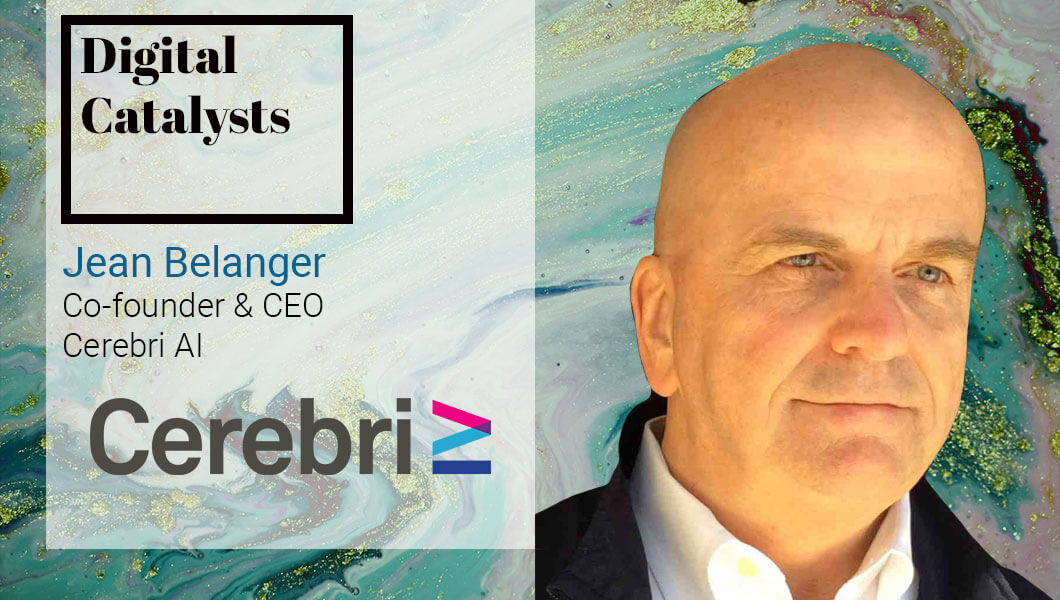
A builder who measures what others overlook
Jean Belanger runs Cerebri AI, the artificial intelligence and data engineering company he co-founded in 2016 with offices in Austin and Toronto. His work today centers on a simple, stubborn question: how do you actually measure what a customer feels about a brand, and then act on it?
The answer he built is called Cerebri Values, which the company describes as the industry's first universal measure of customer success. Instead of treating each interaction as an isolated transaction, the system tries to quantify a customer's commitment to a brand and predict the next best action to take, one customer at a time. In an early deployment with a top-10 global automaker, Belanger has said the approach delivered seven times the sales conversion. "If you cannot measure something, you cannot improve it," he told one interviewer. "Now we can measure commitment and other key metrics."
More recently, Cerebri AI has pointed that machinery at a specific and expensive corner of the enterprise: corporate travel and expense spending, along with the ESG reporting that increasingly rides alongside it. The pitch is consistent with everything Belanger has done before. Take a domain drowning in messy data, build the models that make sense of it, and sell the clarity back to the companies that need it.
What makes the story unusual is that this is not Belanger's first act, or his second, or his third. He has been starting and running technology companies for the better part of three decades, and the pattern repeats: find an unmeasured problem, build the tool, and move on when the work is done.
Belanger did not start in software. He began his career at PwC, working in Ottawa and Paris, then moved into finance. After earning a master's in finance from the London School of Economics, he joined Wood Gundy, later part of CIBC World Markets, where as a vice president of investment banking he served as lead underwriter for three of the four largest public companies in Canada and helped raise more than US$4 billion across Canada, the United States, and Europe. It was a career most people would have kept.
He left it for software. Belanger became chairman and CEO of Metrowerks, a developer-tools company he helped grow from a tiny team into the maker of CodeWarrior. In the 1990s, CodeWarrior was the toolset used to build the vast majority of software running on the Macintosh, from Microsoft Office to parts of Apple's own operating system. MacWorld named it Software Product of the Year, reportedly beating out more than 3,500 other applications. Metrowerks went public on NASDAQ and was acquired by Motorola, where Belanger stayed on as a vice president of business development for the semiconductor business unit.
His next company, Reddwerks, applied operations-research modeling and data science to a decidedly unglamorous problem: supply chains. Founded in Austin, it built software to automate e-commerce and retail order processing, and it counted four of the ten largest US retailers as customers, including Walmart, CVS, Best Buy, and Lowe's. The Austin Business Journal named Reddwerks the city's fastest-growing company in 2010, and Belanger was a finalist for Ernst & Young's Entrepreneur of the Year award in Austin. Reddwerks was acquired by Dematic in 2015. A year later, he started Cerebri AI.
Read across those ventures and the thread is clear. Developer tools, supply chain, and now artificial intelligence look like different industries, but Belanger has approached each the same way. "This is old-school customer service at scale, powered by artificial intelligence and machine learning," he has said of Cerebri AI, and the phrase could describe his whole career. The technology changes; the instinct to measure the unmeasured does not.
Belanger is direct about the things he believes, including the ones that have nothing to do with software. On diversity, he does not reach for corporate language: "Diversity matters. Not because it is a goal in and of itself, but because treating anyone in anything less than a totally equitable manner is just plain stupid." He is optimistic about what AI can do, and he tends to argue for its practical benefits rather than its dangers, pointing to unglamorous wins like spam filtering as evidence that the technology quietly improves ordinary life. "AI has a dramatic impact on productivity," he has said, "and productivity is the 'mother's milk' of progress."
There is a reflective side too. Interested in faith and ethics in a business context, Belanger has conducted interviews with leaders from Islam, Hinduism, Judaism, and Christianity, an unusual side pursuit for a data-science CEO. He is married to an epidemiologist. And he built Cerebri AI, like many Austin founders, out of the Capital Factory accelerator downtown before the company expanded to Toronto and Washington DC, where he now also mentors other founders working the same ground he has covered four times over.
Ask him where all of this is heading and the ambition is characteristically concrete. He talks about moving companies toward "one customer journey per customer," a world in which every individual is understood and served on their own terms rather than as a row in a table. "The sky's the limit," he has said, "as understanding customer behavior is only really just beginning." For a founder who has already spent thirty years building the tools other companies run on, it reads less like a slogan than a to-do list.