Armen Adjemian’s advice to an aspiring entrepreneur can be compressed into two words: “Measure everything!” It is a bracing instruction in a business culture that enjoys the announcement almost as much as the achievement. Before the celebration, there will apparently be a test. Before the test, someone will have to decide what success means.
The co-founder and CEO of DISQO has made a career out of that last complication. His company connects consumer opinions with digital behavior to help businesses understand advertising and customer decisions. The premise carries a small, useful insult to human certainty: saying what people want and knowing what they do are separate accomplishments.
Adjemian’s public story is full of numbers, including a $13.5 million financing in 2018 and an $85 million round in 2021. Yet the more revealing part is his habit of asking what a number permits someone to conclude. A crowded spreadsheet can make an excellent hiding place for an unanswered question.
A friendship before a company
Before DISQO came accounting. Adjemian earned a bachelor’s degree in kinesiology and a master’s degree in accounting at the University of Southern California, then began his career at PricewaterhouseCoopers. The educational combination gives his biography an unusual opening: two disciplines, one university, followed by a profession devoted to keeping a close eye on the figures.
He moved into entrepreneurship, spending the next decade around Los Angeles startups. His career included founding Venture Group and leading Blue Media Ventures. DISQO arrived after that apprenticeship. This was a founder bringing previous business experience to a specific frustration, with people whose working habits he already knew.
Armen Petrosian and Drew Kutcharian had been his friends and colleagues for more than a decade. In 2014, the three saw fragmented information causing problems for market researchers and their clients. They founded DISQO in 2015. Their proposed improvement began at the input: build direct relationships with people willing to provide information about themselves.
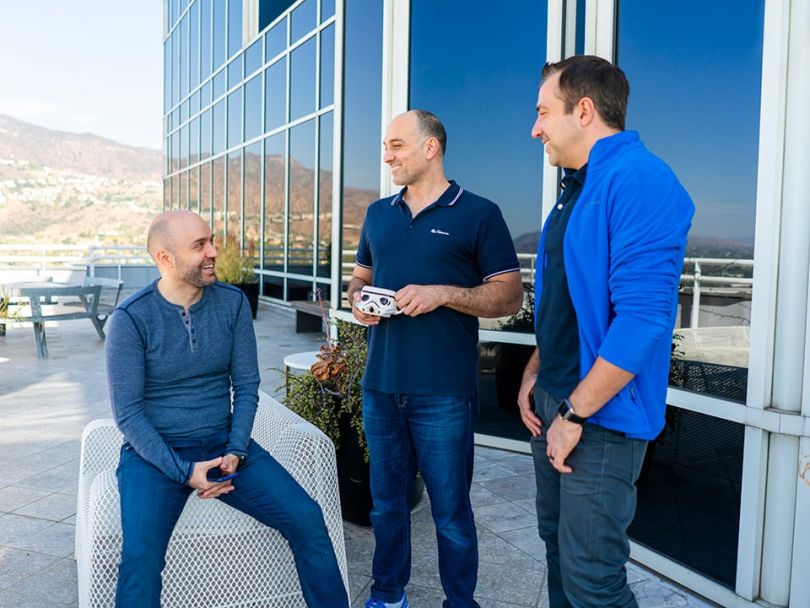
That long acquaintance is worth lingering over. Startup partnerships often have to absorb uncertainty while the partners are still learning one another. These three began with shared history. It did not guarantee an outcome. It did mean the company’s first attempt at understanding people could begin with the people building it.
The customer gets a vote
The difficulty they chose had several parts. Market researchers needed dependable opinions from the right audiences. Advertisers needed to understand behavior across digital environments whose information did not conveniently travel together. A consumer could move among sites, apps and shops while the resulting evidence remained scattered among businesses.
Adjemian’s explanation of DISQO starts with the person making those journeys. People choose to participate, share opinions and, with permission, share behavioral information. They receive value in return. The arrangement makes participation part of the product’s foundation. A relationship with the consumer comes before a report about the consumer.
In a 2021 interview, he reached for the language of food to explain data provenance: “farm-to-table.” It is an unexpectedly domestic image for an industry fond of pipelines. Still, the analogy does useful work. Knowing where an ingredient came from changes how confidently someone can use it. Research data has a supply chain, too.
A conceptual view of the approach, not a claim that every consumer action is captured.
This also changes the meaning of listening. Asking a person a question supplies one kind of evidence. Observing a permitted digital action supplies another. Together, they can help a business examine whether its assumptions about customers survive contact with actual choices. The point is practical: a product team or marketer has to decide what to do next.
For Adjemian, the principle reaches inside the company. He has described experimenting with small changes, checking encouraging results and moving on to the next test. An unsuccessful experiment can leave useful knowledge behind. That makes disappointment a possible working expense, provided someone learns enough to avoid paying for the same mistake twice.
“Even failures provide learning and we celebrate that.”
Armen Adjemian, 2020
His account of leadership includes shared objectives, communicated across the team, and a mixture of goals set from above and below. The language is managerial; the concern is human. As a business grows, people need to know what matters and how their work connects. Otherwise, energetic colleagues can become extremely efficient at heading in different directions.
What $85 million buys
By August 2021, DISQO’s next stage had a price attached. An $85 million Series B was led by Sageview Capital, with March Capital, Valuestream Ventures, Alpha Edison and Bonfire Ventures participating. Sageview’s Dean Nelson and March’s Wes Nichols joined the board. The financing brought new people into Adjemian’s circle of business decisions.
The company said it would expand operations and accelerate its product roadmap. At the time, it reported more than 300 team members and customers spanning brands, research firms and advertising agencies. Those are historical markers, rather than a present-day headcount. They show how far the task had moved from three colleagues identifying a problem.
Adjemian, Petrosian and Kutcharian found DISQO.
$85 million Series B announced.
Feedback Loop acquisition announced.
Money can enlarge an ambition. It also multiplies the decisions required to pursue it. Which product deserves attention? Which customer problem should come first? Adjemian has spoken about the difficulty of choosing among growth opportunities. A founder selling evidence still has to decide how much evidence is enough to commit his own company’s resources.
In May 2022, DISQO acquired Feedback Loop, a software business that helped product and marketing teams obtain consumer feedback. Its chief executive, Rob Holland, became an executive vice president and general manager at DISQO. The acquisition extended the company’s ability to help clients test ideas while they were still being shaped.
The attraction follows Adjemian’s recurring concern with decisions. Feedback that arrives after a launch can explain an expensive surprise. Feedback available during discovery, ideation or design can change the thing being built. Timing gives the same information a different usefulness. An answer becomes more valuable when a team still has room to act on it.
The price of asking
In September 2025, DISQO put accessibility into a product announcement: free self-serve Brand Lift for media companies. The offer combined software with onboarding, training and human support. For Adjemian, the stated aim was to remove barriers that kept campaigns from measuring how advertising affected a brand.
There is a business argument inside that choice. If measurement is expensive or awkward enough, teams reserve it for selected campaigns. A free service can make it easier to ask the question repeatedly. Whether it becomes a habit still depends on the people using it, the campaigns involved and the usefulness of the answers.
The development fits his earlier insistence that new ideas should come with a way of assessing them. Applied to customers, that becomes a question of access: how many teams can afford to check? A company devoted to measurement eventually has to consider the circumstances under which people decide to go without it.
By March 2026, he was discussing another complication at Convergent TV World. Alongside Comcast Advertising’s Carmela Fournier and LG Ads Solutions’ Ioanna Protogiannis, in a discussion moderated by Doug Ray, Adjemian considered the balance between immediate results and longer-term brand building. More information had created its own sorting problem.
His argument was that easier measurement of short-term behavior could draw attention away from the rest of advertising’s effects. A sale today matters. So does the earlier work that made a customer consider the brand. The executive with a reputation for measuring things was asking the industry to be careful about which things received its attention.
The next place people make up their minds
The leadership work continued alongside the product argument. In April 2026, DISQO appointed Terri Walter chief marketing officer, reporting to Adjemian. Her remit included the company’s brand, communications and go-to-market strategy. A business helping others understand their advertising still needed someone responsible for explaining its own.
That spring, the ANA’s May 28 conference agenda paired Adjemian with Mike Bregman, formerly Subway’s chief data and analytics officer and then chief marketing intelligence officer at WPP | Ford. Their listed subject was using AI to make media measurement useful across an organization. The concern had shifted from delivering a campaign report to supplying information people could keep working with.
DISQO also introduced AI Search Lift in 2026, extending its approach to brand engagement inside large language models and AI-powered search. The company described comparing consumers exposed to advertising with comparable consumers who were not exposed. Its question was whether advertising changed subsequent brand interactions in these newer discovery environments.
For Adjemian, that is another version of the original problem. People move to a different place to compare, consider and choose. Businesses want to know what influenced them. The company has to follow that change without losing the direct, permission-based relationship on which its approach depends.
His aspirations remain close to that working question. Help businesses understand customers well enough to make better decisions. Build tools that connect attitudes with actions. Keep testing the assumptions. There is room for ambition in that description, and room for the answer to be inconvenient.
“Measure everything!” sounds like a love of numbers. Adjemian’s career suggests a further attraction: the opportunity to find out. For a founder, that can be an awkward pleasure. The result may send everyone back to work. At least they have a better reason for knowing where to begin.