Founder & CEO · RecVue · Palo Alto, CA
Nishant
Nair
"Revenue should be a system, not a silo."
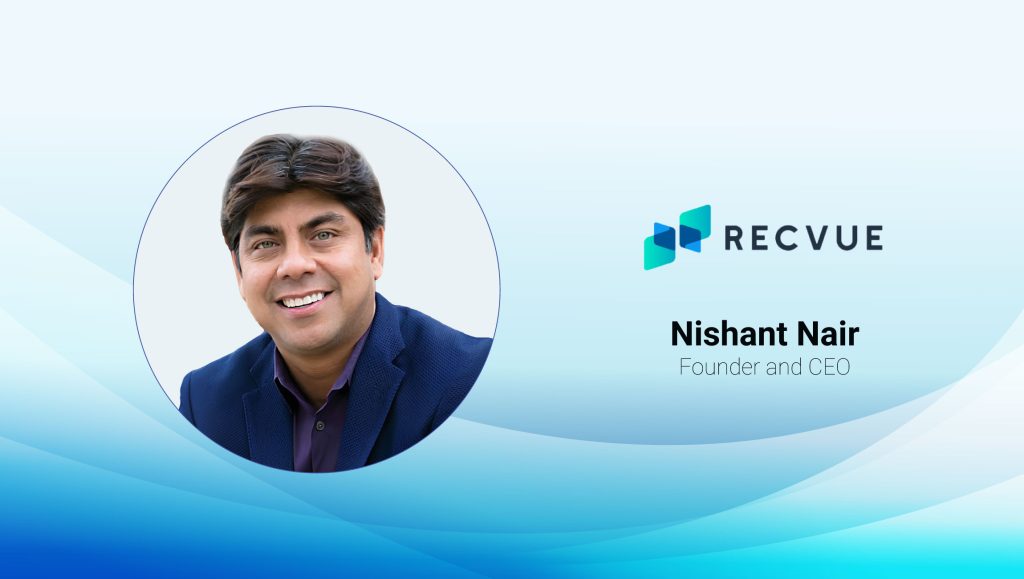
Nishant Nair · Founder & CEO, RecVue
"Revenue should be a system, not a silo."
There's a drawer in nearly every enterprise finance department - the one where the billing exceptions live. The contracts that don't fit the ERP. The partner settlements that still get calculated in spreadsheets. The revenue recognition schedules that require a consultant and three weeks every quarter. Nishant Nair decided that drawer was a business opportunity disguised as a mess.
In August 2017, after eight years co-founding Infovity Inc and watching Silicon Valley's fastest-growing companies - LinkedIn, Yelp, Pinterest, Dropbox - wrestle with the same order-to-cash chaos, Nair founded RecVue. The premise was blunt: enterprise billing systems built for a previous era of commerce are a liability when your business runs on subscriptions, usage, partner revenue sharing, and consumption models that would baffle a legacy ERP configuration.
"Financial and audit systems designed for the Blockbuster world don't meet Netflix business needs."- Nishant Nair, Founder & CEO, RecVue
The Blockbuster-Netflix line isn't clever for the sake of it. It's a diagnosis. Enterprises spend $149 billion annually modernizing CRM and ERP, yet the gap between the two - where order management, revenue recognition, billing, and partner compensation live - remains largely unaddressed. That gap is where RevVue operates. And it's a gap Nair knows from the inside, having spent two decades navigating it as a consultant, a managing partner, and eventually a founder betting his own company on solving it.
The path from University of Mumbai engineering graduate (class of 1996) to Palo Alto founder wasn't a straight line. It wound through Wipro, then iGATE Global Solutions as a senior consultant, then CSC as a principal, then Niche Solutions as managing principal. In 2009, Nair co-founded Infovity Inc - a technology consulting firm that became the implementation partner of choice for Oracle Cloud and Salesforce deployments at some of the most demanding enterprises in the US. Eight years of that taught him something specific: the tools his clients needed for revenue management didn't exist as a product. They were being assembled by hand, every engagement, from parts that didn't quite fit.
RecVue, initially registered as ad-Orb Inc., was his answer. The platform he built - now called RevOS - unifies billing, revenue recognition (ASC 606 and IFRS 15), and partner compensation in a single AI-powered system. It handles multi-currency transactions, 200+ legal entities across 50+ countries, and consumption-based billing events that would require armies of IT staff to process manually. Hertz runs on it. Crown Castle runs on it. World Wide Technology, ACI Worldwide, Landstar - the roster of enterprises trusting RecVue with their revenue operations reads like a list of companies that can't afford to get billing wrong.
"Order-to-cash is undoubtedly amongst the most critical and complex processes in an organization, yet fewer companies paid real attention to it before the pandemic."- Nishant Nair, IMA 'Count Me In' Podcast, 2021
The funding timeline reflects the conviction. RecVue raised $5 million in 2019, then a $13.19 million Series A in January 2021 - led by Cota Capital, with participation from Epic Ventures and Long Light Capital. Total funding reached $20.19 million. The Series A announcement landed with a clear thesis: automate order-to-cash and bridge the gap between CRM and ERP. The phrase became a recurring motif in how Nair explains the company's existence.
By 2025, the product had evolved into RevOS - a next-generation AI-powered revenue operating system that went beyond billing automation into predictive analytics, dynamic pricing engines, and real-time revenue monitoring. Nair positioned it not just as a platform but as the operating infrastructure for what he calls the "XaaS world" - anything-as-a-service business models that legacy ERP simply wasn't built to support.
Then in March 2026 came the move that signaled the next chapter: RecVue acquired AiVidens, an AI-driven receivables management firm, expanding the platform from billing and recognition into revenue-to-cash - encompassing predictive payment intelligence and collections efficiency. The same month, RecVue opened an EMEA office in Brussels, Belgium. Customers using AiVidens had already seen an average 5-day reduction in DSO and 20% improvement in collections efficiency. Nair absorbed that capability into RecVue's platform and announced a new EMEA footprint in the same week.
Nair contributes to the Forbes Technology Council and appears regularly at industry events and in trade media - SalesTechStar, Global FinTech Series, the IMA's Count Me In podcast. His consistent message: revenue operations is not a back-office function. It's a strategic capability, and organizations that treat it as one outperform those that don't by 5-10% in annual revenue - a figure his customers, he says, keep validating.
"Our customers will validate that modernizing the order-to-cash process and deploying RecVue's OTC solution boosts revenues by 5-10% every year."- Nishant Nair, RecVue CEO
What makes Nair's position unusual in the enterprise software landscape is the specificity of the problem he's chosen. Revenue management isn't a sexy category. It doesn't have the conference-stage glamour of AI copilots or the consumer narrative of productivity apps. It's pipe. But it's pipe that every enterprise runs on, and Nair has spent his career learning exactly where it leaks. RecVue's growth to $50 billion billed annually and $100 billion in total revenue under management suggests the market has been waiting for someone who understood the problem well enough to actually solve it.
The company has grown to 180 employees. The platform spans 200+ legal entities in 50+ countries. The customer base has achieved a combined $3.2 billion in revenue growth. By any operational measure, the bet is paying off. The drawer of billing exceptions is getting smaller.
Dynamic billing events, multi-attribute rating, consumption-based billing, and agile pricing models - automated across complex enterprise structures.
Automated compliance with ASC 606 and IFRS 15, real-time revenue waterfall, and multi-entity revenue management across 50+ countries.
Automated partner settlements, revenue sharing, and partner management - eliminating manual spreadsheet-based calculations at enterprise scale.
Sits between Salesforce and Oracle/NetSuite ERP to close the gap where order management and revenue recognition traditionally fall apart.
Real-time revenue monitoring, forecasting, anomaly detection, and business intelligence for enterprise finance and revenue operations teams.
Post-AiVidens acquisition: AI-driven receivables management, predictive payment intelligence, and collections efficiency - 5-day avg DSO reduction for customers.
"Revenue should be a system, not a silo. We built RecVue to unify billing, revenue recognition, and partner share - bridging CRM and ERP - so finance teams can automate with trust, scale with agility, and turn complex monetization into predictable growth."
"Financial and audit systems designed for the Blockbuster world don't meet Netflix business needs."
"Order-to-cash is undoubtedly amongst the most critical and complex processes in an organization, yet fewer companies paid real attention to it before the pandemic."
"Our customers will validate that modernizing the order-to-cash process and deploying RecVue's OTC solution boosts revenues by 5-10% every year."
"Legacy systems lack flexibility, scalability, and require armies of IT resources."
"Companies can't differentiate by just keeping the lights on - they must transform or risk obsolescence."
Nair is a recurring presence in enterprise software media. His interviews span billing automation, revenue recognition compliance, and the broader case for digital transformation in finance operations.
Key appearances include a detailed Q&A with SalesTechStar on RecVue's RevOS platform, a Global FinTech Series interview covering pandemic-era shifts in order-to-cash priorities, and episode 152 of the IMA's "Count Me In" podcast - a 15-minute session on modernizing legacy systems that functions as a concise statement of RecVue's founding thesis.
As a Forbes Technology Council contributor, Nair writes on enterprise cloud platforms, AI in revenue management, and the organizational case for treating revenue operations as a strategic capability rather than an accounting function.