He Got Tired of His Kids Swiping His Charger. So He Turned It Into a Goldfish.
Nice, Inc. turned a problem Apple never bothered to fix - tangled chargers nobody could tell apart - into CableKeeps, a line of $16 rubber sea creatures molded just north of Seattle.
Open the junk drawer in almost any home and you will find the same thing: a small pile of white Apple chargers, cords knotted around each other, none of them labeled, all of them identical. For years this was just the tax you paid for owning gadgets. Then a designer in Washington state looked at that pile and decided it did not have to stay that way. His answer was a goldfish.
That designer is Jim Young, and the company he built around the idea is Nice, Inc. Its flagship product, CableKeeps, is a molded rubber shell that snaps around an Apple power adapter. The prong pokes out where a nose would be, fins fold around the cable, and the whole thing turns an anonymous white brick into something you can actually recognize on sight. It is a small idea. It also happens to solve a problem that hundreds of millions of people share and almost no one had bothered to name.
01A frustration, not a business plan
The origin story is refreshingly ordinary. Young has three sons, and like every parent with a house full of devices, he kept losing his charger to whoever grabbed it first. He also traveled, and he wanted a way to bundle a charger and its cable into a neat, pocketable knot instead of a tangle. Marking his charger so the boys would stop "borrowing" it, and keeping the cord tidy on the road - that was the entire brief.
Rather than settle for a rubber band, Young designed a proper object and took it to Kickstarter in 2011 with a funding goal of $35,000. The pitch was simple enough to explain in a sentence, which is usually a good sign for a physical product. Backers pledged, the campaign got Nice off the ground, and the company set up shop in the Snohomish valley just north of Seattle, where the parts could be molded close to home.
Keeping production local was a choice with real consequences. It let the founders stand next to the machines, adjust the tooling, and work with nearby partners instead of managing a factory nine time zones away. It also let them put "made in the USA" on the package at a moment when almost every other phone accessory on the shelf was stamped with an overseas origin. For a product whose entire appeal is craft and personality, that origin was part of the pitch, not an afterthought.
02Meet the bestiary
What made CableKeeps stick was the decision to give them faces. Instead of a neutral clip, Young built a small cast of sea creatures, each sized to a specific charger and plug type. The result reads less like an accessory line and more like an aquarium for your outlet.
Goldie, the goldfish, fits the smaller iPhone and iPod adapter. Gulp the whale and Nibbles the shark are built for the chunkier iPad brick. Ink the squid is shaped for UK plugs, and Spike the blowfish handles the two-prong Euro standard. Each came in a spread of colors - red, orange, green, light blue and navy - so a household could color-code by owner as well as by animal. Goldie had a party trick, too: set it on its side and it props your phone up like a little stand while it charges.
The engineering underneath the whimsy was deliberate. CableKeeps were molded from Santoprene, a durable rubber, and made in the United States rather than shipped in from overseas. Reviewers kept noting the same thing: they add almost no bulk, and the fins wrap the cord fully for travel or halfway for everyday use on a desk. The adapter slides into the front so its face shows; the plug pokes through the nose; the cable tucks into the fins. Nothing about the shape is decoration for its own sake - every curve maps to a part of the charger it has to grip.
That is the quiet discipline behind the cuteness. A charger holder that looked like a fish but did not actually fit the adapter, or that slipped off in a bag, would be a novelty gift and nothing more. The reason people kept theirs is that the object does its plain job first and the goldfish is a bonus, not an excuse.
03Who actually buys a rubber fish
The customer turned out to be broader than gadget obsessives. There were travelers who wanted a tidy cable bundle in a carry-on. There were families sharing a kitchen outlet who needed to know which charger belonged to whom. And there were design-minded shoppers who simply liked the object, which is why CableKeeps ended up on the shelves of curated retailers like the outfitter Huckberry alongside their own store and Amazon listings. Because the line covered US, UK and Euro plugs, the audience was international from early on.
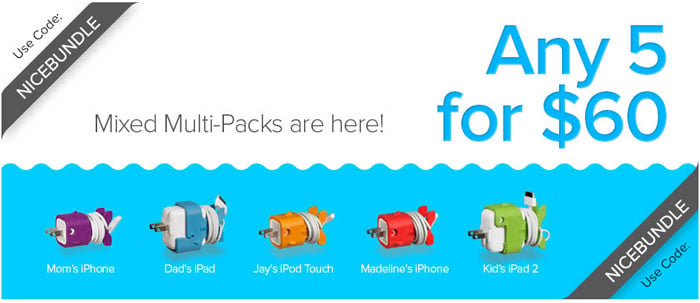
It helped that the price sat in impulse territory. At around $16 each, or roughly $60 for a five-pack, a CableKeep was an easy gift and an easy add-on - the kind of thing that moves in volume when a deal site features it. Nice found that out directly when a LivingSocial promotion sent more than 500 orders through the door in a single week.
04Small on purpose
That order spike is the part of the Nice story most worth stealing. The company never tried to become large. It grew from Young fulfilling orders in his living room to a three-person office with a mini warehouse next door, and it ran its own shipping department rather than handing fulfillment to a third party. The stack was ordinary and cheap - a Shopify storefront, an off-the-shelf shipping tool - and that was the point. A tiny team could absorb a 500-order week without hiring a logistics department.
05Different from a bag of velcro ties
Cable management is not an empty market. The shelves are full of velcro straps, cord clips, spiral wraps and generic organizers that cost a couple of dollars. Nice did not try to beat those on price, and it could not have. What it sold instead was identity and delight. A velcro tie disappears into the drawer; a goldfish does not. By turning the adapter itself - the part you already own and can never tell apart - into a recognizable character, CableKeeps solved a problem the cheap wraps ignore entirely.
The real competitor, in other words, was not another brand. It was the do-nothing default: leaving the chargers tangled and anonymous because untangling them never felt worth a purchase. Nice's job was to make the fix cheap and charming enough that people finally bought one. That is a harder sell than it sounds. Convincing someone to spend $16 solving a problem they have quietly tolerated for years means the object has to earn a smile the moment they see it, then justify itself the first time they travel with it.
There is a lesson in there for anyone building physical products. Nice did not invent a new category or chase a spec war. It took an object everyone already owns, found the one thing wrong with it that nobody had fixed, and made the fix feel like a small gift rather than a chore. The margins on a $16 rubber part are not glamorous, but they are real, and they belong entirely to a company small enough to keep its costs honest.
06Where it sits
Nice belongs to a small, honorable category of hardware companies that pick one overlooked annoyance and build a well-made object around it. There is no app, no subscription, nothing connected. The expertise on display is old-fashioned product design: understanding a material, sizing a mold to a specific plug, and giving the result a personality that earns a spot on a nightstand. It is the kind of company that proves you can build something real on a $16 problem, provided you keep the operation lean enough that $16 products can support it.
The CableKeeps brand was most active in the early-to-mid 2010s, riding a wave of press from TechCrunch, SlashGear, iLounge and others. The lineup later stretched toward adapters and earbud organizers, extending the same idea to the next tangle in the drawer. Today the products are harder to find, and the company's original web address has been repurposed for unrelated content - a quiet second life for a brand whose best idea still shows up every time someone reaches into a drawer and pulls out a goldfish instead of a knot.